
What if building software no longer required slow development cycles or heavy technical lift?
Vibe coding replaces rigid workflows with AI-assisted creation, enabling businesses to prototype, iterate, and launch products at unprecedented speed by combining human insight with intelligent automation.
Vibe Coding: Key Findings
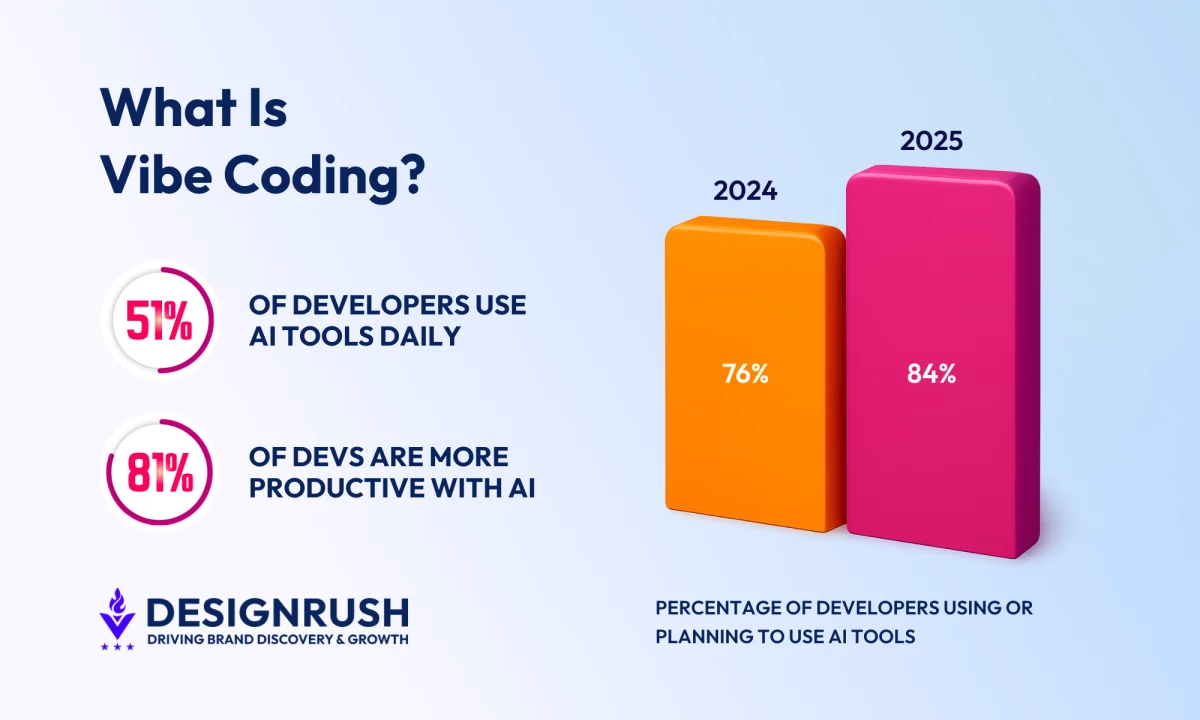
- 51% of developers rely on AI tools daily, as they accelerate prototyping, reduce repetitive tasks, and increase iteration speed.
- Despite AI gains, 46% of developers distrust AI output, and only 3% highly trust it. Most teams use AI for boilerplate while keeping human oversight for core logic.
- Providers like Instinctools combine AI acceleration with CI/CD, architectural governance, testing, and security controls, turning vibe coding into a scalable, production-ready framework.
What Is Vibe Coding?
Vibe coding is an AI-assisted approach to software development where humans define intent, logic, and desired outcomes, while AI generates, refines, and adapts the underlying code.
Instead of manually writing every component, teams guide the build through prompts, feedback, and iteration, enabling faster prototyping, easier experimentation, and quicker delivery without deep technical overhead.
In the latest Stack Overflow survey, 84% of developers say they’re already using or planning to use AI tools, a significant increase from 76% in 2024.
In fact, over half of professional developers now rely on them every single day.
Furthermore, 52% of developers say AI tools and agents have boosted their productivity, giving them clearer paths forward, fewer repetitive tasks, and faster iteration loops.
Scott Jackson, CEO and founder of Essential Designs, says AI has changed the software development game for good:
“Development has gotten faster, cheaper, and way more unpredictable. Half the work is now arguing with AI to stop adding too many things in. The rest is using it to ship things in half the time.”
As AI becomes fully integrated into the development stack, vibe coding becomes the operating system for high-performing teams: a way to keep creativity high, blockers low, and momentum constant.

How Is Vibe Coding Different From Traditional Coding?
Traditional coding requires developers to write precise instructions using programming languages like Python, Java, or C++.
Every function, every action, and every rule must be manually coded, tested, and debugged. This process takes time, deep technical knowledge, and constant maintenance and could take weeks or even months to finish.
Vibe coding changes this by shifting the focus from writing code to describing intent.
Instead of manually programming every detail, developers (or even non-developers) give high-level instructions in plain language, and AI translates them into functional code: a process that can be completed in days, even hours.
Here’s how the two approaches compare:
| Aspect | Traditional Coding | Vibe Coding |
| Skill Level Required | High – Requires coding expertise | Lower – AI assists with code generation |
| Speed | Slower – Developers write everything manually | Faster – AI automates code writing |
| Flexibility | Full control, but requires deep knowledge | Easier to iterate, but depends on AI’s accuracy |
| Use Cases | Complex, custom-built applications | Rapid prototyping, automation, and simple software solutions |
| Cost | Higher – Requires skilled developers | Lower – Reduces development time and resources |
- Traditional coding is slow but precise: Developers have full control, but writing everything manually takes time.
- Vibe coding is fast but AI-dependent: AI speeds up development dramatically, but human oversight is still needed for complex projects.
- Hybrid approaches are emerging: Many businesses use AI to generate code quickly, then refine it manually for better accuracy and performance.
Benefits of AI-Assisted Coding for Businesses
Igor Golovko, head of development and founder of Twincore, outlines the main advantages of AI in development workflows:
"These are not autocomplete machines anymore, they’re helping out with design decisions, debugging, and doc generation.
AI-based code review and pair programming tools are making junior engineers far more efficient and allowing senior engineers to accomplish more architecture and edge case consideration."
Here are the key ways AI-assisted coding is delivering measurable value for businesses today:
- Faster development and cost savings: AI generates code in seconds, compressing timelines from weeks to days and reducing labor costs while speeding up launches and iteration.
- Increased accessibility: AI lowers technical barriers, allowing non-technical roles to contribute through high-level instructions rather than hands-on coding.
- Rapid prototyping and innovation: Teams can turn ideas into working prototypes quickly, test assumptions earlier, and reduce R&D risk.
- Scalability and automation: Repetitive tasks like debugging, documentation, and routine maintenance are automated, freeing developers for higher-value work.
- Flexibility for in-house and outsourced teams: Both in-house and outsourced teams deliver faster, increasing output and shortening turnaround times across projects.
As teams lean more heavily on AI-driven workflows, the biggest risks center on trust, capability erosion, and governance:
The 2025 Stack Overflow survey showed that 46% of developers actively distrust AI output, compared to 33% who trust it, and only 3% say they “highly trust” the results.
Experienced developers are even more cautious, with just 2.6% “highly trusting” AI and 20% “highly distrusting” it.
- Accuracy and trust gaps: Many developers still question AI reliability, creating verification overhead and potential defects. Without strong human review, teams risk shipping flawed logic, security vulnerabilities, or brittle code that undermines product quality and user trust.
- Skill erosion and overreliance: Heavy dependence on AI can weaken core engineering skills, especially debugging, architecture, and problem-solving. Over time, this may produce teams that execute faster but struggle with complex, novel, or high-stakes technical challenges.
- Accountability and governance risks: AI-generated code can blur ownership, review responsibility, and compliance oversight. Without clear guardrails, organizations face higher exposure to security gaps, licensing issues, and inconsistent engineering standards.
Eugene Leow Zhao Wei, director at Marketing Agency Singapore, says hybrid workflows work best.
“We’ve seen strong results when dev leads use AI for boilerplate, while reserving logic-heavy modules for human review.”
Tips for Effective Vibe Coding
Vibe coding can dramatically accelerate development, but only when paired with structure, oversight, and clear boundaries.
For teams exploring this approach, success depends less on prompts and more on process discipline. Here’s how to do it right:
- Evaluate if vibe coding fits your project
- Install non-negotiable guardrails
- Follow a structured workflow
- Enforce skill development standards
1. Evaluate If Vibe Coding Fits Your Project
Use vibe coding for MVPs, internal tools, automation scripts, and experimental features where speed and iteration matter most.
Avoid or limit vibe coding in:
- Safety-critical systems (e.g., healthcare devices, infrastructure controls)
- Regulated workflows without audit trails or compliance safeguards
- Core financial calculations (pricing engines, tax logic, payment processing)
- Authentication and access control systems
- Performance-sensitive distributed infrastructure where resilience and latency are critical
2. Install Non-Negotiable Guardrails
AI-driven velocity requires structural controls. Institutionalize the following safeguards before scaling vibe coding across teams:
- Enforce automated test suites with minimum coverage thresholds before merge
- Integrate continuous security scanning into every pull request and build
- Audit third-party dependencies and verify open-source license compliance
- Require senior-level code reviews for AI-generated or logic-heavy changes
- Implement staged releases with documented rollback and incident protocols
These ensure speed strengthens delivery capacity, and you won’t be introducing technical debt, compliance exposure, or operational risk.
3. Follow a Structured Workflow
Speed only works when backed by structure. A repeatable delivery flow keeps AI-assisted development reliable and production-ready:
Prompt → Pull Request → Test Suite → Security Gate → Staged Deploy → Monitor
This ensures AI-generated code passes architecture validation, automated testing, security checks, and performance monitoring before release.
Providers like Instinctools operationalize this model in practice, combining AI acceleration with clear architectural boundaries, CI/CD pipelines, automated testing, and rigorous security controls so code ships fast and safely.
Their approach blends dedicated engineering teams with structured oversight, turning vibe coding into a scalable delivery framework rather than an ad hoc experiment.
For organizations looking to go further, its GENiE™ AI agent platform acts as an internal accelerator for agent-assisted delivery, pairing AI speed with enterprise-grade discipline.
4. Enforce Skill Development Standards
Arvind Rongala, CEO of Edstellar, warns:
“The risk isn’t just bad code. It’s fading skills. When junior devs let the tool lead, they stop learning how to debug or design.”
AI acceleration must not come at the expense of engineering depth. Protect long-term capability with explicit learning safeguards:
- Require developers to explain AI-generated code before merge approval
- Mandate reverse engineering exercises for complex AI-assisted modules
- Include architecture walkthroughs in PR reviews, not just syntax validation
- Track debugging ownership to ensure engineers solve issues independently
- Evaluate performance on problem-solving ability, not just output speed
High-performing teams treat AI as a second set of hands, while preserving human judgment as the primary driver of technical excellence.
Vibe Coding Examples
To see what vibe coding looks like in practice, these real-world builds show just how far teams can go with AI-led development.
- Dreambase by Andy Keil and Kyle Ledbetter
- SEO Forecasting Tool by Tim Metz
- Pulse WP by Matt Medeiros
- Companies using vibe coding
1. Dreambase by Andy Keil and Kyle Ledbetter
Founders Andy Keil and Kyle Ledbetter had no engineering background, yet they built three full AI-native apps in nine months.
Their process leans on vibe coding at every step: they prototype in Lovable and v0, refine in Cursor, and ship with tools like Supabase, ShadCN, Bolt, Runway, and Whimsical.
With Dreambase, they took the zero-to-one vibe coding mindset even further, from database-first thinking, to stuffed prompts, to running bake-offs where AI generates multiple versions and the best one wins.
Dreambase shows what’s possible when vibe coding removes the usual friction of building data products. It delivers instant, AI-native product analytics straight from a Supabase database.
2. SEO Forecasting Tool by Tim Metz
Tim Metz used vibe coding to create a comprehensive SEO forecasting tool that transformed a chaotic, formula-heavy spreadsheet into a polished, production-ready mini app in under an hour.
By feeding the logic into Claude, Metz generated a working prototype within minutes, then layered on brand styling using simple prompts and visual references.
Throughout the build, AI served as a universal translator: explaining algorithms, converting research into improvements, debugging issues, and surfacing insights from the codebase.
The result is a professional tool built end-to-end through vibe coding, without traditional development bottlenecks.
3. Pulse WP by Matt Medeiros
Matt Medeiros, Publisher at The WP Minute, used vibe coding to build Pulse WP, an AI-powered tool that tracks and summarizes WordPress news.
He turned to Replit, Bolt, and ChatGPT to prototype and ship the concept quickly, without traditional coding barriers. His process involved trial, iteration, and learning how to “talk to” AI tools effectively, ultimately allowing him to move from idea to working product at speed.
Pulse WP reflects how AI can act as a creative partner, enabling rapid experimentation and reinforcing Matt’s role as an industry innovator.
4. Companies Using Vibe Coding
Several companies are integrating vibe coding into their development processes. Some of them are:
- Menlo Park Lab: This generative AI startup, founded by Misbah Syed, leverages vibe coding to develop products like Brainy Docs, which transforms PDFs into explainer videos with slides using AI-generated code.
- Replit: Supported by investors such as A16z and Y Combinator, Replit offers a platform where users can create software using AI without manual coding. CEO Amjad Masad noted that 75% of Replit customers do not write any code.
- Accenture and IBM: Large enterprises like Accenture and IBM have teams where only a fraction of consultants are skilled programmers, while others "vibe" their way through projects by working with predefined Java APIs and structures. Large language models (LLMs) have accelerated this process.
Across these sectors, the pattern is the same: vibe coding compresses timelines, removes complexity, and gives businesses a clear competitive edge.
Roman Rimsa, Managing Director of Sigli, notes:
“We’re already seeing tools that help generate boilerplate code or auto-suggest logic based on context.
Over time, this will expand into smarter testing, with AI simulating user behavior, automated bug detection, and even deployment scripts that adapt based on real-time infrastructure feedback.”
The companies adopting it now are the ones moving fastest, and the ones most likely to shape what software development looks like in the years ahead.
The Future of AI-Assisted Coding
AI-assisted coding is moving beyond simple autocomplete and becoming a core pillar of how software gets built.
As models grow more capable, the shift will be toward deeper collaboration, where developers guide intent while AI handles the scaffolding, analysis, and iteration.
- Hybrid human-AI workflows become standard, blending engineer oversight with automated code generation, testing, and refactoring.
- Prototyping cycles accelerate, with teams using AI agents to spin up functional drafts in minutes, not days.
- AI-led code reviews scale quality, catching bugs, inconsistencies, and security risks before they reach production.
- Non-technical contributors ship more features, using natural-language prompts to build interfaces, automate tasks, and validate ideas.
- Senior engineers shift to higher-level responsibilities, focusing on system architecture, technical governance, and long-term code health.
Gurpreet Singh Walia, CEO of Suffescom Solutions, says discipline moving forward is critical:
“AI-assisted development has completely redefined what speed means in software, but true engineering maturity lies in restraint.
It’s about knowing when to let AI accelerate the process and when to slow down for quality assurance, merging precision with velocity without losing accountability.”
Vibe Coding for Businesses: Final Thoughts
Vibe coding unlocks major benefits, but it demands intentional guardrails.
Teams that succeed in 2026 aren’t the ones who automate everything. They’re the ones who blend speed with scrutiny, and AI power with human expertise.
Our team ranks agencies worldwide to help you find a qualified partner. Visit our Agency Directory for the Top Software Development Companies, as well as:
- Top AI Companies
- Top AI App Development Companies
- Top Enterprise Software Development Companies
- Top Software Testing Companies
- Top AI Consulting Companies
Our design experts also recognize the most innovative design projects across the globe. Visit our Awards section for the best & latest in app designs.
Vibe Coding FAQs
1. Is vibe coding suitable for large-scale software projects?
While vibe coding can accelerate development, it may not be ideal for complex, large-scale projects due to potential challenges in maintaining code quality and consistency. Traditional coding practices and thorough code reviews are recommended for such endeavors.
2. How does vibe coding impact the role of traditional software developers?
Vibe coding serves as a tool to enhance productivity, allowing developers to focus on higher-level problem-solving and design. However, a solid understanding of programming fundamentals remains essential to effectively guide AI-generated code and ensure its reliability.
3. Are there security concerns associated with AI-generated code in vibe coding?
Yes, AI-generated code can introduce security vulnerabilities if not properly reviewed. It's crucial to conduct thorough testing and code reviews to identify and mitigate potential security risks in AI-assisted development.
4. How does vibe coding affect documentation and knowledge transfer?
AI can generate code quickly, but institutional knowledge can suffer if context isn’t captured. Teams should document architectural decisions, prompt logic, and implementation rationale to prevent knowledge silos and onboarding gaps.
5. Can vibe coding create hidden vendor or model dependency risks?
Yes. Overreliance on specific AI tools or proprietary models can create operational and cost dependencies. Teams should evaluate portability, model governance, and long-term tool viability before embedding AI deeply into delivery workflows.