
In a fragmented media ecosystem that increasingly favors the fast, the personalized, and the privacy-compliant, agility is king. AI is simply becoming the price of entry for that agility.
I’ll be discussing how AI is powering modern AdTech — from hyper-personalized targeting to full-cycle campaign automation — so you can outpace your competitors.
AI in AdTech: Key Findings
- By integrating AI into AdTech workflows, agencies have recorded over 27% in cost savings.
- Nestle's use of AI-driven CDO led to a 32% increase in purchase conversion rates and a 40% rise in average order value.
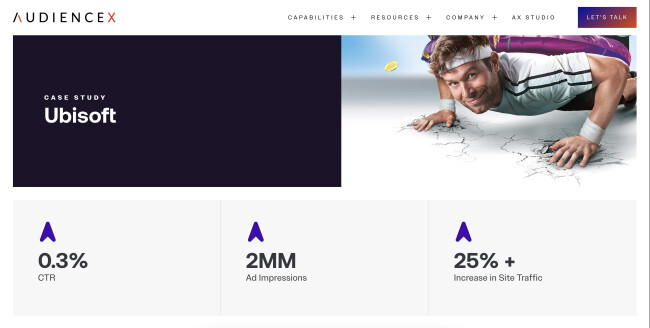
- AI-driven platforms leverage contextual intelligence and first-party data to deliver highly relevant ads, as seen in AudienceX's partnership with Ubisoft, which resulted in a 25% increase in traffic and over 2 million impressions.
- AI systems, like those used by KLM Royal Dutch Airlines, enable dynamic budget reallocation based on real-time performance data, reducing CPA by 10.5% and CPM by 62%.
How AI Is Rewriting the Rules of AdTech
Artificial intelligence is quickly becoming the new infrastructure in AdTech, strengthening performance, personalization, and compliance.
For CMOs, the AI imperative is no longer whether to integrate it but how fast you can scale it across your operations.
Related Articles:
1. AI in Programmatic Advertising
2. How AI is Impacting Advertising ROI
3. What Is AdTech?
4. What Is Model Context Protocol?
1. Pivoting from Broad Campaigns to One-to-One Experiences
Predictive personalization engines now combine behavioral, contextual, and even psychographic data to serve content that resonates with each user in real time.
As such, instead of advertising based on broad demographic assumptions, marketers are targeting with individualized precision.
For instance, AI models will analyze what a person is reading, watching, or clicking in the moment, and adjust the ad creatives and placement dynamically for relevance.
This content hyper-personalization pays off in performance.
Bain & Company found that AI-powered, hyper-personalized campaigns boosted click-through rates by up to 40% compared to generic campaigns.
In practice, Google’s Performance Max (PMAX) uses machine learning to automatically optimize bidding, targeting, ad creatives, and attribution across all Google properties.
In doing so, brands can build right-time experiences on a massive scale.
Disruptive Advertising conducted a study on how PMAX campaigns performed compared to Smart Shopping campaigns. It observed the following improvements on average with PMAX:
- 19% better cost-per-action (CPA)
- 227% increased revenue
- 84% higher return on ad spend (ROAS)
Crucially, this individual-level precision is achieved without manual micromanagement. AI systems monitor user behavior and content context continuously, adjusting ads in milliseconds.
2. Automating the Entire Campaign Lifecycle
Beyond personalizing campaigns, AI is also impacting marketing automation.
Repetitive tasks that once consumed hours are now automated by advanced tools. As a result, marketers have more time to focus on strategy and creative thinking.
The benefit isn’t just speed, it’s also margin control. By automating high-output campaigns, companies reduce wasted spend and expensive human hours.
MediaLink reports that agencies adopting AI into their workflow recorded over 27% in cost savings. Additionally, the cost of producing static images and similar assets has dropped by 1,000%.
In short, automation through AI acts as a force multiplier. Teams can run more campaigns, across more channels, in less time without needing to proportionally increase headcount or budget.
“Most conversations around AI in advertising focus on automation, but the real change is how quickly campaigns can evolve,” Arthur Favier, Founder and CEO of Oppizi, highlights.
“You can test multiple creative versions at once, gather feedback immediately, and adapt based on what people actually respond to. Traditional methods are slower, with fewer touchpoints. AI changes the tempo completely, allowing for real-time learning."
View this post on Instagram
Platforms like Meta’s Advantage+ and Adobe’s Sensei are prime examples of AI AdTech tools automating end-to-end marketing campaigns.
Advantage+ uses Meta’s machine learning to automate audience targeting, budget allocation, content testing, and bid adjustments.
It also continuously learns and reallocates spending to the best-performing audience and placements. As a result, Advantage+ campaigns saw a 22% increase in ROAS and a 7% rise in conversions versus manual targeting strategies.
Meanwhile, Adobe Sensei auto-generates design variations. It will then select optimal assets for different audiences and make data-backed predictions on which creative will perform best.
3. Enabling Smarter Targeting in a Privacy-First World
The depreciation of third-party cookies and tightening privacy regulations have pushed AdTech toward contextual intelligence and first-party data.
But losing cross-site tracking doesn’t mean returning to broad, untargeted ads. Rather, you can turn to AI AdTech tools to leverage contextual advertising and first-party data to deliver highly relevant ads.
Brittany Wray, Senior Director of Platform Solutions at AudienceX, explains in our latest podcast with her:
“Traditional audience targeting often struggles with inconsistent or unreliable data, difficulty integrating with first-party data, imprecise audiences leading to wasted ad spending, and the phase-out of third-party cookies.
“AI algorithms can analyze massive data to identify customer behavior patterns. Our predictor tool, for instance, uses machine learning to address these pain points.”
You can see this in AudienceX’s partnership with Ubisoft.
By leveraging contextual and behavioral data, it refined ad segmentation and prospecting. As a result, it boosted traffic by 25% and gained over 2 million ad impressions.
4. Powering Dynamic Creative Optimization (DCO)
DCO platforms use AI to assemble and adjust different creative elements (images, headlines, calls-to-action) on the fly, based on each viewer’s data and context.
Rather than a static ad, DCO creates a unique ad variant for each impression to engage that specific user at that moment. Elements can be tailored by location, device, weather, and past behavior.
The uplift from this approach is substantial.

When Nestle Indonesia partnered with Jivox, a generative commerce marketing agency, it experienced substantial gains:
- Purchase conversion rates rose by 32%
- Average order value increased by 40%
- ROAS grew by 34%
- Overall store growth increased by 30%
It achieved these results by leveraging Jivox’s AI-driven DCO platform. With it, Nestle automatically created 24 ad copies and creatives that appeared at different times of the day.
For instance, Koko Krunch cereals ads will flash in the morning. In the afternoon, it will feature KitKat. At night, it will feature Milo.
By marrying creative versioning with AI decisions, DCO ensures the ad a person sees is highly relevant, driving performance.
5. Optimizing Budget Allocation via Predictive Analytics
Deciding how to split budgets across channels and campaigns is traditionally a mix of analysis and guesswork.
AI is changing that by reallocating spend automatically based on predictive performance.
These predictive AI analytics systems (often part of campaign management platforms or DSPs) analyze factors like conversion trends and marginal returns in near-real time. It will then forecast customer behavior and interests and proactively adjust budget allocation.
For instance, if Facebook ads show an upward trend in engagement over Google, the AI AdTech system will shift its budget to Facebook within minutes. Something that might take days or weeks when done manually.
This agile reallocation is already reshaping the AdTech space.
Statista reports that in 2022, AI-enabled ad spend amounted to $370 million. By 2032, it will reach $1.3 trillion. In a separate study, Statista predicted that programmatic ads will dominate at 84%.
Kiel Tredrea, founder and president of RED27Creative, further emphasizes: “Traditional last-click attribution is dead — AI now tracks the full customer journey across devices and channels, showing which touchpoints actually drive conversions versus just getting credit.”
View this post on Instagram
You can see this in action in KLM Royal Dutch Airlines partnered with Smartly.io. Using the latter's Predictive Budget Allocation technology, KLM reduced 2 hours of weekly data analysis and ad budget preparation to 15 minutes.
As a result, KLM reduced overall CPA by 10.5%, prospecting CPA by 28%, and CPM by 62%.
6. Implementing Self-Optimizing Loops
Rather than relying on human teams to analyze performance metrics and make periodic adjustments, self-optimizing AI AdTech systems make those adjustments automatically.
These intelligent loops use machine learning to learn from each interaction and improve their decision-making.
Thus, they can identify the best-performing elements of an ad campaign. They can also reconfigure various aspects, like copy, creatives, and platform, to maximize gains.
This capability is especially critical in industries where speed, scale, and precision matter most.
Deckers Brands’ collaboration with Google and Jellyfish is a good example of AI AdTech self-optimizing ability.
By consolidating its ad and analytics strategy with the Google Marketing Platform, Deckers gained a 360 view of consumer behavior across multiple touchpoints.
Using BigQuery ML, Deckers developed a propensity model that predicted buyer behavior based on first-party data. To ensure accurate predictions, the model was continuously refined and tested using first-party data.
Combining this model with Jellyfish’s ML technology, Deckers automatically refined ad elements based on performance signals.
As the system learned from data, it refined both marketing strategies and creative elements, ensuring Deckers remained responsive and agile in an ever-changing consumer landscape.
Impact of AI in AdTech: Privacy, Data, and Competitive Advantage
As AI continues to revolutionize the AdTech industry, it's reshaping how marketers and businesses leverage its potential. Here’s a closer look at these changes and key strategies to stay ahead of the curve.
1. AI Maturity as the Dividing Line
With 78% of businesses adopting AI in at least one function, the real differentiator is no longer whether a company uses AI.
Rather, it’s how advanced their AI adoption is.
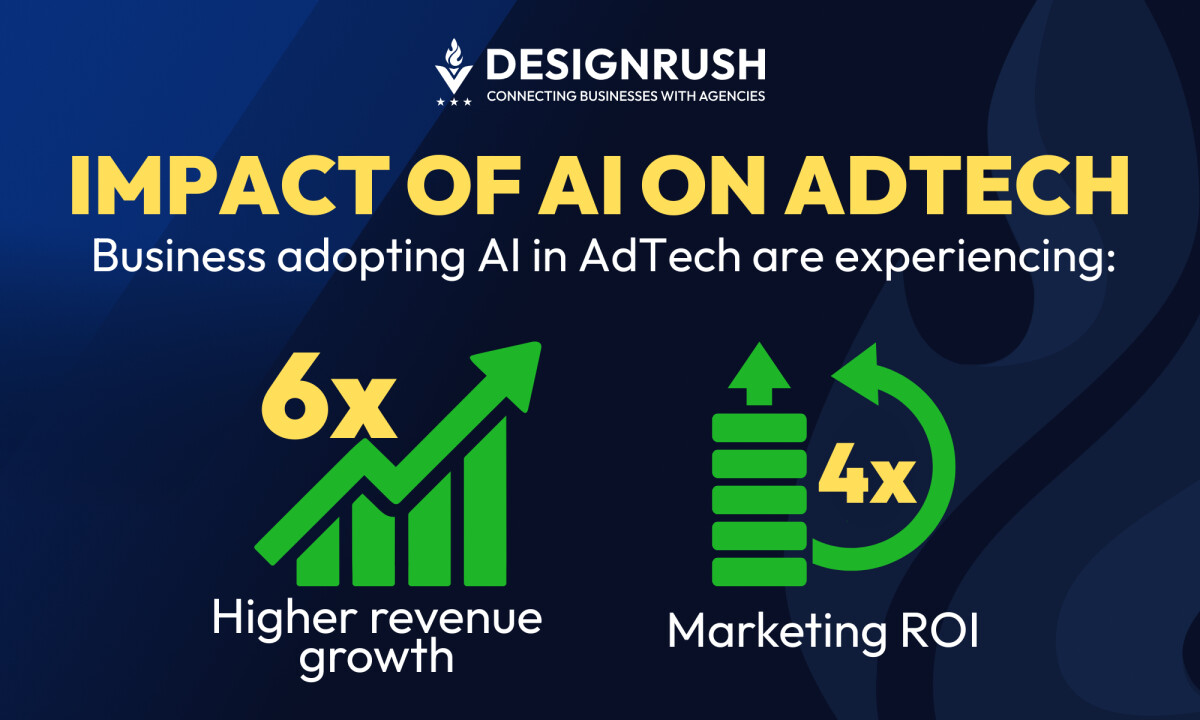
Businesses that treat AI as a core capability are achieving 6x higher revenue growth and 4x higher marketing ROI compared to their peers.
These companies are often characterized as:
- Having multiple AI use cases in production
- Conducting multiple AI experiments monthly
- Complimenting first-party data with third-party data
- Using customized AI tech
According to Davide Righini, CEO of PkitID: “Successful adaptation requires new team structures where creative strategists work closely with data analysts, and approval processes become more agile and performance-focused rather than purely aesthetic.”
He further adds: “The key [also] lies in choosing AI tools that integrate seamlessly with existing workflows while providing the flexibility to maintain brand consistency across all generated variations.”
2. Growing Need for Ethical Targeting
The use of AI in advertising has raised flags around algorithmic bias, transparency of algorithms, and data privacy. Regulators worldwide are formulating guidelines to ensure AI usage is fair and accountable.
For advertisers, strategically differentiating, in the long run, will require demonstrating ethical AI practices and strong data governance.
Leading AdTech firms are already building privacy-safe targeting solutions, including:
- Federated learning:Allows models to be trained on user data that stays on-device, only sharing aggregated insights.
- Consent-aware algorithms: Use explicit user consent to ensure data is only processed in accordance with user preferences, fostering trust and transparency.
- Explainable AI (XAI):Ensures AI systems provide transparent and understandable explanations in their decision-making processes, so users comprehend how outcomes are derived, fostering trust and accountability.
- Zero-party data:Refers to data that consumers willingly provide directly to brands, offering valuable insights while enhancing privacy control.
3. Rise of AI-Driven CPDs
Another way AdTech companies are navigating the cookie-less future is through AI-driven customer data platforms (CDPS).
These platforms ingest data from all customer touchpoints and churn out predictive audience insights and segments that marketers can act on.
Essentially, they turn a jumble of data from web visits, transaction history, email interactions, and call center logs into organized knowledge.
Here’s how AI does it:
- Identity resolution: Figuring out that Jane Doe in the loyalty app is the same as J. Doe on the website
- Propensity modeling: Scoring how likely each user is to take certain actions
- Content recommendations: Suggesting visual elements, copy, color, platform, and placement that will likely maximize ROI
- Closed loop integrations: Updating messaging across integrated activation channels, like Facebook, Google, and email
Already, enterprises using AI-driven personalization campaigns through CDPS have seen a 10%-25% ROAS.
In essence, AI-powered CDPs are becoming the “brain” of omnichannel marketing.
AI in AdTech: Final Words
AI is redefining AdTech across every dimension: media buying, creative production, personalization, analytics, and even governance. The evidence is piling up that those who adopt and integrate AI early are outperforming their peers. They’re launching campaigns faster, targeting more precisely, personalizing at scale, and squeezing more ROI from each marketing dollar.
In short: The AdTech train has left the station, powered by AI engines. Now is the time to get on board and build momentum or be left on the platform.
 Our team ranks agencies worldwide to help you find a qualified partner. Visit our Agency Directory for the AdTech companies, as well as:
- Top Advertising Agencies
- Top Conversion Optimization Agencies
- Top Social Media Marketing Agencies
- Top Content Marketing Agencies
AI AdTech FAQs
1. What’s the biggest risk of AdTech automation powered by AI?
The biggest risk lies in over-reliance on AI without proper oversight, which can lead to unintended biases in targeting or content delivery, potentially harming brand reputation or causing inefficient spend. Ensuring a balance between automation and human control is crucial to mitigate errors and maintain ethical standards, especially in the context of evolving privacy regulations.
2. How do we balance AI with human creativity and strategy in campaign development?
AI should be viewed as a tool that enhances, not replaces, human creativity. While AI excels at automating data analysis, targeting, and optimization, human creativity is still key to crafting compelling stories and messages that resonate with audiences. By combining AI's efficiency with human strategic thinking, we can deliver personalized, high-performing campaigns that retain emotional engagement and brand identity.
As David Zimmerman, Fractional CMO of Reliable Acorn, points out:
“Although every tool seems to have an AI component these days, marketers should remember that the output of AI tools is only as good as the input.”
3. What is the future of AI in AdTech, and how can our agency stay ahead of the curve?
The future of AI in AdTech is increasingly about hyper-personalization, predictive analytics, and privacy-first solutions. To stay ahead, your agency must invest in AI-driven platforms that not only optimize campaigns but also adapt in real time based on user behavior and market shifts. Fostering a culture of innovation, continuously experimenting with AI technologies, and staying agile will ensure your agency leads in both performance and ethical standards.