
AI answers are replacing clicks. If your brand isn’t cited in tools like ChatGPT or Google AI Overviews, it’s invisible.
That’s where tools for tracking LLM brand visibility come in. They show when you’re mentioned, which sources AI pulls from, and where competitors outrank you.
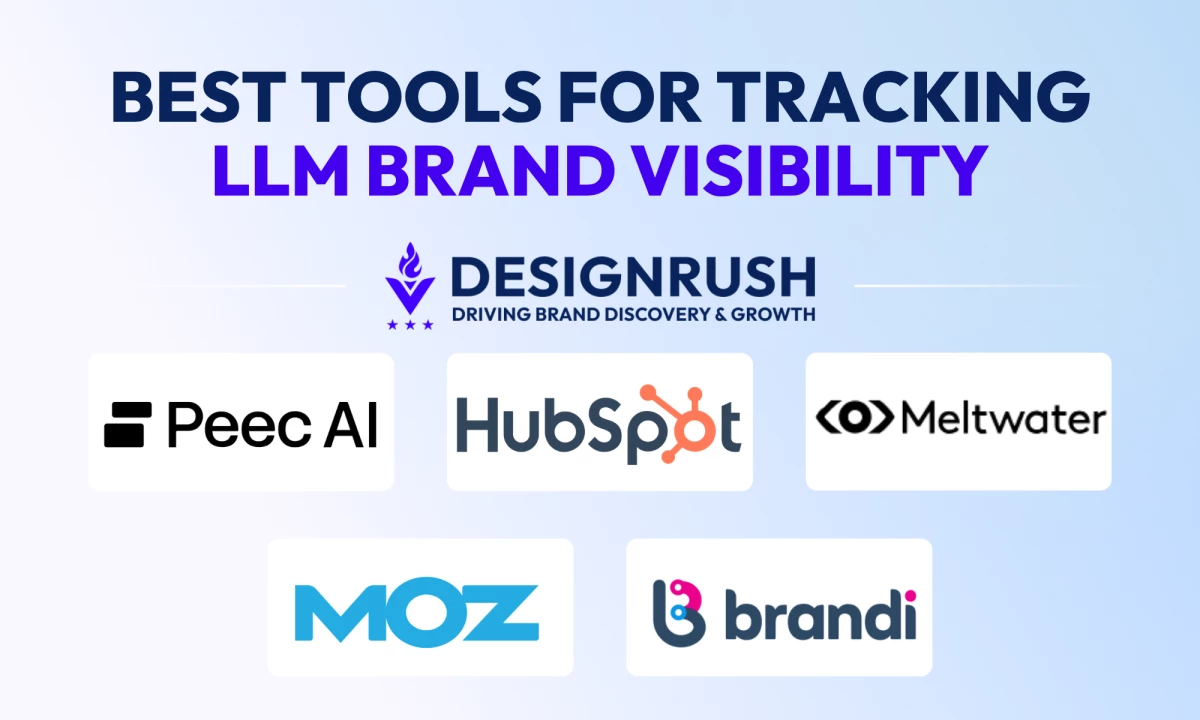
LLM Brand Tracking Tools: Key Findings
- Profound analyzes how AI describes your brand and which sources it cites, while Moz Pro combines AI visibility tracking with traditional SEO tools.
- Brandi AI and OtterlyAI focus on GEO recommendations and content optimization, while HubSpot AEO pairs approachable tracking with built-in tools to act on it.
- Keyword.com ties AI mentions back to traditional search performance, and Ahrefs Brand Radar centers on a large-scale AI research database for analyzing visibility patterns at scale.
Tools for Tracking LLM Brand Visibility Compared
Tools for tracking LLM brand visibility vary in depth. Some focus on monitoring mentions, while others analyze prompts, surface competitor gaps, and support GEO-driven optimization.
The reason they work so differently is that AI visibility doesn't behave like a search ranking. In traditional SEO, you can see exactly where you sit on the page.
In AI answers, there is no fixed position to hold. The same prompt can return a different set of cited brands depending on how it's phrased, which model answers it, and what sources the system pulls from.
A page that ranks first in Google can go unmentioned in an AI answer on the same topic, because the model is assembling a response rather than ordering a list of links. That's why these tools track mentions, prompts, and citations rather than a single ranking position.
McKinsey & Company found that only 16% of brands systematically track AI search performance, leaving most teams not knowing how they appear in AI-generated answers.
The table below breaks down what each platform offers so you can choose based on your needs:
| Tool | Best For | Primary Focus | Starting Price (billed annually) |
| HubSpot AEO | Marketers getting started with AI visibility tracking | Visibility tracking + social, email, content | From $45/month |
| Brandi AI | AI discovery intelligence, brand sentiment & GEO strategy | Prompt strategy + optimization | From $349.99/month |
| Profound | Analyzing how AI describes your brand | Brand mentions, cited sources and sentiment | Custom pricing; seven-day free trial |
| Moz Pro | Integrated SEO and AI visibility | SEO + AI insights | From $79/month |
| Peec AI | Lightweight LLM visibility tracker | Straightforward reporting | From $80/month |
| Keyword.com | Connecting SEO rankings with AI citations | SEO + AI tracking | From $6/month |
| Meltwater GenAI Lens | AI reputation & brand narrative monitoring | Reputation + sentiment monitoring | Contact Sales |
| SE Visible | Multi-brand AI visibility reporting | AI reporting + SEO workflows | From $79/month |
| Ahrefs Brand Radar | Large-scale AI prompt & mention research | Prompt database + visibility research | From $398/month |
| OtterlyAI | Identifying why AI engines ignore your content | GEO optimization + content audits | From $25/month |
1. HubSpot AEO: Best for Marketers Getting Started With AI Visibility Tracking
For teams that want approachable AI visibility tracking paired with the tools to act on it
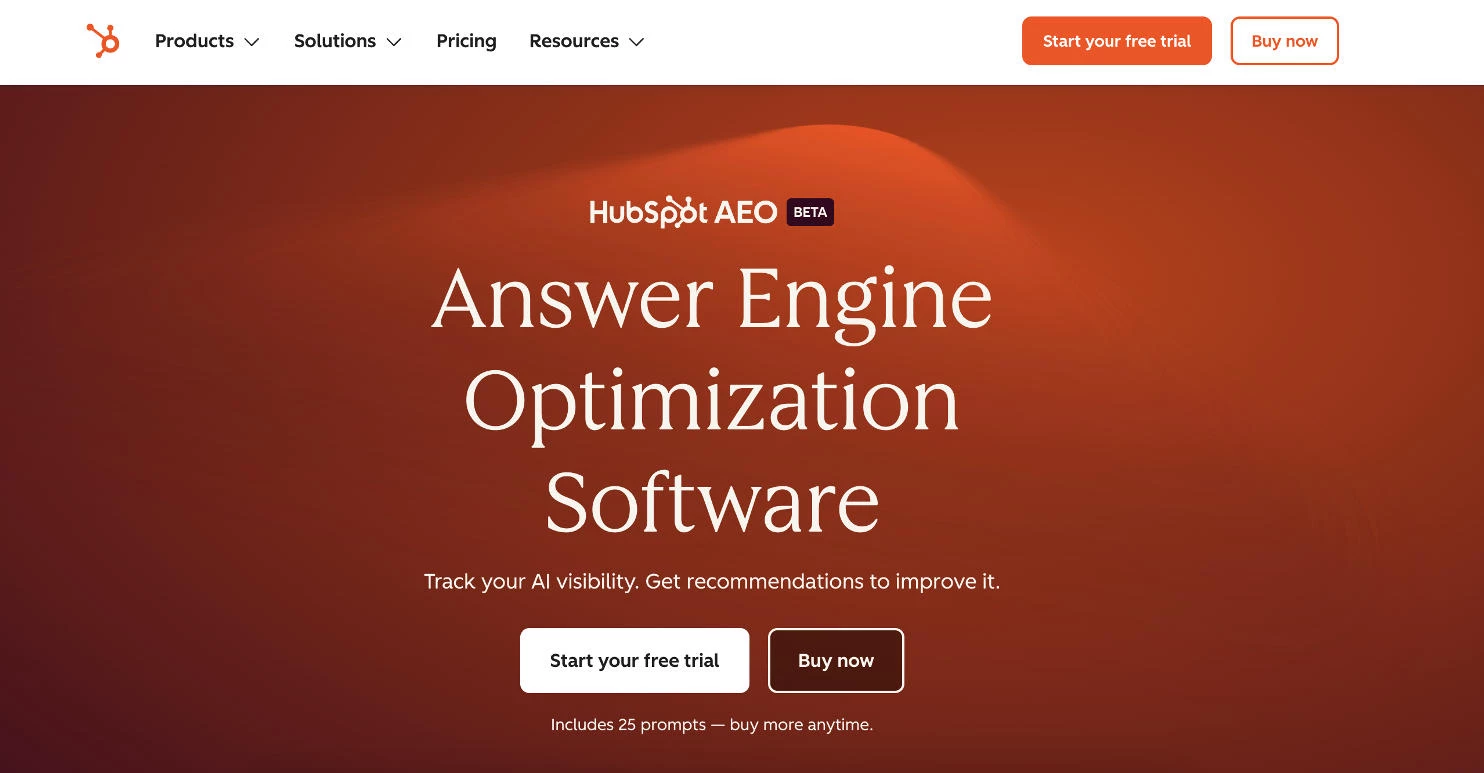
HubSpot AEO tracks how your brand appears in AI-generated answers across ChatGPT, Gemini, and Perplexity, then translates those insights into prioritized recommendations without requiring technical expertise.
It measures your brand visibility score and compares your share of voice against competitors for the prompts that matter most to your business.
You can access HubSpot AEO in two ways:
- Included with a Marketing Hub Professional or Enterprise subscription, where a connection to HubSpot Smart CRM informs your prompt tracking and recommendations from day one.
- Purchased on its own, with Smart CRM and Free Tools available to activate separately.
Beyond tracking visibility, HubSpot AEO helps you act on the insights. You can create blog posts, publish social content, and launch email campaigns from the same platform instead of switching between multiple tools.
Pricing (billed annually)
- HubSpot AEO: $45/month
- AEO in Marketing Hub Professional/Enterprise: Included with subscription, with expanded prompts and Smart CRM-powered recommendations
Pros
- Pairs AI visibility tracking with the content, social, and email tools to act on recommendations
- Suggests prompts based on your company, competitors, and industry to simplify setup
- Built for marketers without technical or AEO expertise
- Includes citation analysis and competitor share of voice at the base price
Cons
- Covers three AI engines compared to the broader platform coverage of some competitors
- Smart CRM-powered recommendations require Marketing Hub Professional or Enterprise, or separate activation
Who’s It For
HubSpot AEO is best suited for marketing teams that are new to AI visibility tracking and want an approachable way to see how their brand appears in AI answers alongside the tools to improve it.
It also fits small and mid-sized businesses and existing HubSpot users who want visibility tracking and an execution layer in one connected system rather than piecing together separate tools.
Key Features
- Brand visibility score and competitor share of voice across ChatGPT, Gemini, and Perplexity
- Prompt tracking with suggestions based on your company, competitors, and industry
- Citation analysis showing which domains, pages, and content types drive AI mentions
- Sentiment analysis measuring how AI describes your brand
- Prioritized AEO recommendations for creating, updating, or fixing content
- Built-in execution tools for blog, social, and email to act on recommendations in one end-to-end system
- Smart CRM integration for business-informed prompt tracking and recommendations
Start your free 28-day trial of HubSpot AEO.
2. Brandi AI: Best for AI Discovery Intelligence, Brand Sentiment & GEO Strategy
For PR, SEO, and marketing teams analyzing competitive differentiation and benchmarking competitor visibility
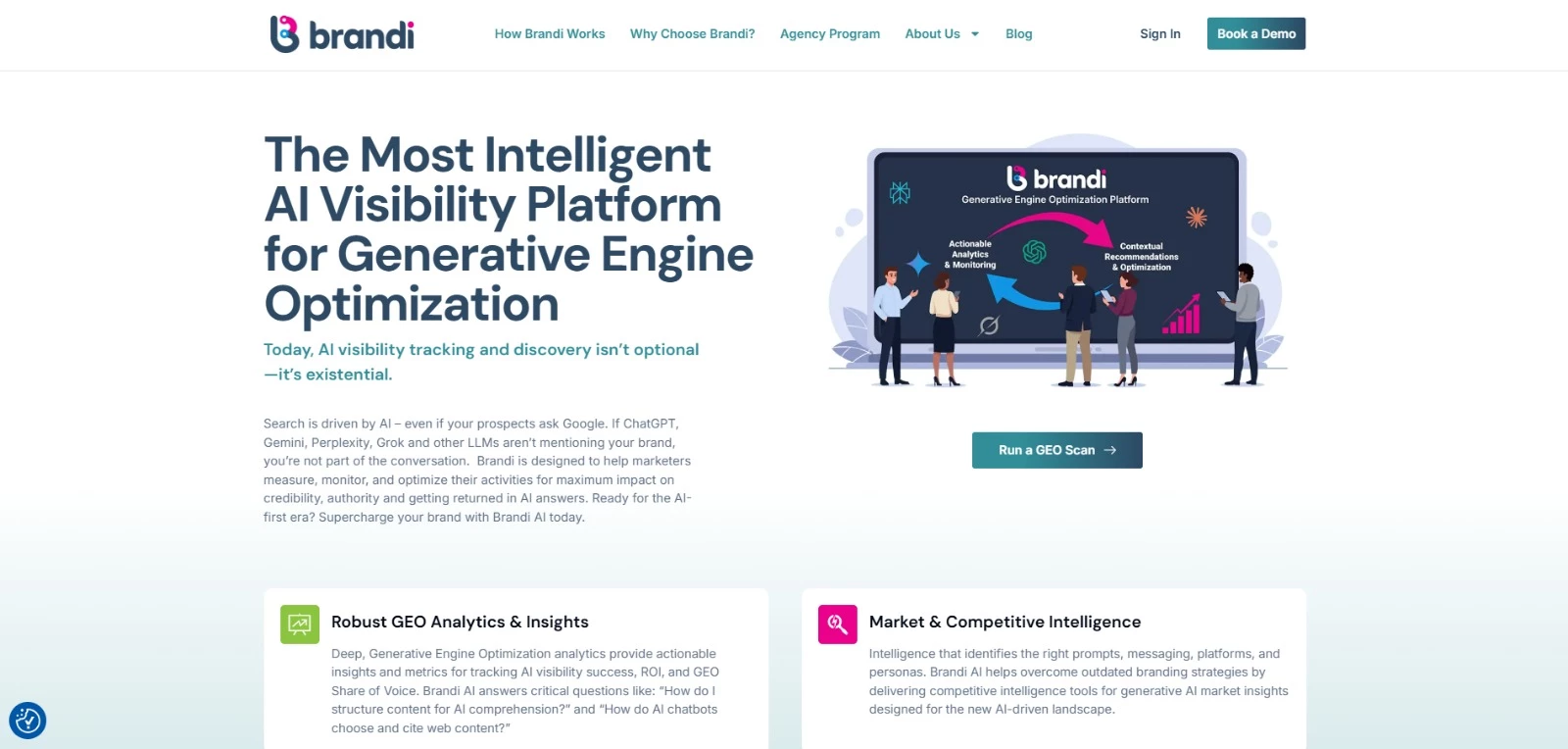
Brandi AI focuses on a problem most marketers are only just beginning to measure - how, why, and where your brand shows up in AI-generated answers.
Instead of tracking rankings, it analyzes real prompts users ask on platforms such as ChatGPT, Gemini, Perplexity, and Google AI Overviews. It then shows whether your brand appears, how often, and in what context.
What makes Brandi different is how it identifies the questions driving competitor visibility and guides you on how to create and restructure content so it’s more likely to be cited by AI systems.
Pricing
- Starts at $349.99/month
Pros
- Tracks brand presence across major AI platforms
- Deep patented sentiment analysis
- Most robust content guidance and optimization
- Identifies high-intent prompts driving visibility
- Competitor benchmarking and gap analysis
- Supports multilingual and regional tracking
Cons
- Designed for use across all of marketing, not just SEO
Who’s It For
Brandi AI is built for CMOs, PR professionals, product marketers, digital marketers, and content strategists who want to move beyond mentions monitoring and actively improve how AI systems represent their brand, including sentiment.
Key Features
- Prompt-level visibility tracking
- Competitive benchmarking in AI answers
- Patented sentiment analysis for deep brand intelligence
- Robust content guidance and optimization
- GEO-focused content recommendations
- Multi-language and regional analysis
3. Profound: Best for In-Depth AI Visibility Analysis
For marketing teams that need to understand where AI mentions their brand and which sources shape those answers
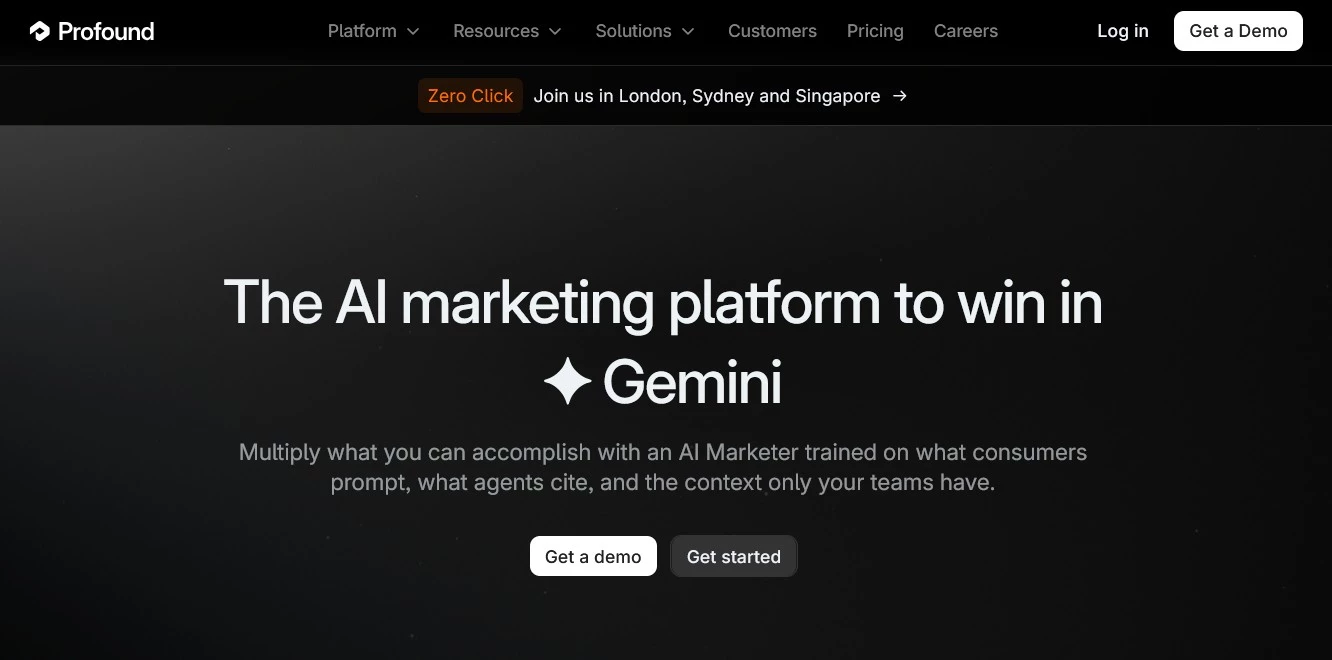
Profound goes beyond counting brand mentions. Its Answer Engine Insights tracks visibility and share of voice, compares competitor presence, and analyzes how AI platforms describe your business.
Citation analysis helps teams identify the websites influencing those responses, while FactCheck flags inaccurate claims and their sources. This gives marketers a clearer starting point for investigating misleading descriptions or gaps in brand coverage.
The platform also captures responses from consumer-facing AI interfaces rather than relying solely on API outputs. Daily tracking helps teams monitor how their visibility changes across repeated prompts.
Pricing
- Free seven-day trial: 50 prompts tracked daily across ChatGPT, Gemini, and Google AI Overviews.
- Enterprise: Custom pricing, with tailored prompt limits and broader AI platform coverage.
Pros
- Connects visibility metrics with citation sources and brand sentiment
- Helps identify inaccurate AI-generated claims about your business
- Supports competitor benchmarking across AI platforms
Cons
- Custom Enterprise pricing makes upfront cost comparisons harder
- Trial prompts are predefined and cannot be customized
- The trial covers only three AI platforms; broader coverage requires Enterprise
Who’s It For
Profound suits established brands and marketing teams that need to investigate why competitors appear in AI answers more often, or why their own brand is described inaccurately.
Its detailed reporting is most useful when a team has the capacity to act on findings through content updates and ongoing monitoring.
Key Features
- Visibility scores and share-of-voice tracking
- Citation-source analysis and competitor comparisons
- Sentiment tracking and recurring brand themes
- FactCheck for identifying inaccurate brand claims
- Custom prompt tracking on Enterprise plans
- Agent Analytics for monitoring AI-sourced website traffic
- Enterprise reporting exports and API access
Start your free 28-day trial of HubSpot AEO.
4. Moz Pro: Best for Integrated SEO and AI Visibility Tracking
For marketing teams that want to monitor traditional search and AI search in one platform
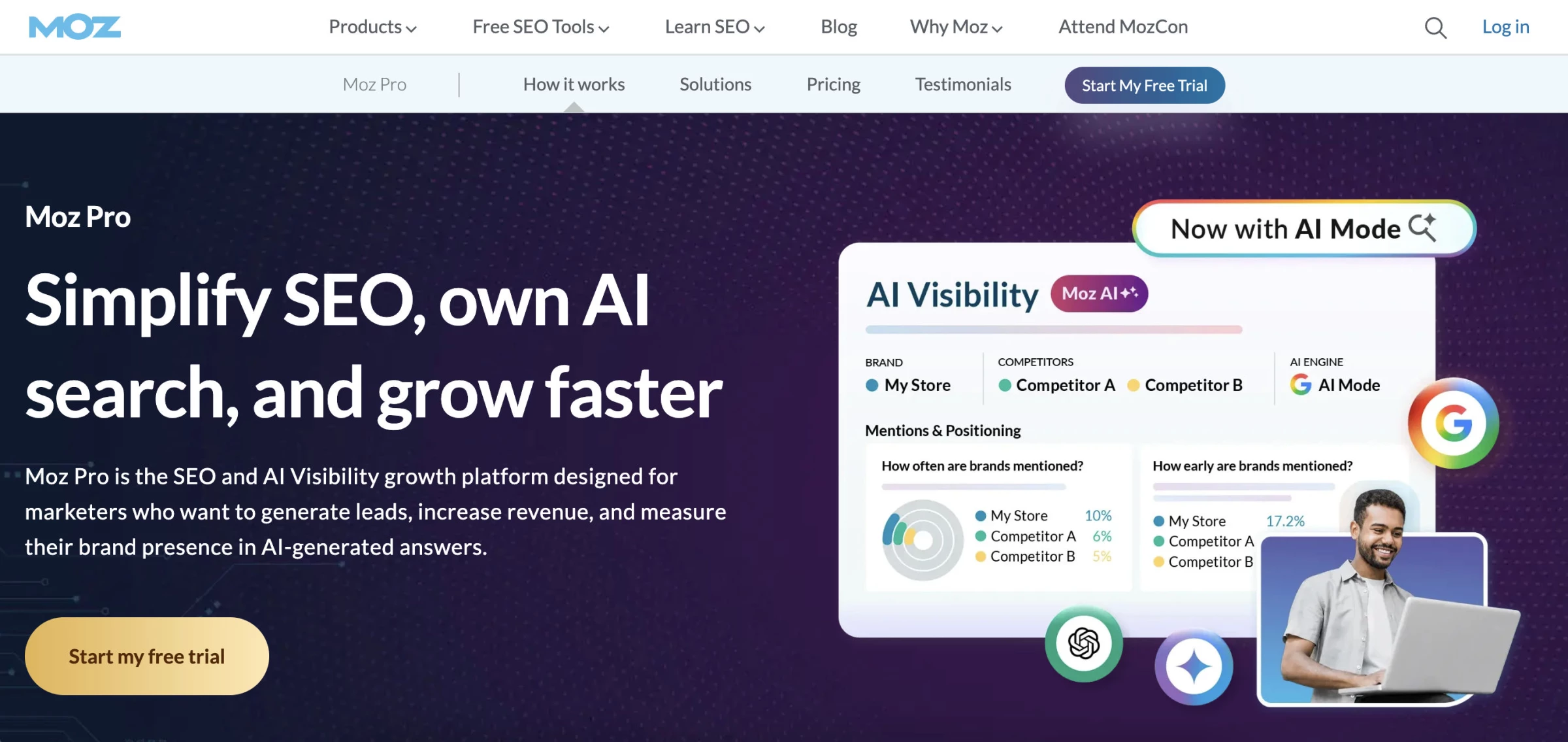
Moz Pro is a long-established SEO platform that has added AI Visibility tracking to its core toolkit, letting teams measure brand presence in AI-generated answers alongside their existing rank tracking, keyword research, and site audit workflows.
The AI Visibility Dashboard tracks how often a brand appears in responses from ChatGPT, Gemini, and Google AI Mode, and how early in those responses it gets mentioned.
Teams can benchmark their presence against competitors and watch visibility shift over time as content and marketing efforts change.
What separates Moz Pro from dedicated GEO tools is the integration.
Rather than running AI visibility tracking on a separate platform, Moz Pro consolidates it inside the same dashboard where teams already manage Keyword Explorer, Rank Tracker, and Brand Authority.
For teams that already use Moz Pro for SEO, AI visibility tracking is one more feature inside a familiar interface rather than a new tool to learn.
Pricing (billed annually)
- Standard: $79/month
- Medium: $143/month
- Large: $239/month
- Enterprise: Custom pricing
Pros
- Includes prompt tracking on Standard, Medium, and Large plans at no extra cost.
- Lets teams measure both traditional rankings and AI brand presence inside a single workflow.
- Backed by Moz's 20-year SEO track record and the industry-standard Domain Authority metric.
- Approachable for teams new to AI visibility tracking, with strong educational resources.
- Includes a 7-day free trial on Medium monthly plans.
Cons
- Covers fewer AI platforms than dedicated GEO tools
- Prompt tracking frequency is set to weekly
Key Features
- AI Visibility Dashboard with brand presence tracking across ChatGPT, Gemini, and Google AI Mode.
- Prompt Responses for reviewing AI-generated answers and the citations used in those responses.
- Competitor benchmarking inside the same dashboard.
- Time-series visibility charts to measure the impact of content and marketing changes.
- Integration with Keyword Explorer, Rank Tracker, Brand Authority, and the wider Moz Pro suite.
- Free Moz Community account available for limited access to MozBar, Keyword Explorer, and Link Explorer.
Who’s It For
Moz Pro is best suited for in-house SEO teams, content marketers, and agencies already invested in traditional search optimization who want to extend their measurement into AI search without adding a separate tool to their stack.
It also fits small and mid-sized businesses that want approachable AI visibility tracking inside a familiar SEO platform, rather than a standalone GEO product with a steeper learning curve.
Explore AI Visibility with Moz Pro.
5. Peec AI: Best Lightweight Multi-LLM Visibility Tracker
For marketing teams that need reliable AI visibility data without complexity
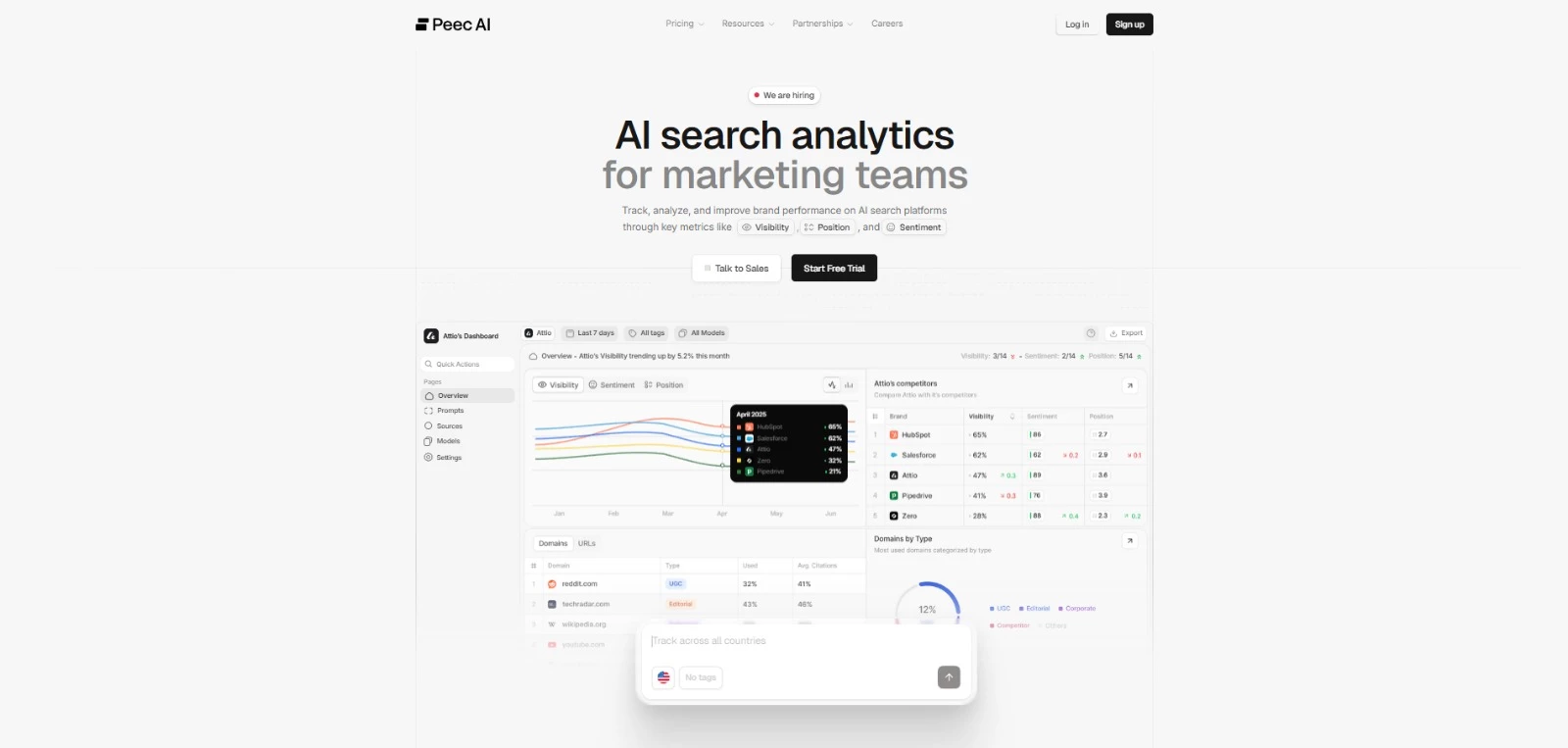
Peec AI is built for tracking how your brand appears in AI search environments, including ChatGPT, Google AI Overviews, Perplexity, Gemini, and Copilot.
Instead of focusing on rankings, it measures AI visibility, showing when your brand is cited, which sources AI pulls from, and how you compare to competitors.
The platform combines daily tracking with prompt-level insights to help you understand not only whether they appear, but also why. That includes identifying coverage gaps, spotting competitor wins, and finding opportunities to improve how your content is picked up by AI systems.
Pricing (billed annually)
- Starter: $80/month (50 prompts, 1 project)
- Pro: $205/month (150 prompts, 2 projects)
- Advanced: $420/month (350 prompts, 5 projects)
- Enterprise: Custom pricing
Pros
- Tracks visibility across major AI platforms and answer engines
- Clear citation and source-level insights
- Prompt-based analysis with competitor comparisons
- Daily tracking with alerts for visibility changes
- Easy-to-navigate interface
Cons
- No free tier
- Limited number of prompts and projects on lower plans
- Some integrations and advanced features are still evolving
Who’s It For
Peec AI is well-suited for marketing teams that want a clear view of how their brand appears in AI-generated responses without being overly complex.
It works well for content teams, SEO leads, and agencies that are already tracking search performance and now need to extend that into AI visibility and GEO.
Key Features
- Tracks brand mentions across ChatGPT, Gemini, Perplexity, Copilot, and AI Overviews
- Citation and source tracking for AI-generated answers
- Prompt-level visibility analysis
- Competitor benchmarking
- Daily tracking with alerting
- API access, MCP integration, Looker Studio integration, and SSO
6. Keyword.com: Best for Connecting SEO Rankings With AI Citations
For teams that want AI visibility tracking alongside traditional SEO monitoring
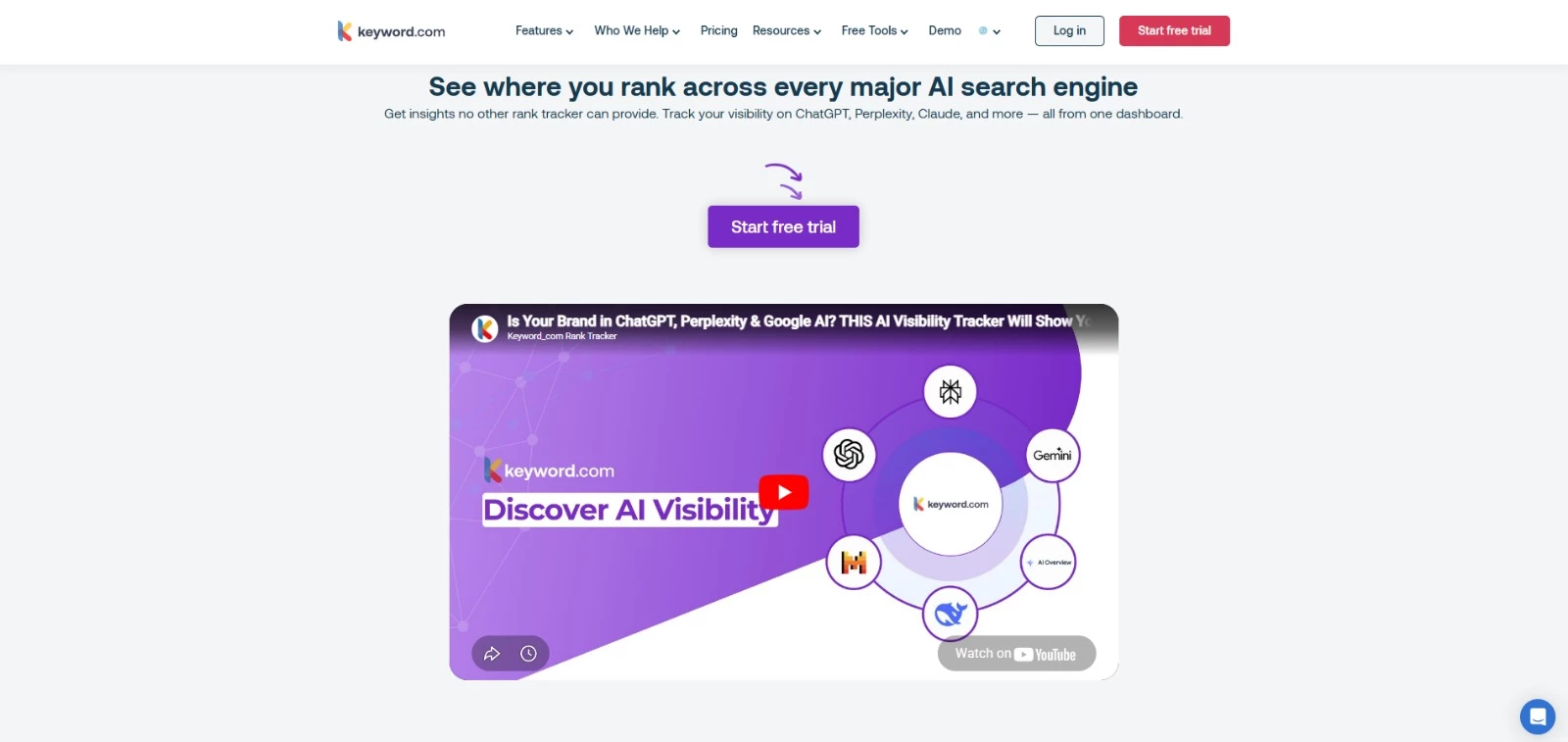
Keyword.com expands traditional rank tracking into AI search, helping teams track how content performs in both Google results and AI-generated answers.
It connects keyword performance with AI citations to show which queries trigger AI Overviews, which pages get referenced, and how visibility changes over time.
Pricing
- Search Visibility: $6/month
- 360° Visibility: From $26/month
- AI Visibility: From $31.17/month
- Custom plans: From $490/month
Pros
- Combines keyword tracking and AI visibility in one platform
- Strong citation and URL-level visibility insights
- Supports multiple AI platforms and answer engines
- Includes reporting, API access, and MCP server support
Cons
- AI visibility features are separated across different plans
- Less advanced persona and workflow analysis than dedicated GEO platforms
- Enterprise customization requires higher-tier plans
Who’s It For
Keyword.com is a well suited for SEO teams that want to extend traditional ranking tracking into AI visibility without switching platforms.
It works well for in-house teams and agencies who need to connect keyword rankings, AI citations and brand exposure within a single reporting workflow.
Key Features
- Tracks which queries trigger AI Overviews and AI-generated answers
- Shows which URLs and sources are cited by LLMs
- Monitors AI visibility trends across platforms over time
- Supports ChatGPT, Gemini, Claude, Perplexity, Copilot, DeepSeek, and Mistral
- Shareable dashboards, reporting, API access, and MCP server support
7. Meltwater GenAI Lens: Best for AI Reputation & Brand Narrative Monitoring
For PR, communications, and brand teams managing how brands are represented across AI platforms
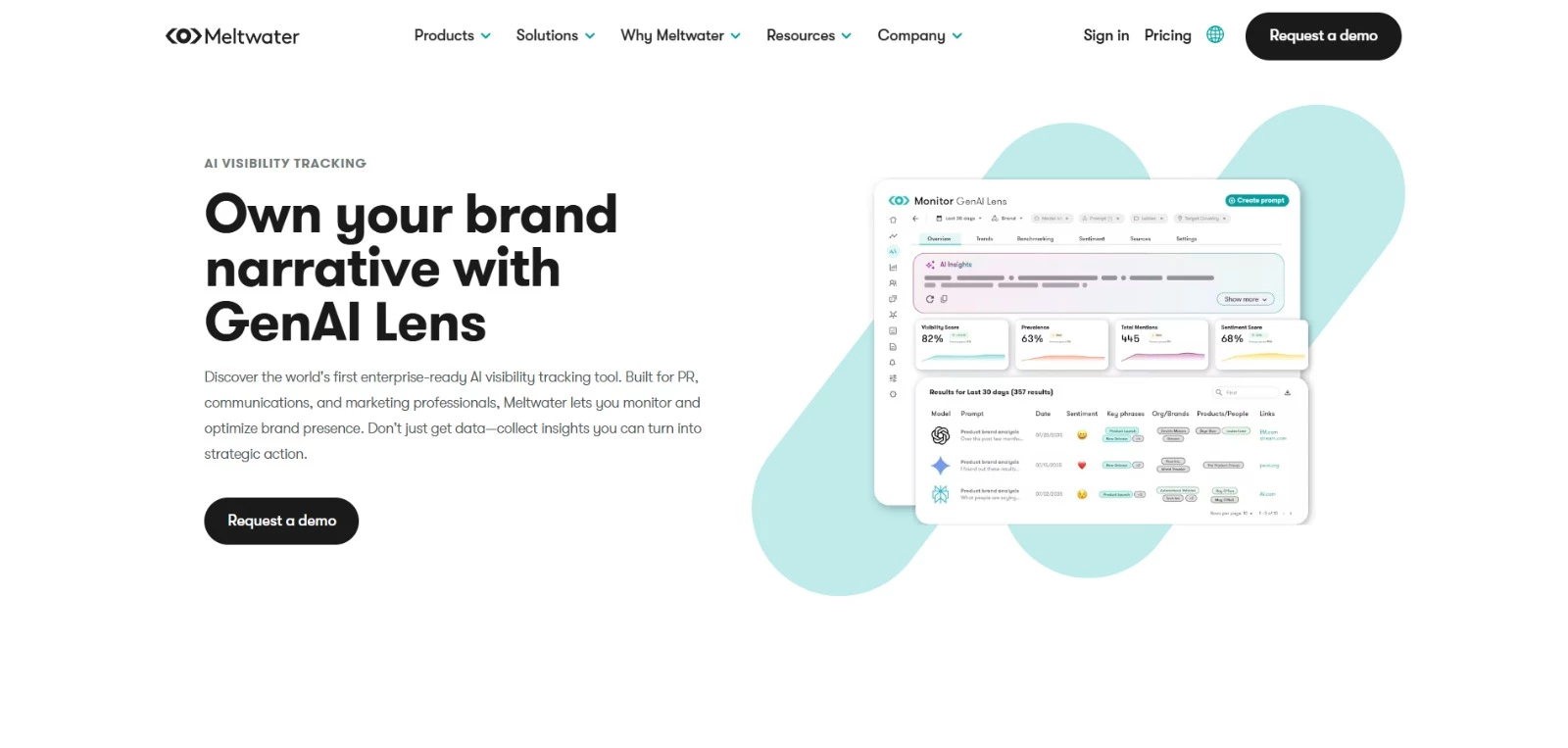
Meltwater GenAI Lens approaches AI visibility from a different angle than most GEO and SEO-focused platforms. It focuses on brand perception, media visibility, sentiment, and competitive positioning inside AI-generated answers.
The platform tracks how brands, products, executives, and competitors appear across tools such as ChatGPT, Gemini, Claude, Perplexity, Grok, DeepSeek, and Google AI Overviews.
It combines LLM visibility tracking with Meltwater's broader media intelligence and social listening infrastructure, giving you a more complete view of how AI systems are shaping brand stories.
Pricing
- Contact Sales
Pros
- Broad LLM and AI search platform coverage
- Strong focus on brand reputation, sentiment, and share of voice
- Combines AI visibility tracking with media monitoring and social listening
- Great fit for enterprise communications and PR workflows
- Includes prompt-level analysis and competitor benchmarking
Cons
- Less SEO and workflow depth than dedicated GEO platforms
- Heavier onboarding and setup compared with standalone AI visibility tools
- Data refresh cycles are slower than some daily-tracking competitors
Who’s It For
Meltwater GenAI Lens is best suited for PR, communications, and enterprise brand teams that need visibility into how AI systems describe brands, products, and competitors in multiple channels.
It’s great if you’re already using Meltwater for media intelligence and social listening and want to extend those workflows into AI visibility and reputation monitoring.
Key Features
- Multi-model tracking over ChatGPT, Gemini, Claude, Perplexity, Grok, DeepSeek, and Google AI Overviews
- Prompt-based monitoring aligned to buyer journeys and search behavior
- Source and citation tracking across AI-generated answers
- AI share of voice and competitive benchmarking
- Sentiment analysis and trend monitoring over time
- GEO-focused visibility recommendations
- API and MCP integrations within enterprise plans
8. SE Visible: Best for Multi-Brand AI Visibility Reporting
For agencies and SEO teams that want AI visibility tracking with traditional search workflows
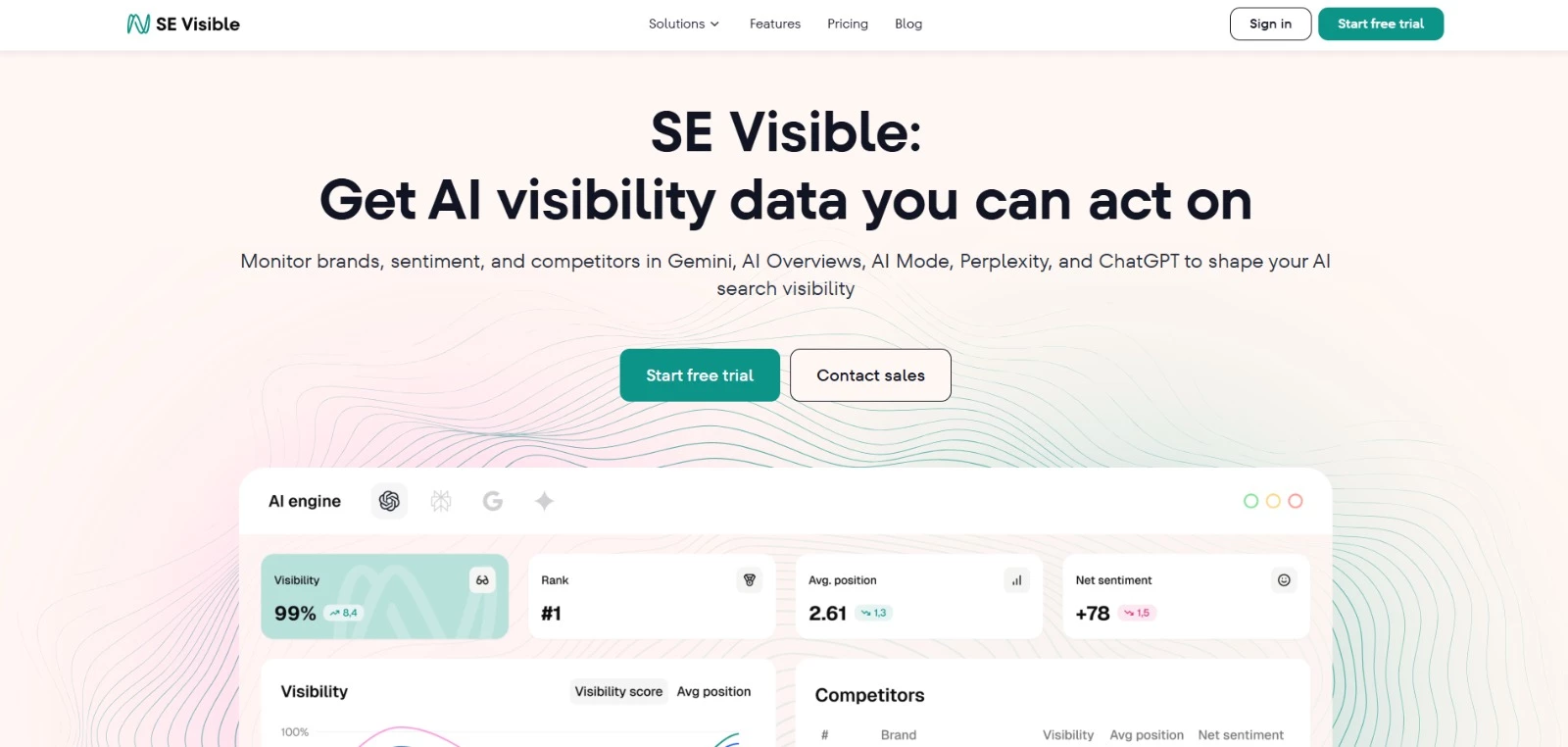
SE Visible by SE Ranking is a dedicated AI visibility platform built to help brands monitor how they appear in AI-generated answers and search experiences.
The tool tracks visibility, sentiment, competitor mentions, citations, and top sources across ChatGPT, Google AI Overviews, AI Mode, Gemini, and Perplexity.
It also connects AI visibility monitoring to broader SEO workflows, so it’s great for agencies and in-house teams already working with SE Ranking.
What makes SE Visible stand out is its balance between traditional SEO data and AI search monitoring. You can analyze prompts, benchmark competitors, monitor cited domains and URLs, and track changes in visibility across platforms, countries, and languages.
Pricing (billed annually)
- Basic: From $79/month annually (200 prompts, 3 brands)
- Core: From $151/month annually (450 prompts, 5 brands)
- Plus: From $284/month annually (1000 prompts, 10 brands)
Pros
- Combines AI visibility monitoring with its SEO platform ecosystem
- Tracks sentiment, citations, competitors, prompts, and AI visibility trends
- Agency-focused workflows with exports, collaboration, and multi-brand tracking
- Includes source and URL-level visibility analysis
Cons
- AI visibility capabilities are still less established than the platform’s traditional SEO features
- Limited GEO-specific optimization guidance compared to more specialized AI visibility tools
Who’s It For
SE Visible works best for SEO teams, agencies, and digital marketing departments that want AI visibility reporting integrated with broader search performance workflows.
It’s useful for teams already managing rankings, reporting, and competitor analysis who now need visibility into how brands appear inside AI-generated answers and search experiences.
Key Features
- AI visibility observing across ChatGPT, Gemini, AI Mode, Perplexity, and Google AI Overviews
- Competitor benchmarking and sentiment monitoring
- Source, domain, and URL citation tracking
- Multi-brand, multi-country, and multi-language monitoring
- Prompt-level visibility analysis and reporting exports
- Collaboration workflows for agencies and large teams
9. Ahrefs Brand Radar: Best for Large-Scale AI Prompt & Mention Research
For marketers already using Ahrefs who want broad AI visibility research tied to search demand and web mentions
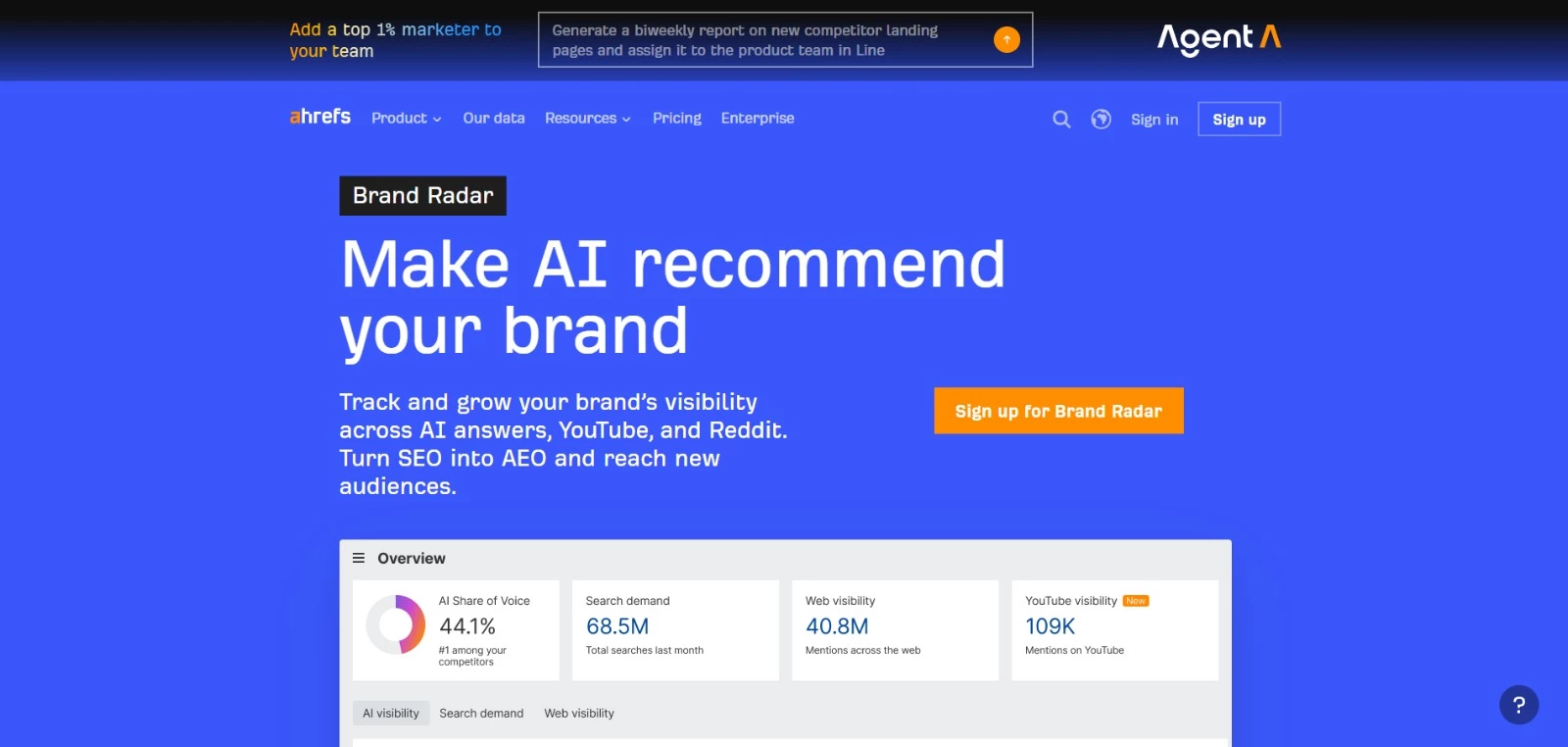
Ahrefs Brand Radar emphasizes scale. The platform tracks hundreds of millions of prompts across AI systems and pairs that data with Ahrefs’ existing search and web index, giving teams a way to research how brands appear in AI answers alongside broader search visibility trends.
Beyond AI mentions, Brand Radar also pulls in signals from YouTube, Reddit, TikTok, and the wider web. That makes it feel closer to a large AI visibility research database than a focused monitoring dashboard.
You can benchmark competitors, analyze citation sources, track share of voice, and explore which prompts surface their brand most often.
Pricing
- Select Platforms: Starts at $398/month
- All Platforms: Starts at $699/month
Pros
- Massive prompt database across AI platforms and search-backed queries
- Tracks visibility in AI answers, web mentions, YouTube, Reddit, and TikTok
- Lets teams research brands, products, people, and regions without project limits
- Familiar environment for existing Ahrefs users
Cons
- The platform currently feels more research-oriented than workflow-oriented
- Insights and reporting still lack some of the refinement found in more mature AI visibility platforms
Who’s It For
Brand Radar makes the most sense for SEO and content teams already invested in Ahrefs and looking to expand into AI visibility research without adopting a separate ecosystem.
It also suits teams doing large-scale competitive analysis, market research, or brand discovery work across AI search, social platforms, and traditional web visibility channels.
Key Features
- AI visibility and share-of-voice tracking
- Large-scale prompt database across AI platforms
- Citation and source analysis
- Competitor benchmarking
- Reddit, YouTube, and TikTok visibility tracking
- Custom prompt tracking
- Search demand and web visibility metrics
- Cross-platform monitoring for ChatGPT, Gemini, Perplexity, Copilot, Grok, and AI Overviews
10. OtterlyAI: Best for Identifying Why AI Engines Ignore Your Content
For marketing teams that want AI visibility tracking tied directly to content audits, prompt research, and optimization workflows
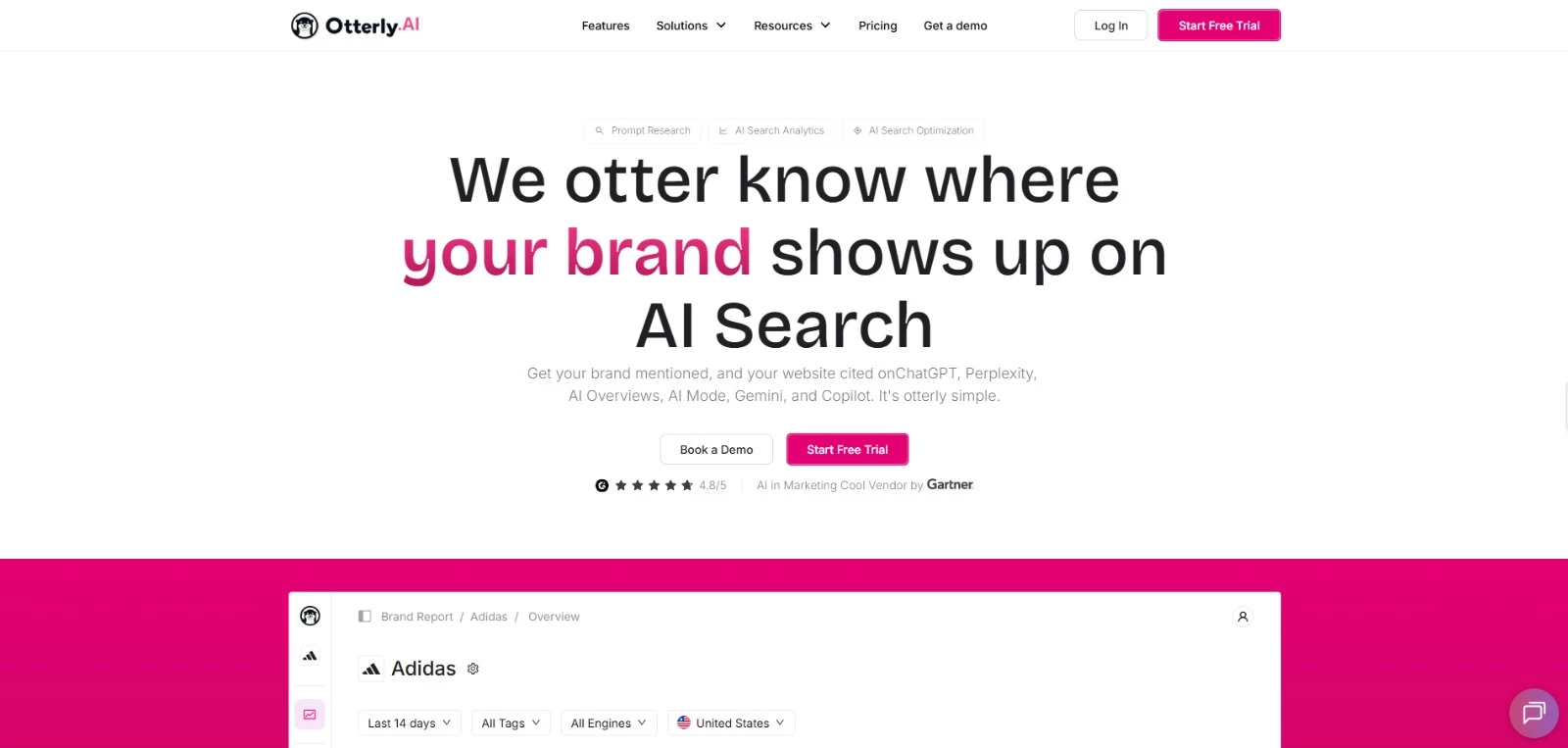
OtterlyAI tracks how brands appear across ChatGPT, Perplexity, Gemini, Copilot, AI Overviews, and AI Mode, then connects those visibility signals back to content gaps, citation opportunities, and GEO recommendations that you can act on.
What separates Otterly from many AI visibility tools is how heavily it leans into optimization and experimentation.
Alongside tracking dashboards, it includes prompt research, crawlability checks, content audits, GEO recommendations, and AI-focused content briefs designed to improve citation potential.
The platform also puts a big emphasis on prompt intent analysis and monitoring how AI engines reference brands over time, not just whether they appear.
Pricing (billed annualy)
- Lite: Starts at $25/month
- Standard: Starts at $160/month
- Premium: Starts at $422/month
Pros
- Connects AI visibility tracking with usable GEO recommendations
- Includes prompt research, content audits, and citation analysis in one platform
- Broad AI search coverage across ChatGPT, Perplexity, Gemini, Copilot, AI Overviews, and AI Mode
- Daily tracking and multi-country monitoring available
- Educational focus with GEO experiments, guides, and research content
Cons
- Some users mention a slight learning curve when setting up prompts, tracking groups, and GEO workflows for the first time
- Certain advanced AI engine coverage features, including Google AI Mode and Gemini tracking, require add-ons instead of being included in the base plans
Who’s It For
OtterlyAI fits content marketing and SEO teams looking to move beyond visibility tracking and improve how their pages perform in AI search results.
It’s also a good match for agencies and in-house teams experimenting with GEO strategies, citation optimization, and AI-focused content updates without building their own manual prompt-testing workflows.
Key Features
- AI prompt research and intent analysis
- AI visibility tracking across major AI search engines
- GEO optimization recommendations
- Content audits and crawlability analysis
- Citation and source tracking
- AI-focused content briefs
- Multi-country AI search tracking
- Daily AI search monitoring
- Public API access
How To Choose the Best LLM Monitoring Tools
The best platform depends on whether you’re trying to track, improve, or manage AI visibility.
If You Want the Most Complete SEO + AI Visibility Solution
Start with:
- Moz Pro
- SE Visible with SE Ranking
Moz Pro combines traditional SEO tools with AI visibility tracking. SE Visible offers another route when paired with SE Ranking, bringing AI brand monitoring alongside keyword research, rank tracking and site audits.
For existing SE Ranking customers, the AI Search Add-on includes access to SE Visible. If you’re comparing costs, check the combined package: SE Visible’s standalone price doesn’t include the full SEO platform.
If You Want Straightforward AI Visibility Tracking
Consider:
- Peec AI
- SE Visible
- Keyword.com
These tools focus on monitoring how your brand appears across ChatGPT, Gemini, Perplexity, AI Overviews, and related platforms, without adding excessively complex GEO workflows.
They’re a good fit if you already run SEO reporting and mainly need visibility data, citation tracking, rankings, and trend monitoring in one place.
If You're New to AEO and Want To Act on What You Find
Consider:
- HubSpot AEO
HubSpot AEO is built for teams getting started with AI visibility who don't want a steep learning curve.
It suggests prompts based on your company and industry, then pairs tracking with an execution layer, so you can create blog posts, publish social content, and run email campaigns to act on recommendations in the same place you spot the gaps.
Choose this if you want approachable tracking and the tools to improve visibility without stitching together separate platforms.
If You Want GEO Recommendations and Optimization Guidance
Look at:
- Brandi AI
- OtterlyAI
These platforms go beyond dashboards and focus more heavily on improving visibility.
You’ll get prompt research, citation opportunities, GEO recommendations, content audits, optimization suggestions, and insight into why certain pages are, or aren’t, being cited by AI engines.
Choose these if your team is actively updating content for AI search visibility.
If You Need Enterprise Reporting, Governance, or Reputation Monitoring
Best option:
- Meltwater GenAI Lens
This focuses more on reputation, sentiment, media visibility, and brand narrative monitoring inside AI-generated answers.
If You Want To Connect AI Visibility With Traditional SEO Signals
Best fit:
- Keyword.com
Keyword.com is great for SEO teams that want to understand which rankings, pages, and search signals influence AI-generated citations and references.
If You Need Large-Scale Prompt and Mention Research
Choose:
- Ahrefs Brand Radar
It’s a research database more than a lightweight monitoring tool. It’s useful for competitive research, market discovery, prompt analysis, and tracking visibility across AI answers, Reddit, YouTube, TikTok, and broader web mentions.
There's also a second question worth asking: how mature is your team's AI visibility practice, and how fast do you need to move? The tools on this list fall broadly into two tiers on that axis:
- Deep, historically grounded enterprise-intelligence platforms (Meltwater GenAI Lens and Ahrefs Brand Radar). These are built for large organizations tracking long-term trends across multiple brands, markets, and stakeholders, and they favor depth, governance, and reporting continuity over speed.
- Lighter, faster tools built for quick testing and iteration (HubSpot AEO and Peec AI). These prioritize speed to first insight and low setup cost, so smaller teams can start tracking, adjust prompts, and see results without a long ramp. The tradeoff is less historical depth and narrower scope.
Most teams sit somewhere between the two, but knowing which end you lean toward narrows the field quickly.
A three-person marketing team testing AEO for the first time and a global brand managing reputation across ten markets can want the exact same job done but need different tools to do it.
Tools for Tracking LLM Brand Visibility: Final Thoughts
AI visibility is quickly becoming an operational priority. Recent data shows that 65% of marketing organizations already have dedicated roles managing AI workflows, with more teams actively building these capabilities.
Tracking mentions is only the starting point. The real value comes from understanding why your brand appears, where it doesn’t, and how to improve your presence in AI-generated answers.
Choose a tool that fits how your team works, then use it to refine how your brand is represented in AI search.
If you need support turning these insights into action, working with the right partner can make a big difference.
Our team ranks agencies worldwide to help you find a qualified partner. Visit our Agency Directory for the top AI Companies, as well as: