
In 2026, a $50K VR budget can build a functional training app or barely cover early prototyping for a more complex platform.
The difference comes down to scope, platform, and how immersive the experience needs to be.
VR Development Cost Breakdown: Key Findings
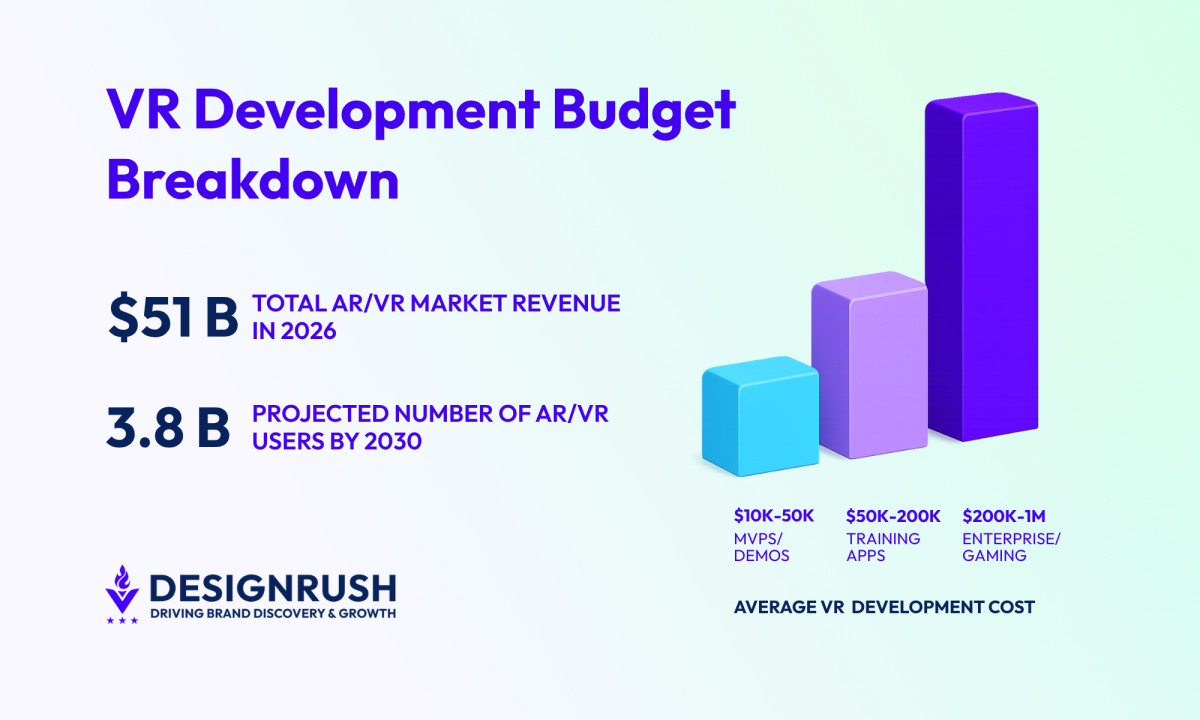
- VR development budgets typically fall into three tiers: $10K–$50K for basic MVPs, $50K–$200K for mid-level applications, and $200K–$1M+ for advanced platforms.
- Design and core development consistently account for the largest share of costs. But cutting corners here directly affects immersion and, ultimately, user adoption.
- Initial development is often just 50% to 70% of total spend. Maintenance, content updates, and marketing are ongoing investments that businesses often underestimate.
How Much Does VR Development Cost?
VR application development costs vary widely depending on the complexity, platform, and level of immersion required.
Most projects fall between $10,000 and $1 million+, with higher budgets tied to advanced features, realistic environments, and multi-platform support.
Project Type | Estimated Cost | Timeline | Best For |
Basic VR experience | $10K–$50K | 1–3 months | MVPs, demos |
Mid-Level app | $50K–$200K | 3–6 months | Training, marketing |
Advanced VR platform | $200K–$1M+ | 6–12+ months | Enterprise, gaming |
A $10K–$50K budget typically delivers a simple, single-environment experience with limited interactivity, enough for demos or early validation.
At $50K–$200K, you’re investing in a more polished product, with custom environments, stronger UX, and meaningful interactivity. This is where most business use cases land.
Once you move into the $200K+ range, costs rise quickly as you add realism, integrations, multiplayer functionality, and cross-platform support. These are full-scale VR platforms, not just applications.
Ultimately, VR app development cost scales with immersion: the more realistic, interactive, and expansive the experience, the higher the investment required.
VR Development Cost by Development Stage
With the global AR/VR market projected to reach $50.9 billion in revenue by 2026 and 3.8 billion users by 2030, demand for immersive experiences is growing fast.
So is the need to understand VR app development cost at a granular level.
VR development isn’t a single line item. It’s a multi-stage investment, where each phase adds to the total cost.
Here’s how that investment typically breaks down:
1. Planning & Research: $2,000–$10,000
This stage defines what you’re building and why. It includes market research, competitor analysis, prototyping, and UX mapping.
Beyond initial planning, this stage also often includes research and development (R&D), which can introduce less predictable costs.
Teams may spend time experimenting, testing technical feasibility, and validating how well specific interactions perform in VR environments. As a result, multiple iteration cycles are often needed before development begins, adding time and cost that aren’t always accounted for upfront.
While costs stay relatively low at this level, skipping this phase often leads to expensive rework later.
2. Design: $5,000–$50,000+
Design is one of the biggest cost drivers in VR. It includes environment creation, 3D modeling, animation, and UI/UX design.
Costs at this stage also vary depending on the type of VR content being created:
- Simpler formats like 360-degree video are faster and more affordable to produce, as they rely on real-world footage with limited interactivity.
- In contrast, CGI-based environments require custom 3D modeling, animation, and scene design, increasing both time and cost.
- Fully interactive VR experiences sit at the highest end, as they combine detailed environments with real-time interactions, physics, and user inputs.
The more realistic and immersive your experience, the more you’ll spend here, especially for custom assets.
3. Development & Coding: $20,000–$300,000+
@project.boost This is what FOUR months of VR game development looks like. #vrgames#quest3#ug#gorillatag#yeeps♬ original sound - Project Boost
This is where most of your budget goes. Actual development covers core functionality, interactivity, physics, and integrations.
Costs scale quickly depending on features like multiplayer, real-time systems, or backend infrastructure.
4. Testing & QA: $5,000–$30,000
VR testing is more complex than traditional apps. You need to ensure performance across devices while minimizing motion issues and usability problems.
This phase is critical for user comfort and retention.
5. Deployment & Launch: $1,000–$10,000
Final costs include app store submission, compliance, and distribution.
While relatively small compared to development, platform requirements (especially console VR) can increase costs here.
VR Development Cost by Platform
A $50K VR app on one platform can turn into a $150K+ project if you expand across devices. Platform choice isn’t just technical; it’s one of the biggest cost multipliers in VR development.
Here’s how different platforms impact your budget:
Platform | Cost Impact | What You’re Paying For | Complexity | Best For |
Meta Quest (Standalone VR) | Moderate | Optimization for limited hardware, standalone performance | Medium | Training, consumer apps |
PC VR (SteamVR) | High | High-end graphics, multi-device support | High | Simulations, gaming |
PlayStation VR (PSVR) | High + licensing | Certification, console optimization | High | AAA experiences |
WebVR / WebXR | Low | Browser-based deployment, limited fidelity | Low–Medium | Marketing, demos |
How Headset Type Further Impacts Cost
Beyond platform ecosystems, the type of headset you’re building for can quietly shift your costs in very different ways.
Headset Type | Cost Impact | Notes |
PC VR | Lower initial | Higher scaling cost due to hardware demands and ongoing optimization |
Standalone VR | Higher initial | Lower infrastructure cost and easier distribution at scale |
Mobile VR | Lowest | Limited immersion and feature set |
What This Means for Your Budget
- Meta Quest is often the most cost-efficient entry point. Lower hardware barriers make it ideal for scaling distribution, but performance optimization still requires time.
- PC VR drives costs up due to high-fidelity graphics and compatibility across multiple headsets. According to industry data, VR gaming continues to be a major driver of overall market growth, pushing demand for higher-end experiences.
- PSVR adds hidden costs through certification and platform restrictions, making it better suited for well-funded projects.
- WebXR is the cheapest to launch, but you’re trading immersion and performance.
VR Development Cost by Team Type
Who you hire to build your VR application can significantly impact both cost and outcomes.
From solo freelancers to full-service agencies, each option comes with trade-offs in pricing, scalability, and expertise.
Here’s how different team structures compare:
Team Type | Cost | Pros | Cons |
Freelancers | Lowest | Affordable, flexible hiring | Limited scalability, inconsistent quality |
In-House Team | High | Full control, deep product alignment | Expensive salaries, long-term overhead |
Agency | Moderate–High | Specialized expertise, faster delivery | Higher upfront investment |
Key Considerations
- Freelancers: Freelancers are the most budget-friendly option, making them ideal for small projects, prototypes, or MVPs. However, managing multiple freelancers can become complex, and scaling development for larger VR applications may be challenging.
- In-House Team: Building an internal VR team offers maximum control over the project and long-term product development. That said, hiring developers, designers, and 3D artists requires significant investment in salaries, tools, and ongoing operational costs.
- Agencies typically provide end-to-end VR development services, including strategy, design, development, and testing. While they come with higher upfront costs, they often deliver faster results and more polished outcomes due to their experience and structured workflows.
Cost to Build a VR App: Real-World Examples
To better understand VR development costs, it helps to look at how different types of applications are priced in real-world scenarios.
From enterprise training simulations to games and virtual tours, costs vary based on complexity, realism, and scale.
Enterprise Training Simulation: $100K–$500K
@ssmhealthjobs Step into the future of nursing with virtual reality training! 🌐 Our nurses are using VR technology to sharpen their skills in a safe, immersive environment. This hands-on training allows them to practice real-world scenarios, ensuring they’re ready to provide top-notch care. 💪 #nurse#rn#education#training#virtualreality#ssmhealth#jobs♬ original sound - ssmhealthjobs
Enterprise VR training is one of the most common — and expensive — use cases due to its need for realism, interactivity, and scalability.
These applications are widely used in industries like healthcare, aviation, and manufacturing.
- For example, VR training platforms used in healthcare simulations have been shown to improve procedural accuracy by 42% and reduce training time by 38%, highlighting the value of high-fidelity environments.
- Typical enterprise-grade VR simulations (e.g., surgical or flight training) range from $100,000 to $300,000+, with more advanced, multi-user systems reaching $500,000+.
Example use cases:
- Surgical training simulations
- Flight and aviation simulators
- Industrial safety training
VR Game Development: $20K–$1M+ (Indie to AAA)
@cashoutvr This is what 6 months of vr game development looks like
♬ [Raw recording] Record playback noise 01 (3 minutes) - Icy Light
VR game costs vary dramatically depending on the scope. Indie developers often build smaller experiences with limited environments and mechanics, while AAA studios invest heavily in graphics, physics, and multiplayer systems.
- Smaller VR games or prototypes can be developed within $20,000–$100,000, especially with small teams and pre-built assets.
- Large-scale VR games with advanced mechanics and high-end visuals can exceed $1 million, particularly when developed for PC or console platforms with cinematic-quality assets.
Example use cases:
- Indie VR puzzle or experience-based games
- Multiplayer VR shooters or open-world games
Real Estate VR Tours: $10K–$50K
@ac_realestatetech Step inside without stepping out 🏠 #realestate#proptech#realestatetech#vr#technology#realestateagent#realestateagent#realestatetiktok♬ Aesthetic - Tollan Kim
VR real estate tours are among the more affordable VR applications, focusing primarily on visual immersion rather than complex interactivity.
- VR product showcase applications — including real estate walkthroughs — typically cost between $15,000 and $40,000, depending on the number of environments and level of detail.
Example use cases:
- Virtual property walkthroughs
- Architectural visualization
- Real estate marketing experiences
AR vs. VR Development Cost: Key Differences
@tech.explain Virtual reality engineer explains the difference between the terms VR, AR, MR, and XR #tech#engineering#stem#science#virtualreality♬ Retro Sounds - DreamyBeats
The main distinction comes down to hardware requirements, level of immersion, and technical complexity, all of which influence how much time and budget a project demands.
Factor | AR Development | VR Development |
Hardware | Smartphones, tablets | Dedicated headsets |
Cost Range | $5,000–$300,000 | $10,000–$1M+ |
Complexity | Medium | High |
Use Cases | Retail, navigation, marketing | Training, simulation, gaming |
Key Differences Explained
- Hardware requirements: AR runs on smartphones, keeping development and testing costs lower. VR relies on dedicated headsets, adding complexity in optimization, performance, and device compatibility.
- Development complexity: AR enhances the real world, while VR builds entirely new ones. Creating immersive 3D environments with spatial interactions makes VR significantly more resource-intensive.
- Cost implications: Full immersion comes at a price. VR demands higher-quality assets, deeper optimization, and rigorous testing, which is why it typically costs more than AR.
For most projects, AR is the more cost-efficient entry point, especially for marketing and retail use cases.
However, VR delivers deeper immersion and higher impact, making the additional investment worthwhile for training, simulation, and enterprise applications where realism and engagement are critical.
Hidden Costs of Virtual Reality Development
A VR project doesn’t end at launch. In many cases, the initial build is only 50% to 70% of the total investment, with ongoing and hidden costs filling the gap.
As VR adoption grows across industries, these additional costs are becoming more significant.
@cactusinsane VR Test Last year I was testing out a program currently being developed for a good friend of mine and tested all of the current features available and how well they performed. #tiktok#vrtesting#vr#programming#alphatest♬ original sound - Capt Cactus
- Maintenance & updates: VR apps require continuous updates to stay compatible with evolving hardware and operating systems. Annual maintenance alone can add 15% to 25% of your initial build cost.
- Content creation: Immersive VR relies heavily on custom 3D environments, animation, and sound design. These assets often need ongoing updates, especially for training or simulation apps.
- Licensing: While engines like Unity and Unreal are accessible, advanced features, plugins, and SDKs introduce recurring licensing costs as your app scales.
- Hardware testing: Testing across headsets is essential. Even as hardware becomes more affordable (enterprise headsets can cost under $1,000), managing multiple devices still adds cost and complexity.
- Marketing & distribution: Without promotion, even strong VR apps struggle to gain traction. Paid ads, app store optimization, and distribution strategies can significantly increase total investment.
How To Reduce VR Development Costs
VR development can quickly become expensive, but the right strategy can significantly lower your total investment without compromising quality.
By prioritizing efficiency and focusing on what truly matters, businesses can control costs while still delivering impactful immersive experiences.
- Start with an MVP: Instead of building a full-featured VR application from the start, focus on a minimum viable product (MVP). This allows you to validate your concept, gather user feedback, and iterate before committing to a larger budget.
- Use pre-built assets: Custom 3D environments and models are costly. Assets from marketplaces can drastically reduce design time and expenses, especially in early development stages.
- Choose the right platform early: Selecting a single platform before or during ideation, such as a standalone headset or WebXR, helps avoid expensive rework and cross-platform optimization later.
- Outsource strategically: Outsourcing parts of development to experienced teams or regions with lower hourly rates can reduce costs. The key is to outsource selectively while maintaining quality control.
- Use cross-platform engines: Game engines like Unity and Unreal Engine streamline VR development with built-in tools, templates, and integrations. They enable faster development and make it easier to scale across platforms.
- Limit custom features initially: Highly customized features, complex interactions, and advanced integrations can quickly inflate costs. Start with core functionality and expand over time based on user needs and business goals.
VR Development Pricing: Final Thoughts
Virtual reality app development costs in 2026 are shaped by many different decisions. Platform, scope, team structure, and long-term strategy all determine whether you’re building a $20K prototype or a $1M+ immersive platform.
The most successful VR projects start focused, scale strategically, and treat development as an ongoing evolution, not a one-time build.

Our team ranks agencies worldwide to help you find a qualified partner. Visit our Agency Directory for the top AR/VR companies, as well as:
- Top AI Consulting Companies
- Top Custom Software Development Companies
- Top Mobile App Development Companies
- Top IT Services Companies
- Top California Virtual Reality Companies
Our design experts also recognize the most innovative design projects across the globe. Visit our Awards section to see the best in VR website design.
Virtual Reality Development Cost FAQs
1. What is the average VR app development timeline?
VR app development typically takes 1 to 12+ months, depending on scope and complexity.
MVPs can launch in 1 to 3 months, while enterprise-grade platforms with custom environments, integrations, and testing phases often require 6 to 12+ months.
2 Why is VR development more expensive than traditional apps?
VR development is more expensive because it involves building fully immersive 3D environments, spatial interactions, and real-time rendering systems. It also requires device-specific optimization and extensive testing, increasing both development time and costs.
3. Can a small business afford VR development?
Yes, small businesses can enter VR by starting with a $10K to $50K MVP, focusing on a single use case or platform. This approach minimizes risk while allowing validation before scaling features or expanding investment.
4. How can I reduce VR development costs without sacrificing quality?
Start with a focused MVP, use pre-built 3D assets, prioritize one platform, and avoid overbuilding features until user feedback and product-market fit justify further investment.
5. Should I hire freelancers or an agency for VR development?
Freelancers are cost-effective for smaller or experimental projects but may lack scalability.
Agencies provide structured workflows, broader expertise, and faster delivery, making them better suited for complex or business-critical VR applications.