
Startup funding stages were built for a world where seed rounds were a few million dollars, and companies spent years moving from Series A to C.
AI has broken these categories. Seed rounds can now reach billions, and companies like Anthropic jumped from a $3.5B raise to a $13B Series F within the same year.
Startup Funding Rounds: Key Findings
- Fundraising stages no longer tell the whole story. A seed round can range from a few million dollars to $6.2B, so evaluate the company behind the label.
- Investors care more about growth momentum than absolute revenue. Fast-growing startups can often raise more easily than larger but slower-growing peers.
- Show how today's product can become tomorrow's category leader. Investors back startups that can grow from a niche solution into a category leader.
How AI Megadeals Broke Venture Capital's Shared Language
1. Largest Startup Funding Rounds of All Time
2. Largest IPOs of All Time
3. Leading Venture Capital Firms
4. Startup Failure Rates & Stats
Startup funding stages are the checkpoints a company hits on its way from early idea to public markets.
For most of the last decade, founders and investors spoke this same language. A seed round was a few million dollars to prove a team could build.
A Series A meant you had found product-market fit and were ready to scale it. A Series B meant the growth was repeatable.
The labels were shorthand for how far along a company was, and everyone roughly agreed on what each one required.
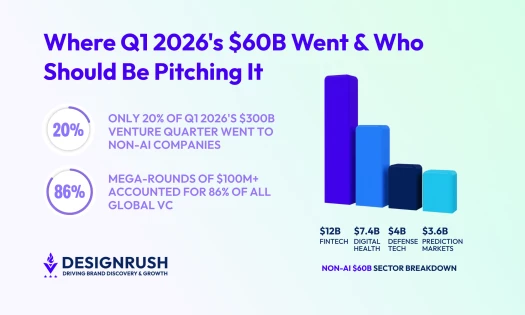
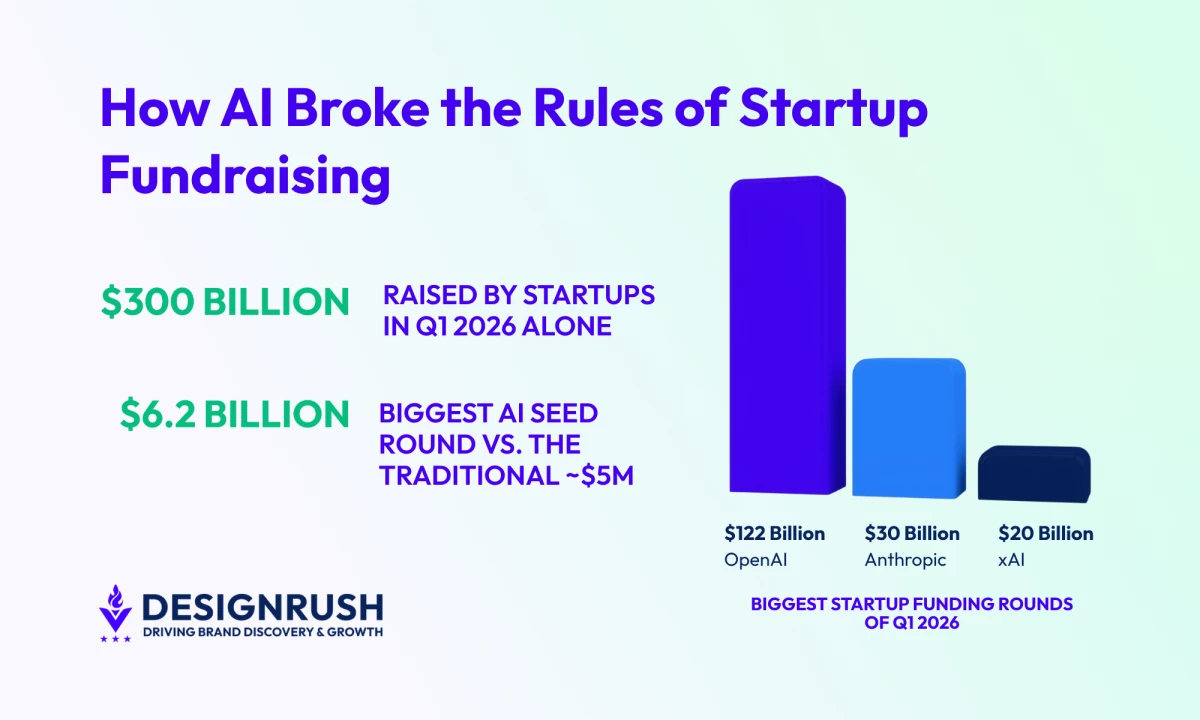
Now, with startups raising about $305 billion globally in Q1 2026 alone, the stage labels stopped meaning anything consistent.
- Seed now describes both a $2 million round for a first-time founder and Project Prometheus's $6.2 billion seed at launch, one of the largest seed-stage raises in technology history, with no shipped product.
- Series F describes both a $50 million round for a conventional software company and Anthropic's $13 billion raise.
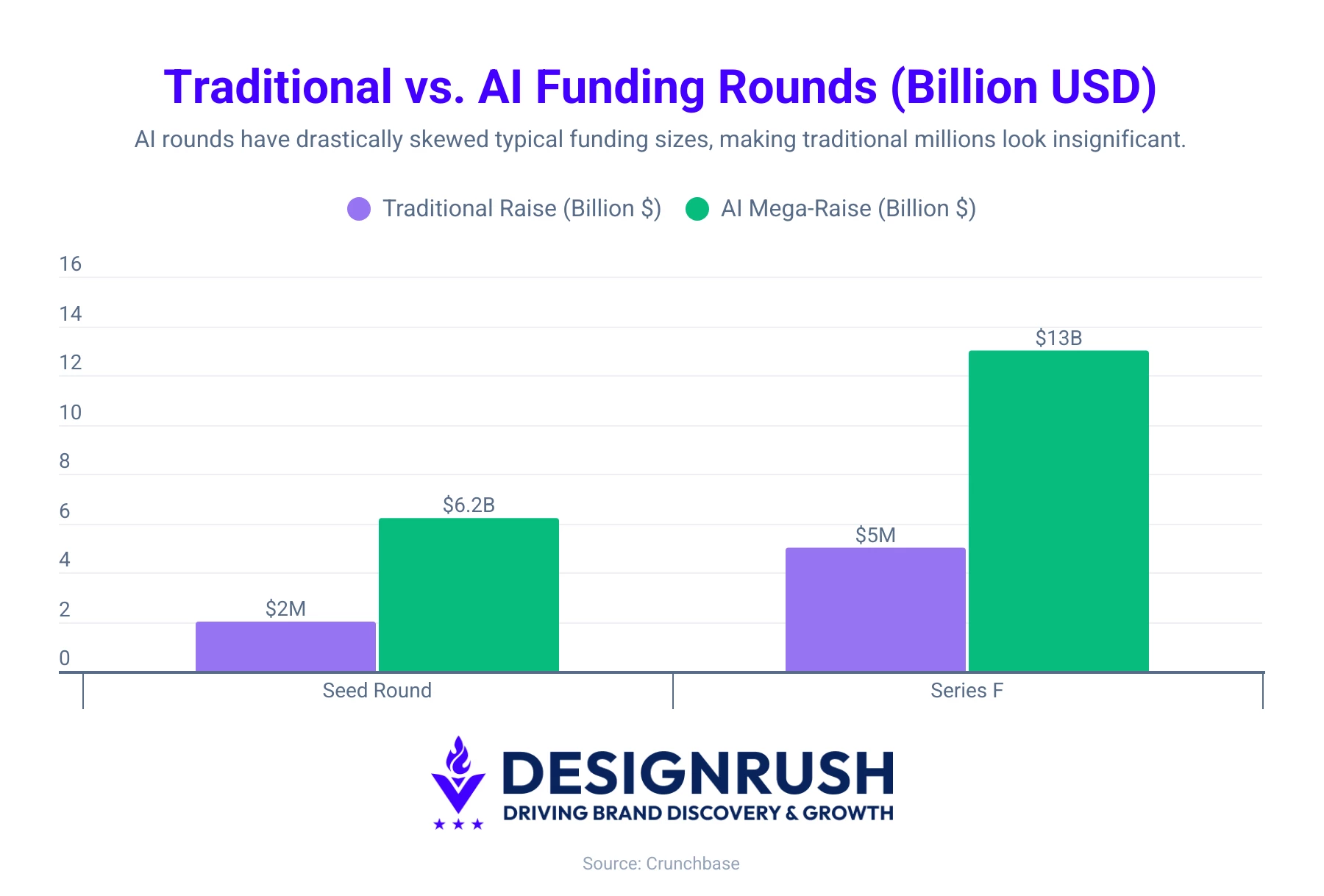 The reason is that frontier AI’s capital requirement is now so large, and investors believe the cost of missing the category leader is higher than the risk of overpaying.


The 3 Types of AI Startups and Why They Fund Differently
These three categories are often grouped under 'AI,' but their capital structures are entirely different:
1. Frontier Model Labs: Raising Billions to Train Foundation Models
Frontier labs develop the foundation models that power modern AI systems.
Training state-of-the-art models requires enormous amounts of capital for GPUs, data, talent, and research, which is why these companies are responsible for many of the largest funding rounds in venture capital history.
Examples include OpenAI, Anthropic, and Thinking Machines Lab.
Typical funding profile:
- Multi-billion-dollar rounds
- Strategic investors and hyperscalers
- Capital funds compute and model training instead of traditional sales expansion
- Valuations are heavily influenced by long-term platform potential
2. AI Infrastructure Companies: Building the Layer the Frontier Runs On
Infrastructure companies build the tools, systems, and services that enable AI development.
This includes data-labeling platforms, AI development tools, model orchestration software, inference platforms, cloud infrastructure, and semiconductor providers.
Typical funding profile:
- Large but generally smaller rounds than frontier labs
- Investors focus on platform adoption and ecosystem positioning
- Revenue is often easier to measure than in research-focused labs
- Growth is tied to overall AI industry expansion
3. Applied AI Companies: Building Products on Top of Models
Applied AI startups use existing foundation models to solve specific business or consumer problems. This is where the majority of AI startups operate today.
These companies focus on workflows, UX, proprietary data, and industry-specific applications.
Typical funding profile:
- Traditional seed, Series A, and growth-stage fundraising patterns
- Capital is usually spent on product development, customer acquisition, and scaling operations
- Investors evaluate customer traction, retention, and revenue similarly to SaaS businesses
- Competition is often intense because the underlying models are widely available
AI vs. Traditional Funding Stages at a Glance
A quick reference for the rest of the article. Traditional figures reflect the pre-2023 norm, while the AI-era figures reflect 2025-2026 rounds:
Stage | Traditional size | AI-era size (2025-26) | Who writes the check | Cohort Example |
$500K-$5M | $100M-$2B (frontier); $2M-$15M (applied AI) | Angels, accelerators, top seed funds; a16z et al. at frontier | Project Prometheus | |
$10M-$30M | $50M-$150M (frontier); $30M-$50M (applied AI) | Tier-1 venture firms | Altos Labs | |
$30M-$300M | $500M-$6B | Tier-1 VCs and crossover funds | Ant Financial | |
$100M-$1B | $1B-$30B | Crossover funds, sovereign wealth, hyperscalers | Anthropic | |
$200M-$1B | $10B-$122B | Hyperscalers (as compute) plus sovereign wealth funds | OpenAI | |
$100M-$5B raised | ~$85.7B (SpaceX, 2026) | Public markets | SpaceX |
Although the stage labels remain the same, what they signal about company maturity, investor expectations, and round dynamics has changed across every level.
Stage 1: Pre-Seed & Seed - Funding Potential Before Proof
- Typical size: $500K-$5M traditionally, now $100M-$2B in AI funding
- What investors look for: A strong founding team and a credible technical thesis, often before revenue
Traditionally, seed money, usually $500,000 to $5 million, bought a team enough runway to build something and put it in front of customers. You were funding the search for product-market fit.
For frontier labs, seed has become bets on a small group of people whom investors believe can build a category-defining model, priced before there is anything to measure.
For applied AI, where companies build products on top of existing models, seed looks closer to normal.
Largest Funding Rounds for Pre-Seed & Seed
Company | Amount | Date | Sector |
Project Prometheus | $6.2B | Nov 2025 | AI Infrastructure |
Thinking Machines Lab | $2B | Jul 2025 | AI/Frontier |
Safe Superintelligence | $2B | 2025 | AI/Frontier |
Advanced Machine Intelligence (Yann LeCun) | ~$1B | 2026 | AI/Frontier |
Yuga Labs | $450M | 2022 | Crypto/NFT |
Project Prometheus: How Bezos Raised $6.2B Before Building a Single Product
Bezos's lab raised billions four months after launch despite having no working product, with investors backing the founding team rather than any technology.
Co-founded with Vik Bajaj, a Google X veteran who helped start Waymo and Verily, Prometheus is training models on real-world physics, robotics, and engineering data for aerospace, manufacturing, and drug discovery.
The investor logic hinges on data scarcity. Unlike LLMs trained on abundant text, physical AI requires real-world experimental data that is expensive and slow to accumulate, a structural moat that justified the check before any product existed.
Stage 2: Series A - Funding Compute Before Customers
- Typical size: $10M-$30M traditionally, now $50M-$150M in AI funding
- What investors look for: Early product-market fit and signs of repeatable growth
The traditional Series A, $10 million to $30 million, was the first institutional check, and it should show early product-market fit and signs that growth repeats.
In the AI era, the timing has inverted. Frontier and infrastructure companies now raise $50 million to $150 million at Series A to fund compute and talent before meaningful customer traction exists, because at that scale, you cannot wait for traction to fund the infrastructure that produces it.
Largest Funding Rounds for Series A
Company | Amount | Year | Sector |
Altos Labs | $3.0B | 2021 | Longevity biotech |
Articulate | $1.5B | 2021 | E-learning software |
Xaira Therapeutics | $1.0B | 2024 | Applied AI/Drug discovery |
Pacific Fusion | $900M | 2024 | Fusion energy |
Perch | $775M | 2021 | E-commerce |
How Altos Labs Raised $3B to Reverse Aging Without a Single Clinical Trial
Altos Labs, a longevity-biology company, launched in 2022 with $3 billion in initial funding, making it the most heavily funded biotech startup in history.
Shinya Yamanaka, the 2012 Nobel laureate whose discovery of cellular reprogramming made the field possible, chairs the advisory board. Bezos and Yuri Milner anchored the funding.
There was no clinical data, no approved therapy, and no revenue. Investors were paying for the team and the thesis, the same logic that frontier AI rounds use today.
This mega-Series A predates the AI boom, and the largest ones still aren't AI. That’s because AI Series A megarounds are increasingly rare, as frontier labs now jump from giant seeds straight to Series B+.
Stage 3: Series B-C - Pricing Category Leadership
- Typical size: $30M-$300M traditionally, now $500M-$6B in AI funding
- What investors look for: Proven growth and signals of market leadership
Traditional Series B and C rounds, $30 million to a few hundred million, rewarded proven, repeatable growth and early signs of market leadership.
In AI funding, valuations at this stage are set by a different calculation. Investors are not multiplying current revenue; they are estimating the total size of a category and pricing the company as if it already owns it.
That is why a company with no profit can command a multibillion-dollar valuation. Waymo's $5.6 billion Series C in 2024 valued it at $45 billion, and the company has since raised again at far higher numbers.
Largest Funding Rounds for Series B-C
Company | Amount | Stage | Year | Sector |
Ant Financial | $14B | Series C | 2018 | Fintech |
xAI | $6B | Series C | 2024 | AI/Frontier LLM |
Waymo | $5.6B | Series C | 2024 | Autonomous vehicles |
Ant Financial | $4.5B | Series B | 2016 | Fintech |
How Ant Financial's $14B Series C Wrote the Category Rules, Then Lost Everything
At the time, it was the biggest single private fundraising ever recorded, per Crunchbase. It valued Alibaba's payments arm at $150 billion, with GIC, Temasek, and Warburg Pincus joining ahead of a planned IPO.
The bet was that Alipay had become the payment infrastructure for 1.4 billion people and was about to go global. The logic held until Jack Ma publicly criticized Chinese financial regulators in October 2020.
Two days before what would have been the world's largest IPO, it was cancelled. By early 2026, Ant's valuation had fallen to roughly $78-100 billion, more than 70% below its peak.
Ant Financial proved investors would pay for category dominance six years before AI did. It also proved that the math runs in reverse when the exit assumption breaks.
Stage 4: Series D-F+ - Betting on the Category Winner
- Typical size: $500M-$13B+
- What investors look for: Revenue scale and a visible path to IPO or acquisition
Late-stage rounds used to be about scale and a visible path to exit. In frontier AI, this is where the numbers stop resembling venture capital as anyone knew it.
Anthropic raised a $3.5 billion Series E in March 2025 at a $61.5 billion valuation, then a $13 billion Series F funding just seven months later in October at $183 billion. In May 2026, it had raised again, roughly $65 billion at Series H.
Largest Funding Rounds for Series D-F+
Company | Amount | Stage | Date | Valuation |
Anthropic | $65B | Series H | May 2026 | $965B |
Anthropic | $30B | Series G | Feb 2026 | $380B |
xAI | ~$20B | Series E | Jan 2026 | $230B |
Waymo | $16B | Series D | Feb 2026 | $126B |
Anthropic | $13B | Series F | Oct 2025 | $183B |
How Anthropic Raised $65B in 105 Days to Overtake OpenAI
This is the single largest equity round ever attributed to a private company, at a $965 billion valuation, and marked what’s expected to be its final private fundraise before an IPO.
Days later, on June 1, 2026, the company confirmed it, filing a confidential S-1 with the SEC, ahead of rival OpenAI.
In eight months, Anthropic's valuation went from $183 billion to $965 billion, a 5.3x increase unprecedented for a startup at this scale.
The round puts Anthropic's valuation above OpenAI's, making it the most valuable AI company in Silicon Valley.
Stage 5: Growth & Strategic Rounds - When Capital and Distribution Merge
- Typical size: $1B-$110B+
- What investors look for: Strategic alignment between capital, cloud infrastructure, and distribution
When Microsoft "invested" in OpenAI, or Amazon in Anthropic, a large share of that money never moved as cash. It moved as cloud credits, wherein compute the startup can only spend on the investor's own infrastructure.
Microsoft's multi-year commitment to OpenAI, structured heavily as Azure capacity rather than a wire transfer, is what made OpenAI's $40 billion round in 2025 and its $122 billion round in 2026 possible at that scale.
Amazon and Google have done the same with Anthropic through AWS and Google Cloud.
Largest Funding Rounds for Growth & Strategic Rounds
Company | Amount | Date | Sector |
OpenAI | $122B | Mar 2026 | AI/Frontier |
OpenAI | $40B | Mar 2025 | AI/Frontier |
Reliance Jio Platforms | ~$20B (aggregate) | 2020 | Telecom |
Meta to Scale AI | $14.3B | 2025 | AI (49% stake)/Infrastructure |
Microsoft to OpenAI | ~$13B | through 2025 | AI/Compute |
Why OpenAI's $122B Round Is More Infrastructure Deal Than Venture Round
OpenAI’s $122B is the largest private funding round in history, at an $852 billion valuation.
Amazon committed $50 billion, Nvidia $30 billion, and SoftBank $30 billion, with the remaining $12 billion from a broader pool, including $3 billion from individual investors through bank channels.
However, much of the $122 billion headline is committed leverage and conditional promise. Amazon invests $50 billion in OpenAI, and OpenAI commits to spend on AWS. Google does the same as Anthropic.
At this scale, the investor and infrastructure provider have become the same entity.
Stage 6: IPO - AI’s Next Mega-Capital Event
- Typical size: $1B-$85.7B (SpaceX, 2026 – the current record)
- What investors look for: Public-market readiness and long-term liquidity
The traditional IPO turned private value into public, liquid value and tested whether a company survives public-market scrutiny. AI asks that question on a scale no one has seen.
SpaceX, which absorbed xAI in an all-stock merger in February 2026, went public on June 12, 2026, trading on the Nasdaq under the ticker SPCX. It was priced at $135 per share, raising roughly $85.7 billion, making it the largest IPO in history.
Shares opened at $150 and closed at $161.11, up about 19%, lifting SpaceX's market value past $2 trillion and briefly making Elon Musk the world's first trillionaire.
The entire structure we’ve described above, including the mega-seeds and category pricing, rests on the assumption that these companies will eventually reach public markets at valuations that justify the private ones.
By late July, SPCX had fallen roughly 50% to near $105, below its own $135 offer price. Then, on August 6, its first lockup released 911.5 million insider shares. The stock rose, closing August 7 at $133.11, then slipped back below it when a second tranche of 319 million insider shares unlocked on August 20.
It's the the second of seven releases that will free roughly 88% of the company's 13 billion shares through 2027.
Public markets absorbed the largest IPO in history, repriced it roughly 50% within seven weeks, and bid it back up when revenue grew. Growth is still being funded, but it's being audited quarterly now.
OpenAI, which filed its confidential S-1 on June 8 (a week after Anthropic), has pushed its own listing toward 2027, leaving Anthropic likely to be the first frontier lab to test the same gauntlet.
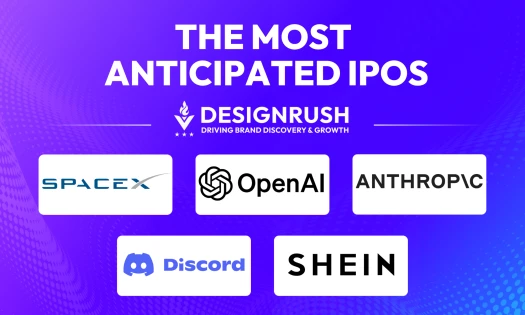
The next test is imminent and larger. Anthropic is preparing to file publicly for an IPO and investors expect it to match or beat SpaceX's record $86.2 billion raise.
Largest IPOs of All Time
Company | Raise | Year | Sector |
SpaceX (incl. xAI) | $85.7B | 2026 | Space/AI |
SK Hynix | $26.5B | 2026 | Semiconductors/AI memory |
Saudi Aramco | $25.6B | 2019 | Oil |
Alibaba | $21.8B | 2014 | E-commerce |
SoftBank Corp | $21.3B | 2018 | Telecom |
Note: SK Hynix has traded in Seoul since 1996, but its Nasdaq debut was a capital-raising public offering comparable to an IPO.
4 Things Investors Are Scrutinizing in the AI Era
AI has made it surprisingly easy to generate the appearance of traction, which means investors have become much more skeptical of surface-level metrics.
As a result, investors have shifted away from pattern-matching and toward judgment. Four questions tend to matter most.
- Growth rate matters more than current revenue
- Where your revenue comes from matters as much as how much
- Today's product needs a credible path to tomorrow's category leader
- Customer stickiness is now the strongest signal of real product-market fit
1. Growth Rate Matters More Than Current Revenue
Absolute revenue matters less than it did a few years ago. What investors care about now is whether a company is accelerating toward product-market fit or beginning to slow down.
A startup generating $1 million in ARR while growing 30% month over month may be viewed more favorably than a company with $10 million in ARR growing only 10% per quarter.
This is because investors are trying to determine where a company sits on its growth curve and whether the next 12 to 24 months could produce a step-change in scale.
This is especially true in the AI era, where category leaders can emerge quickly.
2. Where Your Revenue Comes From Matters as Much as How Much
Revenue quality has become as important as revenue quantity.
Many AI startups report impressive top-line growth, but investors now spend far more time understanding where that revenue comes from.
A company generating $500,000 in recurring revenue with strong retention and healthy margins can often raise capital more easily than a company generating $5 million from pilots, consulting work, or one-time deployments.
3. Today's Product Needs a Credible Path to Tomorrow's Category Leader
Investors rarely fund startups solely because of today's product. They invest because they believe today's product can become a much larger company.
The challenge is balancing ambition with credibility.
Investors want to see a believable path from today's wedge to tomorrow's market leader. The stronger and more logical the expansion path is, the more attractive the opportunity becomes.
4. Customer Stickiness Is Now the Strongest Signal of Real Product-Market Fit
The question investors now ask most often is whether a product can hold its users.
The market has produced countless examples of AI products that experienced explosive growth only to decline just as quickly once competitors emerged or user interest faded.
During diligence, they often speak directly with customers to understand how deeply the product is embedded in daily operations.
AI Startup Investment Stages: What’s Next?
Every valuation in this guide rests on one assumption: that frontier AI companies will reach public markets at prices that justify what investors paid in private.
That assumption met its first test in late June 2026, and that turned bearish fast: within six weeks of the largest IPO in history, SpaceX traded below its offer price, a reminder that clearing the public-market bar and holding the valuation are different things.
OpenAI and Anthropic's expected listings are the next tests, at a scale no market has absorbed before.
For everyone else, the fundamentals of a good raise haven't changed. The noise around them just got a lot louder.

Our team ranks agencies worldwide to help you find a qualified partner. Visit our Agency Directory for the Top Business Consulting Firms as well as:
- Top Startup Consulting Firms
- Top Business Operations Consulting Firms
- Top Small Business Consulting Firms
- Top Consulting Firms in Columbus
Our design experts also recognize the most innovative design projects across the globe. Visit our Awards section for the best & latest.
AI Startup Funding Stages FAQs
1. What are startup funding stages?
The checkpoints a company moves through on its way from early idea to IPO.
Pre-seed, Seed, Series A, B, C, and later-stage rounds: each reflects how much has been proven, how much risk remains, and what investors think the company is worth.
In most cases, earlier stages mean more uncertainty and lower valuations; by Series C and beyond, investors expect real revenue and a visible path to scale. In AI funding, those assumptions have been stretched considerably.
2. Why are AI funding rounds so much larger than traditional rounds?
Two reasons. Training frontier models requires compute at a scale where traditional revenue-based math does not apply, so investors price the size of the category rather than current revenue.
3. What is a strategic investment, and how is it different from a regular VC investment?
A strategic round bundles capital with infrastructure and distribution, most often cloud compute.
When Microsoft or Amazon "invests" in a frontier lab, much of it arrives as credits the startup can only spend on that company's cloud, not as cash.
It functions more like a long-term infrastructure partnership than a conventional equity check, which is why the headline dollar figures can be misleading.
4. What is a "megaround"?
A megaround is a single venture funding event above $100 million. Once rare, megarounds now account for the majority of AI venture dollars, even though they represent a small share of total deal count.
5. Why did Anthropic raise multiple rounds in the same year?
Frontier labs raise as fast as they can deploy capital into compute and talent, and demand for both is effectively unlimited at this stage.
Anthropic raised a $3.5 billion Series E in March 2025, a $13 billion Series F that October, a $30 billion Series G in February 2026, and a $65 billion Series H in May 2026 at a $965 billion valuation – its expected final private raise before an IPO.
The pace reflects how quickly training costs and competitive pressure consume funding.
6. What do funding stage labels actually mean now?
Less than they used to. "Seed" can mean a $2 million first check or a $2 billion frontier raise; "Series F" can mean $50 million or $13 billion.
The label no longer reliably signals a company's maturity, what it has proven, or what investors expect. You have to look at the actual size, investors, and metrics behind the label.