
As a business owner, to ensure you’re getting your money’s worth when outsourcing a service, research is crucial before opting for a vendor. This is where a well-written request for proposal (RFP) comes in, as it will highlight all your requirements and preferences, helping you filter those who don’t meet your standards.
So, what is an RFP and when to use it? In this guide, we will explain its meaning and definition, what an RFP document should entail, and how to write an RFP for a successful procurement process. We will also discuss different types of RFPs for projects in various niches — from software development to eCommerce. Let’s dive in!
What Is an RFP and When To Use it?
In simple terms, an RFP is a formal document outlining a company’s intent and effort to secure a service or product. An organization buying a service or a product issues the RFP document, containing the project’s details, to request vendor bids for a product, solution, or service and invites them to send their proposal that will meet the organization’s needs.

RFP Use Cases
RFPs are typically used when your organization needs to procure goods or services from external vendors or service providers. Here are some common scenarios when using an RFP is appropriate:
- Complex projects or services
- Lack of internal expertise
- Competitive bidding process
- Customized solutions
- Regulatory requirements
- Large-scale purchases
- Risk mitigation
Businesses create and use RFPs when they:
- Want to purchase services that will improve their business processes and bottom-line
- Want to outsource business processes (learn more about BPOs)
- Are aware of very specific business issues that they want to solve with a new and improved solution
- Don’t have the internal capacities to tackle some projects, such as creating an eCommerce platform or rebranding their business
What to Include in an RFP?
An RFP document is not a one-size-fits-all solution. It needs to be tailored to each business’s specific needs and according to the type of service or solution the company requires. However, you can start drafting your RFP document by following a template for the initial structure which you can alter.
A standard RFP document should include this essential info about your company:
- Project name or description
- Company name
- Address
- City, state, zip Code
- Procurement contact person (PCP)
- Telephone number of PCP
- Email address of PCP
The RFP’s body should also contain additional details about your project, such as:
- Your company’s background
- Project goals and overall scope
- Your overall budget
- Proposed selection schedule
- Time and method for submission of proposals
- Project timeline
- Elements of proposal
- Evaluation criteria
- Possible roadblocks
For example, if you're writing an RFP for business consultants, the key things you must outline are your project requirements, objectives, and timeline.
RFP Process: How To Write an RFP in 7 Steps
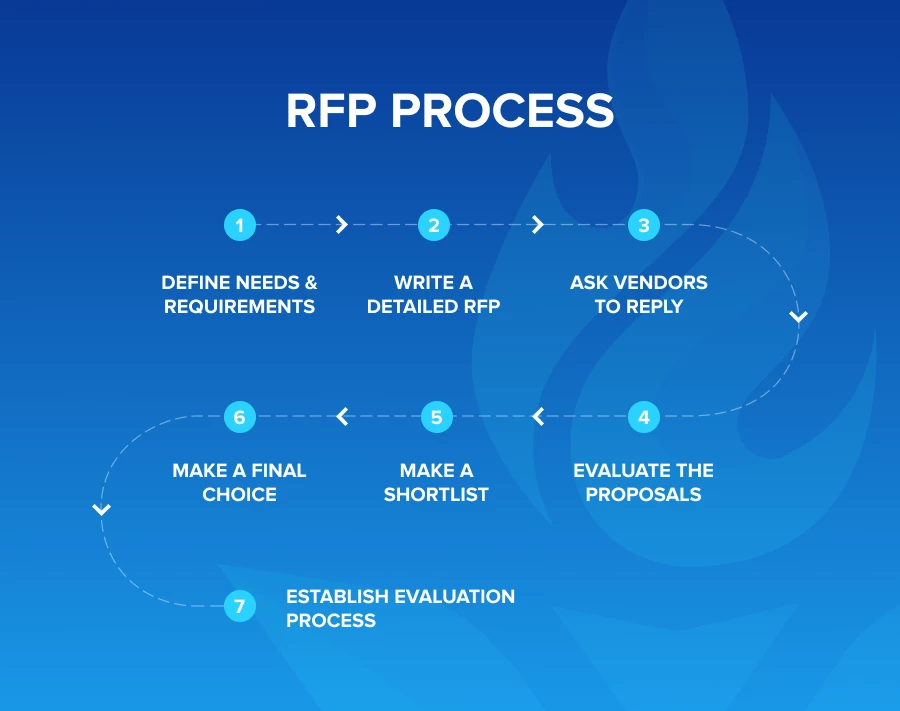
Once you understand what elements constitute an average request for a proposal document, it’s time to start drafting it.
But before – and after – you do that, there are certain steps you should take to successfully prepare for drafting an RFP and to see the procurement process through to the end.
- Define Your Needs and Requirements
- Write a Comprehensive RFP
- Ask Vendors to Reply
- Assess the Proposals
- Make a Shortlist
- Make a Final Selection
- Establish a Vendor Evaluation Process
1. Define Your Needs and Requirements
Your company’s procurement manager and team in charge of drafting the request for proposal should decide on and articulate the type of service/solution you are looking for. Teams and staff impacted by the procurement — stakeholders, IT department, finance department, end–users, etc. — should also be involved in defining the requirements.
This team will come up with RFP questions, prioritize the selection criteria, and establish the entire scope. The result of this step is defining the RFP, the issue(s) the company needs to solve, or the goal it wishes to achieve.
2. Write a Comprehensive RFP
When writing your RFP, include questions to vendors that reflect your company’s specific needs. You can adapt these questions to any future procurement. Asking the right questions in your RFP ensures that you’ll have the information you need to make a confident decision.
Some of the questions to your vendors include:
- Who are your competitors?
- What is your service/product implementation process like?
- What kind of training do you provide?
- Do you have any references and relevant case studies?
- How will you protect our organization from risk?
- How will your customer success team help us meet our goals?
3. Ask Vendors To Reply
After writing the RFP, you need to gather vendor proposals. Create a list of vendors, send your RFP to them, and ask them for direct responses or use a bid service to post your RFP publicly. The latter option will get you more responses but may also bring in some responses that are irrelevant to your procurement.
4. Assess the Proposals
After gathering vendor proposals, you need to evaluate their answers with a scoring approach that will help align your decision factors. Establish point values for individual questions in the RFPs based on their importance for your business to objectively establish which vendor is the best fit for your company.
5. Make a Shortlist
Following the evaluation of the arrived proposals, create a shortlist of the five best vendors (the vendors that are most likely to provide the solution fit for your needs). These vendors will move on to the final stage of your procurement process where you will ask them additional questions related to your business and their offerings.
6. Make a Final Selection
After coming up with your final choice, inform all the vendors you’ve shortlisted, regardless of whether you’ve chosen them or not. To those that didn’t make the cut, provide feedback on why they weren’t chosen – they may still be a viable option for your company in the future and you should try and be on good terms with them.
7. Establish a Vendor Evaluation Process
To ensure that the chosen vendor delivers a return on investment, determine your vendor evaluation process. For example, you can use a supplier scorecard to make sure vendors meet your requirements. Also, it is important to communicate to the vendor the areas they’re lacking in so they can correct them and meet your expectations.
RFP Benefits
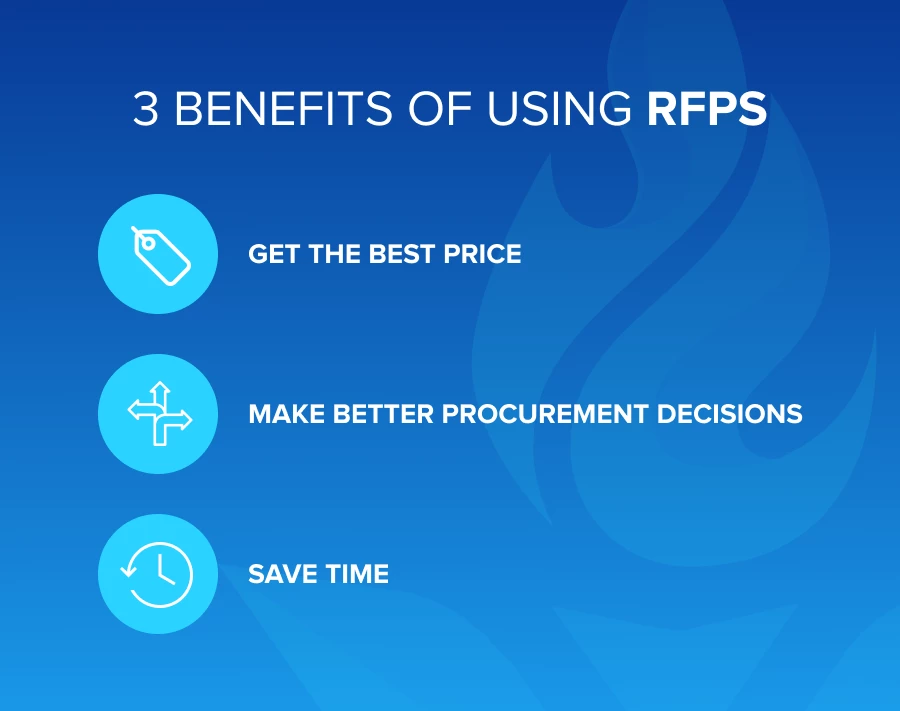
Issuing an RFP helps businesses find the best vendor for their needs and minimizes the risk of poor ROI.
A well-written request for proposal helps companies:
- Get the best pricing: More competing vendors in the responses increase the likelihood of businesses issuing RFPs getting the best pricing. RFPs allow issuers to compare pricing and value metrics to make sure they work with the right vendor.
- Make better-informed buying decisions: By allowing your company to compare many different bids, RFPs help you to decide on the option that gives the most value to you, is the most sustainable and most comprehensive.
- Save time by easily comparing vendors: RFPs’ strict formatting guidelines save the time your procurement team would lose researching bidding companies. These guidelines ensure your team finds and compares data from each response timely. In particular, RFPs can be invaluable when sourcing IT service providers. They ensure alignment with both technical requirements and budget constraints.
To make things more streamlined, many business organizations use software solutions to streamline the RFP process since these documents involve a lot of moving parts and can be quite time-consuming to make.
Using software for generating RFPs such as Provalido, RFP360, Loopio and others help you:
- Create RFPs faster: Especially helpful for companies that issue RFPs regularly and in great amounts. Since a lot of RFPs include the same or similar information and ask a lot of the same questions, RFP software can help by storing and organizing RFP templates and questions that you can reuse quickly.
- Gather and keep track of vendor proposals in one place: RFP software tools provide greater visibility into vendors’ responses, saving you time by avoiding follow-ups and reminder emails.
- Evaluate proposals side by side: Most RFP software systems make it easy to rank RFP responses, helping you find the right vendor more easily.
Types of RFPs
There are as many types of RFPs as there are industries, but here are the most common ones with at-a-glance descriptions, as well as resources with in-depth clarifications:
- Software Development RFP
- Mobile App Development RFP
- Digital Marketing RFP
- Web Development and Design RFP
- SEO RFP
- Branding RFP
- PPC RFP
- IT Services RFP
- eCommerce RFP
Software Development RFP
RFP for software development is the initial document that you can use when looking to select a software development partner, specifically.
Like all other types of requests for proposal, an RFP for software development needs to outline specifics about the project, your business, deliverable dates and so on. The end goal is to procure a software development vendor that is capable of providing a reliable product tailored to your goals and needs.
That said, a software development RFP example would include:
- Your company description
- Project scope and deliverables
- Project infrastructure
- Product requirements
- List of experts in your company that will add value to the process
As expected, there’s a lot more to software development RFPs.
Mobile App Development RFP
Like software development RFPs, a mobile app development RFP is a procurement document companies draft and send to vendors when they need a mobile app developed.
The mobile app development RFP essentials are:
- Your company information and executive summary
- Project scope requirements/project description
- Stakeholders and target audience
- Overall requirements
- Use cases
- Services
- Budget
- Project timeline
Here’s where you can learn much more about mobile development RPFs.
Digital Marketing RFP
If you’re looking to hire a digital marketing company to devise campaigns for social media, email, PPC, and other platforms, you need to create an RFP for digital marketing services.
Digital marketing RFP documents should generally include:
- Your company and brand background
- Digital marketing project overview with goals
- Current digital marketing performance benchmarks
- Suggested platforms and channels
- Your budget
- Campaign expectations and goals
While these are the basics, here’s our in-depth guide for digital marketing RFPs.
Web Development and Design RFP
Similarly, an RFP document for website design and development includes vital procurement information such as presenting the scope and details of your website projects, your objectives and goals, as well as asking vendors essential questions based on which you will make your final decision.
The absolute essentials of RFP for website design and web development RFP are as follows:
- Company overview
- Project overview
- New website functionality requirements
- Your website budget
- Proposal requirements
Learn about all the particulars of web development and design RFPs.
SEO RFP
When looking to procure a third-party vendor to perform search engine optimization for your website, you need a specialized SEO RFP that includes these salient points:
- Your company info and business forecast
- Information about your market, vertical, and competitors
- Current state of your online rankings and SEO
- The budget for SEO
- SEO project goals and specific KPIs
To learn more about creating the ultimate SEO RFP, consider taking a look at one of our corresponding guides.
Branding RFP
The most future-proof way to go about branding or rebranding is to draft your own RFP for branding agencies that will present an optimal branding strategy, as well as outline specific deliverables, deadlines, expectations and budget.
The RFP for branding services should contain these bare essentials:
- Company info
- Company’s background, marketplace and competitors
- Perceived company’s mission, vision and value proposition
- Your current branding challenges and problems
- Target audience
- Branding and rebranding budget
Read our branding RFP guide to learn more.
PPC RFP
PPC advertising is best left to professional agencies. When looking to hire one, writing a paid media RFP is the number one step.
This document should entail:
- An overview of your company
- Digital marketing objectives
- Scope of the PPC project
- Timeline and budget
- RFP response requirements
As with the rest, we have a dedicated, full-fledged media buying RFP guide.
IT Services RFP
Finding a new IT services provider can be a difficult and intimidating process. Requests for proposals are a safe and streamlined way to help organizations procure the right third-party vendor that can deliver professional services and value in this field.
IT is, of course, a very broad industry, so the strategic sourcing process relies on evaluating your exact requirements, IT solution’s usability, technical capabilities, and customer resources.
With that said, a typical RFP for IT services consists of:
- Your company information
- Line of work and the industry you operate in
- Specific IT services requirements
- Budget
Learn more about IT RFP essentials and take advantage of our free template.
eCommerce RFP
In case your business needs a solid eCommerce platform, as well as the auxiliary services that go with it (e.g. SEO for eCommerce), creating an RFP is the first step you should take.
Writing an RFP for eCommerce is a demanding process, but a well-structured request for proposal with questions tailored to your future project and desired objectives can help you find a partner capable of providing the fitting solution.
A good RFP for eCommerce must always contain:
- Your company overview
- eCommerce expectations and goals
- Desired functionalities of an eCommerce platform
- Scope of work
- Number of products and/or services offered
- Your budget
Lastly, here’s our dedicated guide to eCommerce RFPs.
RFP vs. RFQ vs. RFI
When getting in touch with prospective vendors, RFPs aren’t your only option. You can also write a request for quote (RFQ) or a request for information (RFI), which help you get the services or goods you need from the vendors that meet your criteria.
As we’ve already covered RFPs, let’s talk a bit about RFQs and RFIs.
Request for Quote (RFQ)
An RFQ is a less formal document used to gather pricing information from vendors for standard goods or services. RFQs are often used when the project requirements are well-defined, and the organization seeks competitive pricing from multiple vendors.
Key components of an RFQ include:
- Description of the goods or services required
- Quantity or volume needed
- Specifications or technical requirements
- Pricing details, including unit prices and total costs
- Terms and conditions, such as payment terms and delivery schedules
Request for Information (RFI)
An RFI is a preliminary document used to gather information from potential vendors about their capabilities, products, or services. As opposed to RFPs and RFQs, RFIs are typically used when the organization is exploring options or conducting market research rather than formally requesting a quote or proposal.
Key components of an RFI include:
- Background information about the organization and its objectives
- Questions or inquiries about the vendor's capabilities, experience, and expertise
- Requests for general information or industry insights
- Timeline for responses and next steps
Business Requests for Proposal: Bottom Line
All in all, an RFP is usually reserved for the most complex projects, while RFQs are great for gathering pricing information. RFIs are great for preliminary vendor research — to get a better understanding of your potential future clients or partners.
That said, not using a request for proposal when looking for professional services can result in financial losses, as poor time management and overall inefficiency due to the inferior choice of company can badly affect your business down the line. Well-written RFPs help you avoid just that.
Although every RFP is different and varies in length, requirements, and submission details, each of them contains essential elements that are pertinent parts of the document. It is critical to customize each RFP according to your company’s specific project requirements, the type of services you seek and the variety of potential vendors.

Our team ranks agencies worldwide to help you find a qualified partner. Visit our Agency Directory for the top business consulting companies, as well as:
- Top Small Business Consulting Firms
- Top Startup Consulting Firms
- Top HR Consulting Firms
- Top Software Consulting Companies
- Top Consulting Firms in Columbus
Our design experts also recognize the most innovative design projects across the globe. With a growing wave of fresh branding, be sure to explore our Awards section.
Request for Proposal (RFP) FAQs
What are RFP requirements?
RFP requirements outline the needs and expectations of a company in terms of purchasing goods or services. The RFP specifies what the company is searching for, such as product specifications, timelines, and expected costs.
It may also indicate qualifications an organization must meet to be considered eligible, along with any additional documents necessary to submit a proposal. All these requirements help companies identify their best vendor options and select the one that meets their operational needs.
When should you use an RFP?
An RFP is typically used when comparing multiple vendors that offer similar solutions and requires complex decision-making to select the right partner for the job.
How do you evaluate RFP responses?
Evaluating RFP responses involves carefully reviewing and analyzing each proposal to determine which vendor best meets your needs and requirements. This process typically includes assessing factors such as the vendor's understanding of the project/service, proposed approach or solution, experience and qualifications, pricing and terms, references, and overall fit with your goals and brand values.
You may use scoring matrices or criteria-based evaluations to objectively compare and rank proposals, ensuring a fair and thorough assessment. The goal is to identify the vendor that offers the most comprehensive and competitive proposal, ultimately leading to the selection of the best-suited partner for the project or service.