
I’ve spent one decade watching companies stall at the same crossroads: should we build the marketing team in-house or bring in an agency? The wrong call costs millions. The right one unlocks revenue momentum.
Agency vs. In-House Marketing: Key Points
- If you need speed and scale, hand it to an agency to launch faster and protect your budget.
- If your work is compliance-heavy or tied to leadership narrative, keep it in-house for control.
- If you’re scaling with mid to large budgets, run hybrid: own brand and data inside, give agencies CRO, analytics, and creative.
What CMOs Ask Me About the In-House vs. Agency Call
Every CMO eventually hits the same wall: the team is maxed out, budgets are under scrutiny, and investors want results yesterday.
I’ve sat in that seat, and the decision that separates companies that scale from those that stall is simple: knowing when to double down in-house and when to hand the keys to an agency.
Let me show you how I make that call.
Marketing Agency vs. In-House: When Each Performs Better
I’ve run both models, and let me show you where I draw the line.
When Is an In-House Team Better?
If the work demands precision, proximity, or deep internal alignment, you’ll get better outcomes by keeping it in-house. Why?
- Founder narrative and brand messaging
At a fintech client, I tried outsourcing executive comms. Legal slowed everything down, and the CEO felt misrepresented. Once we kept it internal, approvals moved in days instead of months.
- Always-on lifecycle or community programs
Internal teams know customer history. I have seen agencies miss important context in nurture campaigns because they lacked visibility. Retention performs better with the in-house team.
- Compliance-heavy categories
In healthcare and finance, I keep campaigns inside. In-house teams clear legal reviews quickly, while agencies stall waiting for approvals.
- Lower-budget, low-complexity setups
If spend is under $25,000 per month across one or two channels, I recommend hiring a strong generalist. I have built small teams that ran these budgets more efficiently than an agency.
When Does an Agency Deliver Better Results?
View this post on Instagram
On the flip side, when speed, volume, or specialization are what’s holding you back, a digital marketing agency can give you leverage more quickly.
- Launching new channels fast
I had a retail client who needed TikTok ads live before Black Friday. Their in-house estimate was five weeks. The agency delivered in twelve days. That speed protected the quarter.
- Breaking creative fatigue
At a DTC brand I advised, CPMs spiked after week three because the team only produced a handful of variants. I brought in an agency that shipped forty new creatives in a month. Customer acquisition costs (CAC) dropped 18% in six weeks.
- Conversion rate optimization
Most internal teams lack dedicated CRO roles. I saw landing pages underperform by forty percent until an agency CRO pod took over. Within two months, they were testing weekly and lifted conversion rates by double digits.
- Fixing analytics and attribution
One client was spending six figures without realizing half their tracking was broken. The agency audited and repaired the setup in three weeks. Data-driven budget calls became possible again.
- Managing larger media budgets
Once monthly spend passes fifty to one hundred thousand, agencies outperform. They bring cross-account learning and prebuilt systems that prevent expensive mistakes. I have seen internal teams burn six figures because they lacked this infrastructure.
I don’t say this lightly: agencies can help you avoid six-figure mistakes if you deploy them in the right places.
What’s Slowing You Down: Speed, Skills, or Structure?
When results stall, most leaders blame the channel or the strategy.
Nine times out of ten, the real problem is slower execution, missing skills, or team strain.
I break it down into three lenses.
1. Launch Velocity
Speed is the first place I look.
Internal teams usually move more slowly than they admit.
Here is how the timelines break in reality:
| Task | In-House | Agency | Hybrid (Ideal Target) |
| New paid channel (feeds, ads) | 3–6 weeks | 1–3 weeks | 10–15 days |
| Creative refresh (10–20 variants) | 1–2 weeks | 3–7 days | 5-day weekly cadence |
| New landing page (templated) | 2–4 weeks | 7–14 days | 10 days, including QA |
| A/B test from brief to readout | 2–4 weeks | 1–2 weeks | Weekly readouts |
| Lifecycle nurture build (5–7 emails) | 3–5 weeks | 2–3 weeks | 2 weeks (with pre-approved blocks) |
| Analytics fix (CAPI, SS, tagging, QA) | 4–8 weeks | 2–4 weeks | 3 weeks + ongoing QA |
In hybrid setups, I aim for:
- 2 to 4 funnel experiments per week
- 20 to 60 new ad variants per month
- CRO readouts every 14 days
I keep agencies involved here because they already have the templates, playbooks, and roles that cut weeks out of the process.
2. Skills Coverage
The second place I check is whether the right skills exist. Gaps are expensive, and they drag velocity.
- Analytics ownership: At one client, nobody owned instrumentation. Events were broken, CAC was skewed, and budget calls were wrong. I brought in an agency to audit and rebuild. Within three weeks, spending decisions were based on clean data.
- CRO: I have seen landing pages run 40% below potential because nobody handled UX copy, testing, or QA. Agencies with CRO pods can close that gap fast.
- Creative strategy: Metadata shows performance drops after 7-10 days without new creative. Internal teams rarely hit that cadence. I use agencies to maintain creative velocity.
- Lifecycle operations: When nurture flows stall, payback slides by one to two months. I hire agency specialists to rebuild email waves.
- Experimentation management: Random tests are wasted money. Someone has to own hypotheses, stop-loss rules, and reporting. Agencies have playbooks for this.
- Traffic or production management: Without an asset tracker, throughput drops 30-50%. I prevent this by assigning it to an agency traffic manager.
- RevOps alignment: If CRM and marketing are not synced, you optimize for MQLs instead of revenue. I always connect an agency RevOps lead to keep loops tight.
3. Team Health
Even strong teams break down if strain builds. I look for warning signs early and correct with external support.
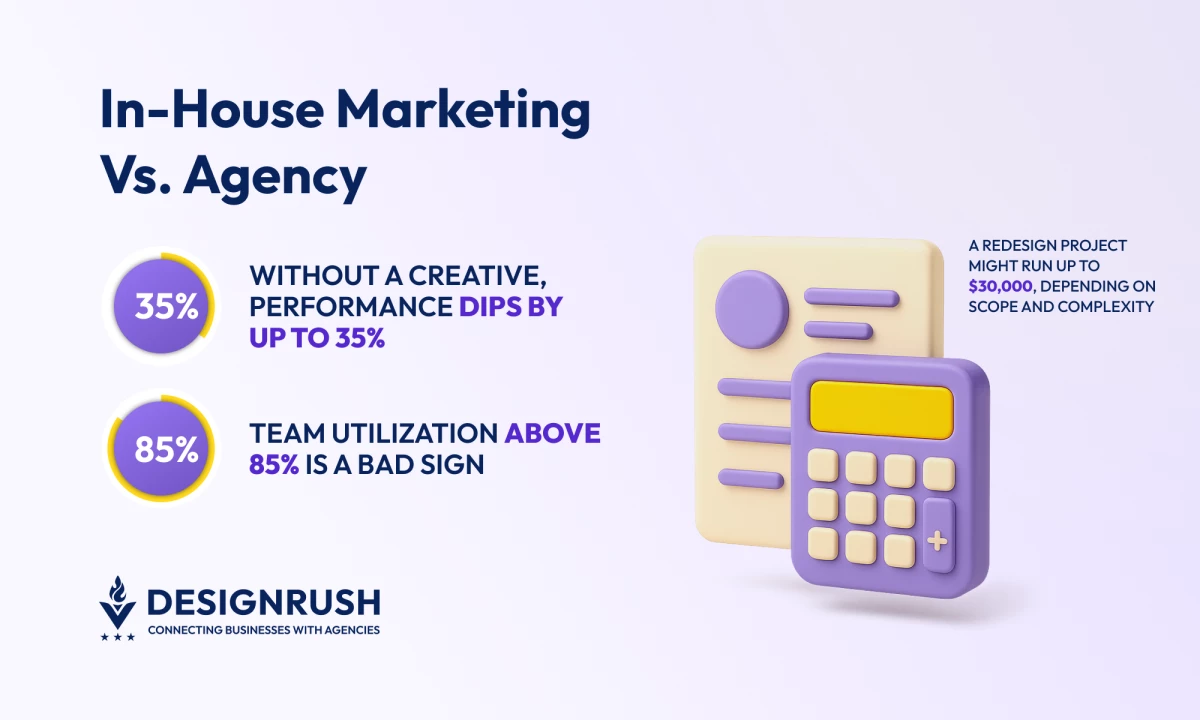
- Utilization above 85%: I saw this once at a SaaS company. Burnout followed within weeks. I shifted creative work to an agency pod to restore capacity.
- Creative backlog older than 7 days: If the first asset takes longer than a week to ship, I bring in an agency design team to clear the queue.
- Half the planned experiments shipped: When cadence drops, I outsource test builds until the loop is restored.
- Tracking fixes unresolved for more than 2 weeks: I escalate to the agency analytics team before budget decisions go off-track.
- CAC rising 15% with no new tests: This signals a broken learning loop. I immediately add an agency CRO or creative sprint to reset.
- Heroics and all-nighters: If QA misses become normal, I bring in agency QA support. Systems should absorb pressure, not people.
- Managers stuck in traffic mode: When leaders spend more than 30% of their time chasing assets, I push execution work to an agency so managers can focus on direction.
The Cost of Building In-House
Hiring internally looks safe on paper, but the math rarely works once you add time, overhead, and hidden costs.
I always calculate the real spend before advising a client to bring roles inside.
What Building Internally Really Costs
A full-time hire is never just salary.
Once you factor in benefits, taxes, tools, and management overhead, I usually see fully loaded comp land at 1.25–1.4× base pay. For a $130K growth role, that’s closer to $162K–$182K a year.
And you don’t get that impact overnight.
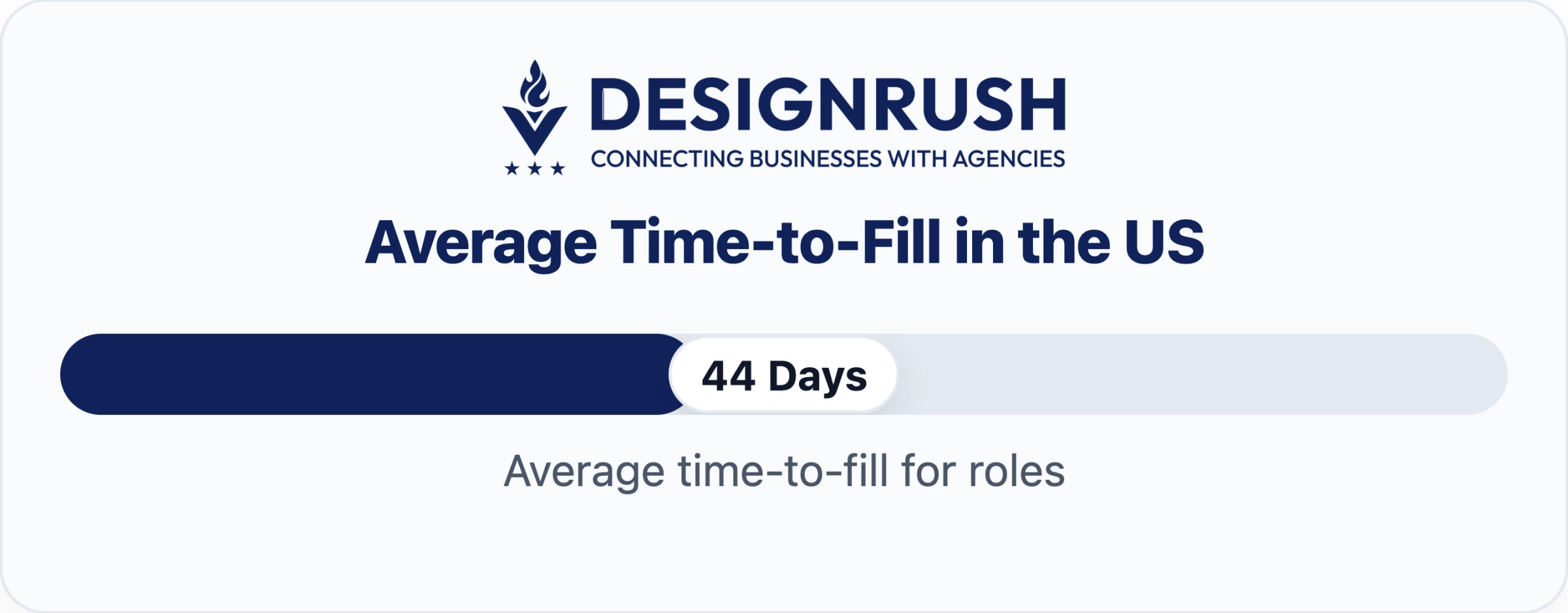
The average time-to-fill for roles in the US is 44 days, with onboarding adding another 6–10 weeks. That’s at least two to three months before ROI, even longer for senior hires.
Attrition hits hard, too. In 2025, the cost of employee attrition is estimated to be between 50% and 200% of an employee's annual salary, depending on their role and seniority.
Tooling and creative add more. ESPs, CDPs, analytics, QA, and reporting easily start at $20K annually and can climb well past $100K at scale.
When you do the math, two mid-level growth hires at $130K each can quickly cost $324K–$364K/year fully loaded.
For that spend, many agencies deliver a full bench at $25K–$45K a month.
Smarter Ways To Add Capacity
When clients feel stuck but aren’t ready to add full-time headcount, I use modular agency projects.
They give leverage without long-term cost, and they leave the team with assets and playbooks that stay behind.
Here’s how that looks:
- 90-day channel sprint: Setup, creative pack, three test waves, and a handoff playbook.
- CRO jumpstart: Research, two landing pages, QA, and a three-month backlog.
- Analytics fix: Audit, server-side setup, dashboards, and QA checklist.
- Creative test pack: 30–60 assets across three concepts, with weekly reporting.
- Lifecycle rebuild: Onboarding, reactivation, and recovery templates built in 30/60/90-day waves.
- Fractional leadership: 1–2 days a week to install governance and cadences.
- Office-hours retainer: 10–20 hours a month to cover spikes and reviews.
Why do I do it this way? Every option has a clean exit. You keep the assets and processes, and you avoid bloating the org chart before the business is ready.
The Case for Hybrid Teams
I’ve never believed in a one-size-fits-all model.
The smartest setups I’ve seen split responsibilities based on where in-house teams add the most value and where agencies can deliver leverage faster.
How I Structure Hybrid Models
I use a simple RACI-style split:
- In-house: Owns objectives, budget, brand, offers, CRM truth, and data.
- Agency: Runs media buying, creative at scale, CRO builds, instrumentation, and experiment ops.
- Shared: Reporting, quarterly reviews, backlog prioritization.
This mirrors what Gartner advises: CMOs should keep strategy aligned with business goals internally, while deciding case by case which capability gaps to resource with external partners.
Scaling by Spend Level
Here’s how I guide leaders to think about it:
Smaller budgets: Keep strategy in-house. Use an agency sprint or mini-pod for creative or CRO.
Mid-range budgets: In-house owns strategy and analytics. Agency handles media, creative ops, and CRO.
Larger budgets: I set up two agency pods, one for acquisition and one for lifecycle plus CRO. In-house leads revenue ops and brand.
The right balance depends on your budget and scale.
What works for a lean team with tighter ad spend won’t hold up for brands investing heavily across multiple channels.
How Often I Re-Evaluate
I check the balance quarterly or whenever a major shift happens, like a funding round or market launch.
My reset rule is simple:
- If CAC drifts more than 20 percent above target without explanation, I change the model.
- If test cadence falls below half of the plan for six weeks or more, I shift more work to an agency.
Agencies give me speed and leverage, while in-house keeps control and brand authority. Done right, the structure protects both.
Find More Agency Hiring Resources:
- Digital Marketing Objectives That Drive Real Business Outcomes
- Questions To Ask a Digital Marketing Agency
- How To Strategically Plan Your SEO Budget
The strongest companies don’t choose one side forever. They build hybrid models, keeping strategy close, while leaning on agencies to scale execution without slowing down.

Our team ranks agencies worldwide to help you find a qualified partner. Visit our Agency Directory to find top-rated digital marketing companies, as well as:
- Affiliate Marketing Companies
- Conversion Rate Optimization Services
- Media Buying Agencies
- Content Marketing Agencies
In-House vs. Agency Marketing: FAQs
1. Is in-house marketing cheaper than hiring an agency?
Not always. While salaries may look like a fixed investment, fully loaded costs (benefits, tools, training, management) add up quickly. Agencies can often deliver a full team of specialists for the cost of one or two in-house hires.
2. What’s the main advantage of a digital marketing agency vs in-house?
Agencies bring speed, scale, and specialized expertise. In-house teams know the brand best, but agencies often outperform when you need fast execution across multiple channels or fresh creative to fight ad fatigue.
3. Can a company switch from in-house to agency marketing later?
Yes. Many companies start with in-house teams and bring in agencies when they need more capacity or advanced capabilities. A hybrid approach lets you adjust without fully committing to one model.