
eCommerce in 2026 is a global proving ground. While Amazon and Alibaba still cast long shadows, the rise of regional titans and tech disruptors is rewriting the rules.
We'll break down their business models, tech, and reach, revealing key entry points for brands and agencies to differentiate and integrate.
Top eCommerce Companies: Key Findings
- Amazon leads globally with a $2.4 trillion market cap, controlling over 40% of the US eCommerce market and generating $690 billion in GMV.
- Alibaba ($378B) dominates China and APAC with massive livestream commerce ($84B GMV in one day during Singles’ Day).
- Emerging leaders Shopee and MercadoLibre lead mobile-first, gamified, and fintech-driven markets in SEA and Latin America, while Shopify and Temu expand globally with DTC.
The Titans Shaping eCommerce’s Next Trillion
1. Types of eCommerce Businesses
2. International eCommerce Strategies
3. eCommerce Statistics 2026
4. Top eCommerce Trends
eCommerce is surging, with online sales estimated to exceed $4.3 T worldwide.
Agencies that innovate, optimize, and connect platforms, tech, and culture will lead the next wave of growth.
Company | Market Cap (2025) | Core Region | Key Strengths |
Amazon | ~$2.4T | Global | Prime logistics, AWS, voice shopping |
Walmart | ~$760B | US | Omnichannel retail, in-store synergy |
Alibaba | ~$378B | China/APAC | Livestream, Singles' Day scale |
Shopify | ~$160B | Global | DTC platform, app ecosystem |
Temu (PDD) | ~$150B | Global | Viral, low-cost, Gen Z friendly |
MercadoLibre | ~$120B | LATAM | Fintech + logistics + mobile-first |
Shopee (Sea) | ~$99B | SEA/LATAM | Gamified mobile, live commerce |
Flipkart | $35–40B | India | Vernacular UX, regional focus |
eBay | ~$35B | Global | P2P, collectibles, AI listings |
Rakuten | ~$11B | Japan | Loyalty ecosystem, seasonal UX |
Etsy | ~$6B | Global | Handmade, mobile-centric |
1. Amazon (US / Global): ~$2.4 T
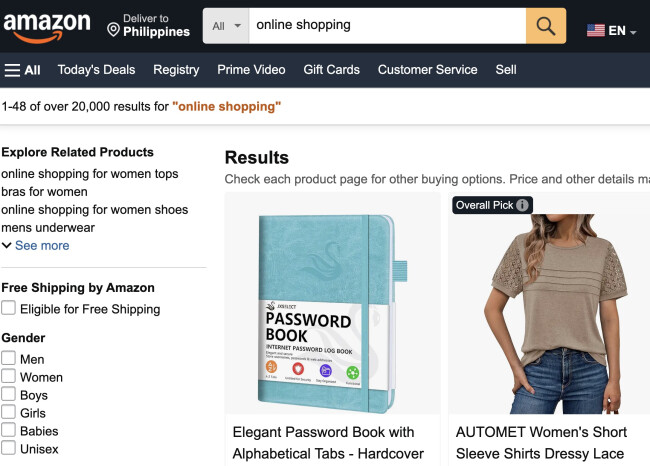
- HQ: Washington, United States
- Region: US / Global
- Market cap: ~$2.4 Trillion
- Stock value: ~$200 per share (AMZN:NASDAQ)
Amazon commands over 40% of US eCommerce market share (eMarketer), far ahead of any competitor.
It has built an unparalleled logistics network enabling same-day and next-day Prime delivery in many regions, and it leverages AWS cloud and AI for personalization and voice commerce (through Alexa).
In 2025, Amazon’s total revenue hit $650 B, reflecting both its retail and cloud dominance. Its gross merchandise value (GMV) is estimated at around $690 B including third-party sellers, making it the world’s largest online marketplace by sales volume.
Agency opportunities:
- Amazon DSP advertising & storefronts: Optimize Amazon’s Demand-Side Platform ads and branded storefronts to improve visibility and ROAS.
- Cross-channel retargeting: Coordinating off-Amazon advertising (e.g., social media retargeting) to drive traffic back to Amazon listings.
- Voice commerce UX: Design voice-friendly shopping experiences (skills for Alexa). Voice shopping, while still nascent, is part of Amazon’s ecosystem strategy.
2. Walmart (US): ~$760 B
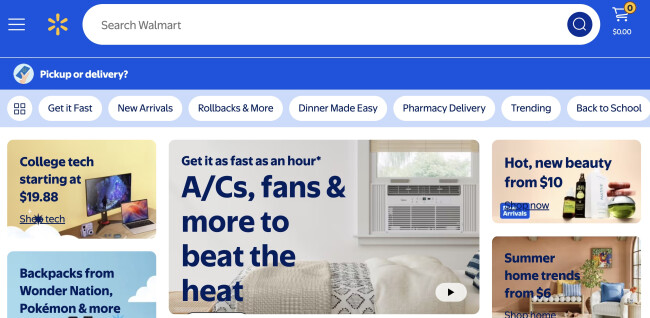
- HQ: Arkansas, United States
- Region: United States
- Market cap: ~$760 B (July 2025)
- Stock value: ~$90 per share (WMT:NYSE)
Walmart has undergone a digital transformation, now blending its physical retail might with online growth. It’s the #2 eCommerce retailer in the U.S. with around 10% market share of US online retail.
Its strengths include a rapidly expanding retail media network (Walmart Connect) and the synergy of 150M weekly store visitors with online data. Walmart uses its 4,600+ stores as fulfillment nodes (DIGIDAY) for same-day pickup/delivery, a brick-to-click model Amazon can’t easily match.
Walmart’s advertising business is growing faster (26% YoY in one quarter) than Amazon’s (20% YoY), showing its potential to outpace Amazon in retail media growth in coming years.
Agency opportunities:
- Retail media & attribution: Run Walmart Connect ad campaigns and model how those ads drive both online and in-store sales, enabling full-funnel attribution.
- Omnichannel campaign layering: Layer campaigns across Walmart.com, in-store signage, and partner channels. Walmart’s ability to use in-store shopper data for online targeting gives agencies a unique edge in cross-channel strategy.
3. Alibaba Group (China / APAC): ~$280 B
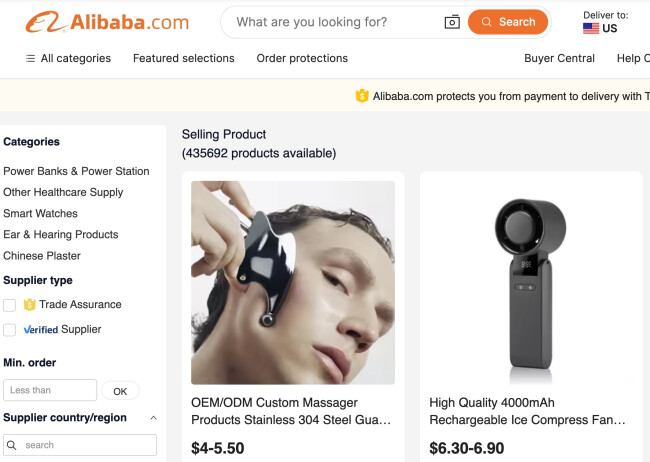
- HQ: Hangzhou, China
- Region: China / APAC
- Market cap: ~$378B (early 2026)
- Stock value: ~$120 per share (BABA:NYSE)
Alibaba’s ecosystem (Taobao, Tmall, AliExpress, etc.) boasts millions of daily active consumers and processed a staggering $84 B in GMV in one day during Singles’ Day 2021-2022 (Statista).
Alibaba also leads in livestream commerce. In China, live-stream shopping is a major sales channel, with conversion rates up to 30% (10× higher than conventional eCommerce) and with the majority of users buying via livestream (McKinsey).
Alibaba’s logistics arm, Cainiao, and its Alipay payments network further solidify its position. The company’s scale in APAC means it often rivals or surpasses Amazon in regional GMV.
Agency opportunities:
- Livestream campaign production: Agencies can connect brands with Taobao Live or Douyin influencers to produce real-time shopping events.
- China-friendly UX & marketing: Localize apps and websites with Chinese UX norms like red packet gamification, dense content, and advanced filters.
- APAC market entry strategy: Agencies support launches on platforms like Tmall Global and Lazada, creating multilingual creative and localized campaigns.
Insights: McKinsey predicts live commerce could drive 10–20% of all eCommerce by 2026. Brands that act now, via livestreaming, influencer partnerships, and local payment options, can win big in consumer engagement.
4. Shopify (Global): ~$160 B
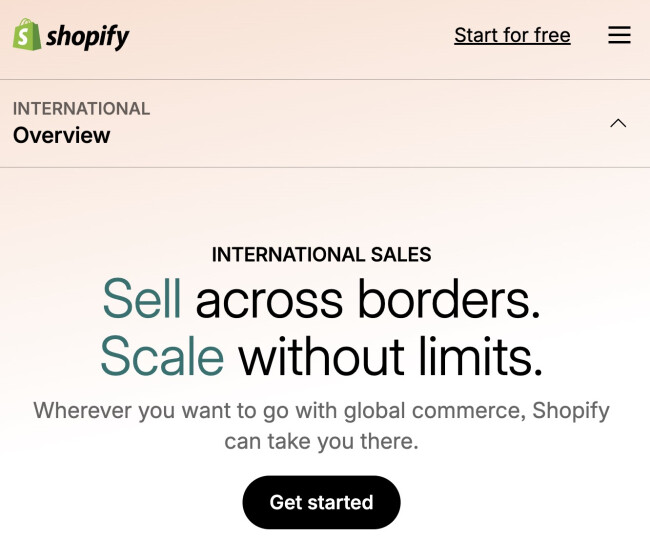
- HQ: Ottawa, Canada
- Region: Global
- Market cap: ~$160 B (mid-2025)
- Stock value: ~$120 per share (SHOP:NASDAQ)
Shopify isn’t a traditional marketplace but powers millions of online stores in 175+ countries.
Its core strengths are an extensive app/plugin ecosystem (for payments, marketing, fulfillment, etc.) and a platform model that takes no commission on sales (merchants keep more margin, just paying subscription and payment fees).
Shopify’s focus on customization and ownership has attracted sellers who want a direct-to-consumer (DTC) presence. It also offers Shopify Plus for large enterprises, and features like Shop Pay (fast checkout), Shopify Fulfillment Network, and powerful analytics.
Agency opportunities:
- Custom development & app integration: High demand exists for agencies that build custom themes or integrate apps (e.g., loyalty, AR try-ons, Recharge). Many brands migrating to Shopify Plus need expert support.
- Checkout optimization: Agencies can reduce cart abandonment through CRO services — A/B testing layouts, improving mobile speed, and adding upsells.
- Subscription & loyalty systems: Agencies can implement subscription flows and gamified loyalty programs to drive retention.
“As a developer, we often recommend brands take a modular approach with Shopify — start with core functionality, then map your customer journey to app or API integrations that fill specific gaps,” says Caleb Bradley, CEO and Founder at Bighorn Web Solutions, a leading eCommerce development agency."Prioritize tools that directly impact conversion, like upsell flows, analytics, or payment optimization. Shopify’s strength lies in how well it lets you build incrementally, without a full re-platform.”
5. Temu / PDD Holdings (Global): ~$150 Billion
- HQ: Massachusetts, United States
- Region: Global
- Market cap: ~$150 Billion (PDD Holdings)
- Stock value: ~$100 per share (PDD:NASDAQ)
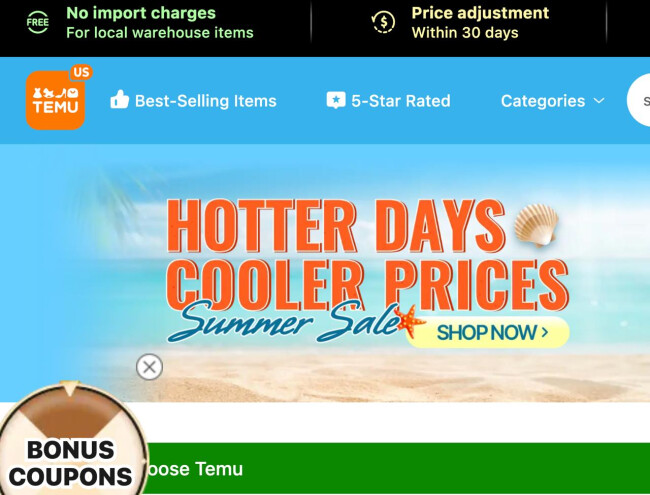
Temu burst onto the global scene in late 2022 and has rapidly become one of the most downloaded shopping apps in the US.
Backed by China’s PDD Holdings (parent of Pinduoduo), Temu employs a TikTok-native, viral marketing playbook combined with an ultra-low-cost sourcing model.
It offers a dizzying array of cheap goods (many under $10) shipped directly from Chinese factories, often with aggressive discounts and gamified referrals.
In 2024, Temu reportedly reached 292 million global monthly active users and an estimated $70.8 B in GMV. However, it faces trust and quality concerns in Western markets, as well as scrutiny over data security.
Agency opportunities:
- Brand credibility campaigns: Help build trust through PR, authentic reviews, unboxing videos, and clear messaging around buyer protection and return policies.
- Viral content & influencer marketing: Create TikTok and Instagram content (e.g., #TemuHaul) to fuel discovery shopping. Micro-influencers showcasing stylish low-cost finds can drive massive Gen Z engagement.
6. MercadoLibre (Latin America) ~$120 B
- HQ: Montevideo, Uruguay
- Region: Latin America
- Market cap: ~$120 B (July 2025)
- Stock value: ~$2,000 per share (MELI:NASDAQ)
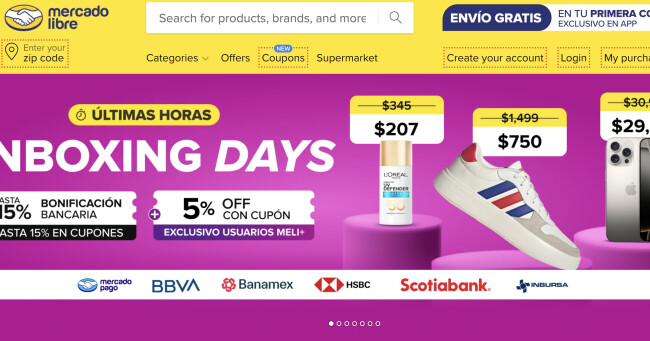
Often called the “Amazon of LATAM,” MercadoLibre dominates in Brazil, Argentina, and Mexico. Its marketplace model is complemented by a fintech arm (MercadoPago digital payments and Mercado Crédito lending) and a robust logistics network (Mercado Envios).
The integration of fintech means many unbanked or underbanked consumers can shop using cash vouchers or local payment methods, expanding the eCommerce audience.
Uniquely, MercadoLibre has thrived in a mobile-first environment. A majority of Latin American online shoppers use smartphones, and MercadoLibre’s app is among the most downloaded across the region.
Nina Jelic, Lead Product Strategist at Infinum, explains why mobile-first design matters in today’s retail market:
“People used to research products in stores, but foot traffic has been dropping for over a decade. That traffic’s now on smartphones.
In 2025, customers get ideas, look up info, compare, and decide — all on mobile. When done right, mobile-first design removes every unnecessary tap between discovery and purchase.”
Caleb Bradley, CEO and founder at Bighorn Web Solutions, agrees, adding:
“MercadoLibre’s model shows that mobile-first eCommerce about minimizing friction, not just responsive design.
For agencies, that means reducing tap depth, offering one-click local payment options, and caching content for poor connectivity.
If your mobile experience doesn’t account for local tech realities, you’re not really mobile-first. You’re just mobile-friendly.”
Agency opportunities:
- Mobile UX for low-bandwidth markets: Optimize sites and ads for slower connections and older devices using PWAs and compressed media.
- Multilingual content & SEO: Agencies can localize SEO and create culturally relevant content to reach high-traffic regions, tailoring Portuguese for Brazil or region-specific Spanish for markets like Mexico or Argentina.
7. Shopee / Sea Limited (SEA): ~$99 B
- HQ: Singapore
- Region: SEA & Latin America
- Market cap: ~$99 B (mid-July)
- Stock value: ~$160 per share (SE:NYSE)
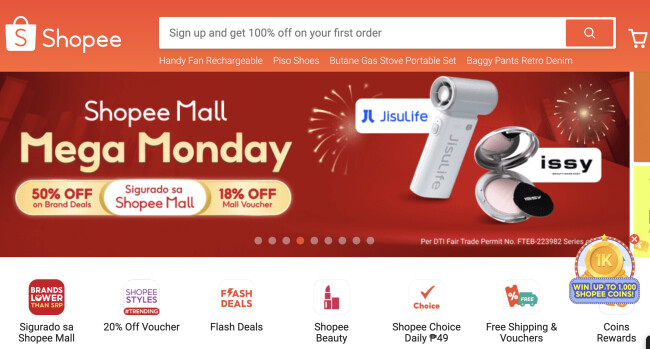
Shopee is the top eCommerce platform in Southeast Asia, spanning Singapore, Indonesia, Malaysia, Thailand, Vietnam, the Philippines, and Taiwan, and is growing in Latin America as well.
Shopee is not only retaining scale; it has turned a profit. Sea Ltd. reported positive EBITDA in 2024 and delivered a GMV of $100 B (+28% YoY), with forecasts expecting 20% GMV growth in 2025.
Shopee’s strengths include a mobile-first app driving sales with gamification and live commerce. Sea's fintech service, Monee, is booming too, with loans up 75% year over year, providing convenient credit and insurance options.
Agency opportunities:
- Mobile app marketing & UX optimization: Improve app funnels, referral flows, and retention games.
- Live-stream campaign management: Shopee Live is a major sales driver; agencies can manage live-stream shows, coordinate influencers, and optimize stream formats and offers.
- Localized festivals & performance ads: Craft campaigns around regional sale events (e.g., 9.9, 11.11, Fabulous Fridays), using targeted ad strategies.
8. Flipkart (India): $35–40 B
- HQ: Bengaluru, India
- Region: India
- Market cap: $35–40 B
- Stock value: Private (majority owned by Walmart, no public stock)
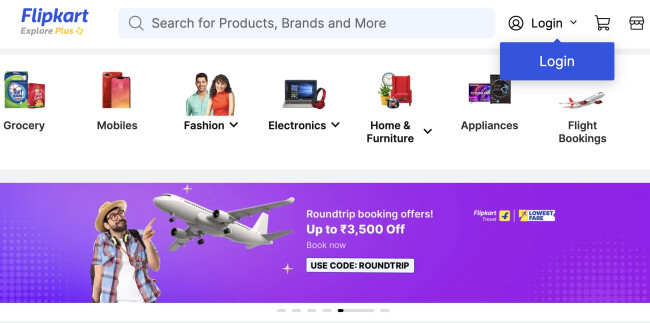
Flipkart is India’s homegrown eCommerce leader (alongside Amazon India). It differentiates through vernacular user experience and deep penetration beyond big metros.
The Flipkart app is available in 11 Indian languages and even offers voice search in Hindi and other dialects — critical in a country where hundreds of millions of new internet users prefer local languages.
Massive sale events like Big Billion Days (during Diwali festival season) showcase Flipkart’s scale and focus on affordability for the “next billion” consumers.
It also has vertical-specific arms (Myntra for fashion, Flipkart Grocery, etc.) and is integrating entertainment (streaming, games) into its app to increase engagement.
Agency opportunities:
- Regional mobile-first UX: Design lightweight, vernacular websites or PWAs for low-end Android devices and poor connectivity. Include features like larger fonts for local scripts and voice-assisted search.
- Localization for festive cycles: Align marketing with Indian festivals (e.g., Diwali, Holi, Ramadan) and payday cycles. Agencies can create localized campaigns with culturally relevant imagery, regional offers, and timed promotions.
9. eBay (Global): ~$35 B
- HQ: San Jose, United States
- Region: Global
- Market cap: ~$35 B
- Stock value: ~$75 per share (EBAY:NASDAQ)
eBay remains a massive peer-to-peer and collectible marketplace with approximately 134 M active buyers and $74.7 B GMV in 2024— a ~2% YoY increase.
Q1 2025 revenue grew slightly to $2.6 B, while GMV was $18 B, driven by categories like trading cards and AI-powered listing tools for bulk seller listings.
eBay’s core strengths lie in its robust C2C platform, which is perfect for second-hand items, collectibles, and unique listings. The platform uses AI innovations like “Magical Bulk Listing” tools and AI-driven content, boosting search relevance by 6% (eBay).
Agency opportunities:
- Collectibles & niche campaigns: Craft targeted campaigns focused on high-growth verticals like trading cards or vintage fashion, especially with AI-listing tools.
- AI-enhanced listing services: Offer seller support services to create optimized, AI-powered product listings, including bulk uploads and enhanced searchability.
- Advertising optimization: Manage eBay’s Promoted Listings and display ads to help sellers gain visibility, with emerging tools leveraging LLM-driven keyphrase relevance models for performance ads.
10. Rakuten (Japan): ~$11 B
- HQ: Tokyo, Japan
- Region: Japan
- Market cap: ~$11 B (July 2025)
- Stock value: ~$10 per share (TYO: 4755)
Japan’s Rakuten is a unique case — part eCommerce marketplace, part loyalty program, part fintech and more. Rakuten Ichiba (its marketplace) remains a top eCommerce site in Japan, offering a “shopping mall” experience where thousands of merchants operate storefronts.
Its key differentiator is the Rakuten Super Points loyalty system, which is deeply integrated across its services (Rakuten Card, Rakuten Bank, etc.). Rakuten’s 100 M+ members in Japan keep spending due to its ecosystem.
This ecosystem approach results in high customer lifetime value: Japanese consumers collect and spend Rakuten points on everyday purchases, creating a sticky loop.
Rakuten’s user experience is also attuned to local preferences (which often means information-rich pages and seasonal promotions aligned with Japanese holidays).
Agency opportunities:
- Loyalty integration & gamification: Tap into Rakuten’s Super Points system, designing campaigns with point multipliers (e.g., “10× points day”) to attract deal-seeking shoppers and target high-LTV customers.
- Japanese localization & UI design: Adapt sites to Japanese UX norms (dense content, modest design, formal tone) and local behaviors like gift-giving seasons or weekday/weekend shopping trends.
11. Etsy (Global): ~$6 B
- HQ: New York, United States
- Region: Global
- Market cap: ~$6 B
- Stock value: ~$60 per share (NASDAQ: ETSY)
Etsy is the world’s go-to marketplace for handmade, vintage, and craft goods. As of end-2024, Etsy connected 95 M active buyers with 8 M sellers, offering over 100 M items in its marketplace.
The platform remains mobile-first: 44.5% of its Q1 2025 GMS came from its app, which also saw growing conversion and new user downloads (DigitalCommerce360).
Etsy’s core strengths lie in its niche, curated experience that attracts buyers looking for handmade and unique items. The platform benefits from high mobile adoption, supported by a robust app ecosystem and a strong sense of community.
Agency opportunities:
- Category-driven branding: Position sellers in niche markets (e.g., eco-friendly home decor, artisanal jewelry) through targeted branding, styling, and audience research.
- Mobile UX optimization: Improve mobile-first storefronts and ad experiences, critical as mobile accounts for nearly half of Etsy’s GMS.
KPIs Defining eCommerce Leadership in 2025
Several key performance indicators (KPIs) distinguish the eCommerce leaders and should guide agency strategies:
- Total revenue & GMV – Sales volume remains the primary signal of market dominance.
- Fulfillment speed – Faster delivery improves conversion and satisfaction.
- Mobile optimization – Over 70% of eCommerce traffic is mobile-first.
- Customer LTV & retention – Top brands focus on long-term value, not just one-off sales.
- AI/ML personalization – Personalization drives higher AOV and conversion.
Top brands are metrics-obsessed: GMV growth, delivery speed, app usage, repeat rate, and AOV. Agencies that speak in these terms — and back claims with benchmarks or case studies — stand out.
Top eCommerce Companies: Final Words
Digital commerce is becoming more complex and tech-driven. In 2025, every brand aims to emulate Amazon Prime, Alibaba’s live shopping, Shopify’s DTC revolution, or MercadoLibre’s fintech ecosystem.
Integration is key: connecting channels (online/offline), data and personalization, and local nuances within global strategies.
Businesses must move beyond basic services to mastering algorithms, AI personalization, and cross-border growth.

Our team ranks agencies worldwide to help you find a qualified partner. Visit our Agency Directory for the Top eCommerce Companies, as well as:
- Top eCommerce Development Companies in the United States
- Top Small Business eCommerce Companies
- Top eCommerce Marketing Agencies
- Top eCommerce SEO Agencies
- Top eCommerce Web Design Companies
Top eCommerce Companies FAQs
1. What are the top eCommerce companies in 2025?
Amazon, Alibaba, Shopify, Walmart, Flipkart, MercadoLibre, Shopee, and Rakuten lead globally, dominating their regions and business models. For example, Amazon controls ~40% of US online retail, while Alibaba serves over 900 million consumers in China.
2. How can agencies capitalize on this eCommerce growth?
Agencies should specialize by platform (e.g., Amazon storefronts, Shopify Plus), focus on localization, and excel in performance marketing, marketplace ads, conversion optimization, and logistics.
Advising on omnichannel integration (online + offline) is increasingly valuable. The key is becoming the go-to expert for brand success on major platforms.
3. What’s the key agency positioning strategy going forward?
ROI-driven specialization is crucial. Agencies must showcase measurable results, boosting metrics like conversion, AOV, or LTV, and speak the language of executives.
Highlight proven success in platform-specific strategies and back claims with data. Focus on platform and regional expertise that is directly tied to client revenue growth.