
Choosing the right ISP proxy can make or break your data strategy. Here’s a deep dive into the top providers, what they offer, and what real users are saying right now.
ISP Proxy Providers: Key Findings
- Enterprise leaders like Oxylabs and Bright Data focus on scale, advanced tooling, and high success rates for large data operations.
- Mid-range providers such as SOAX and NetNut balance performance, geo-targeting, and stable sessions for growing data teams.
- Budget and quality-focused options like Webshare, Decodo, NodeMaven, and Rayobyte offer ISP proxies suited for long sessions and account workflows.
ISP Proxy Providers Reviewed
Managing reliable data access at scale has never been simple, with switching proxy types, dodging IP bans, juggling bandwidth costs, and making sure your tools actually connect when it counts.
That’s where ISP proxies come into play. The right provider can give you speed, stability, and session consistency. Here, we break down the top options and what real users are saying about them.
| Provider | Best For | Unlimited Bandwidth | City-Level Geo-Targeting | Pricing (Starting At) |
| Webshare | Budget-friendly static ISP | ✅ | ✅ | $0.30/IP |
| Decodo | Beginner-friendly static ISP | ✅ (dedicated plans) | ✅ | $3.33/IP |
| Oxylabs | Enterprise scraping | ✅ | ✅ | $1.60/IP |
| Bright Data | Scale plus tooling | ❌ (traffic-based options) | ✅ | $1.80/IP (Shared) |
| SOAX | Geo-targeted ISP sessions | ❌ | ✅ | $3.60/GB |
| NodeMaven | Long and stable sessions | ✅ | ❌ (mainly country-level) | €4.99/IP |
| NetNut | Direct ISP connectivity | ❌ | ✅ | $17.5/GB |
| Rayobyte | Ethical, unlimited-bandwidth ISP | ✅ | ❌ (limited locations) | $5/IP |
1. Webshare – Budget-Friendly and Flexible Proxy Plans
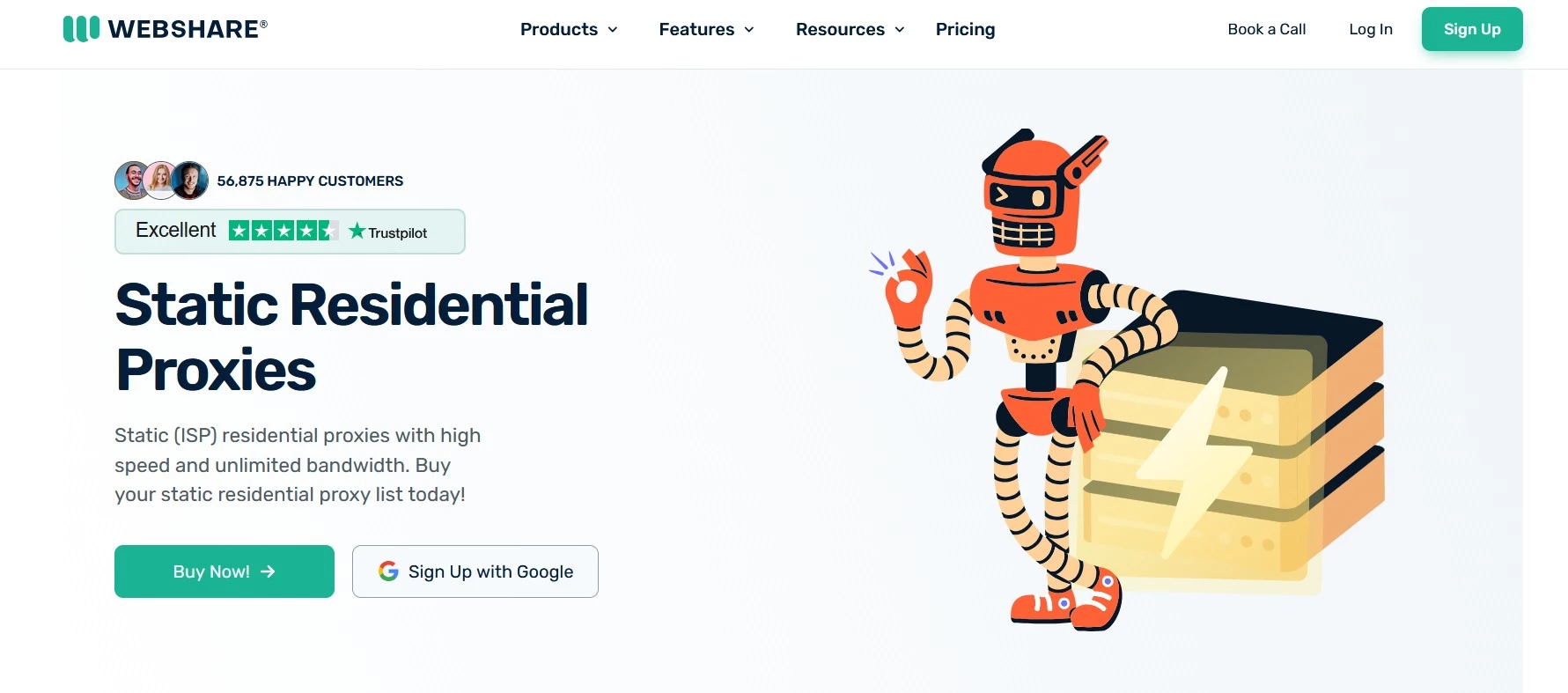
Webshare is a budget-friendly proxy provider offering flexible plans, multiple proxy types, and a self-service platform designed for individuals, developers, and small teams that need affordable access to reliable proxies.
| Pros | Cons |
|
|
It’s a practical option for users who want to start small, test setups, and scale gradually without committing to large upfront contracts.
Webshare’s mix of proxy types makes it easy to switch between high-speed datacenter IPs and more anonymous residential IPs depending on the task.
This flexibility supports use cases like web scraping, SEO monitoring, automation, social media management, and general data collection.
The platform is built for ease of use, with a control panel that simplifies proxy configuration, IP authorization, and plan adjustments.
Pricing
Webshare offers some of the lowest entry pricing among ISP/static residential providers:
- Static residential (ISP) proxies start at $0.30 per IP
- Volume discounts reduce pricing to $0.225 per IP on large plans
- Rotating residential proxies start at $1.40 per GB
- A free plan includes 10 proxies and 1GB/month for testing
Key Features
- Large global IP network: 500K+ datacenter & ISP proxies and 80M+ residential IPs across 195 countries
- Static residential (ISP) proxies with high performance: Up to 1 Gbps speeds and unlimited bandwidth
- Flexible, self-service plans: Customize proxy count, bandwidth, and location, plus a free plan with 10 proxies and 1GB/month
What Users Say
Webshare is often described as a strong value option, with users highlighting its affordability, ease of setup, and reliable performance for everyday scraping and automation tasks.
While it may not offer the same level of enterprise tooling as higher-priced providers, many users find that it delivers dependable results for small to mid-scale projects, especially when budget flexibility is the most important.



2. Decodo (formerly Smartproxy) – A Beginner-Friendly ISP Proxy Provider
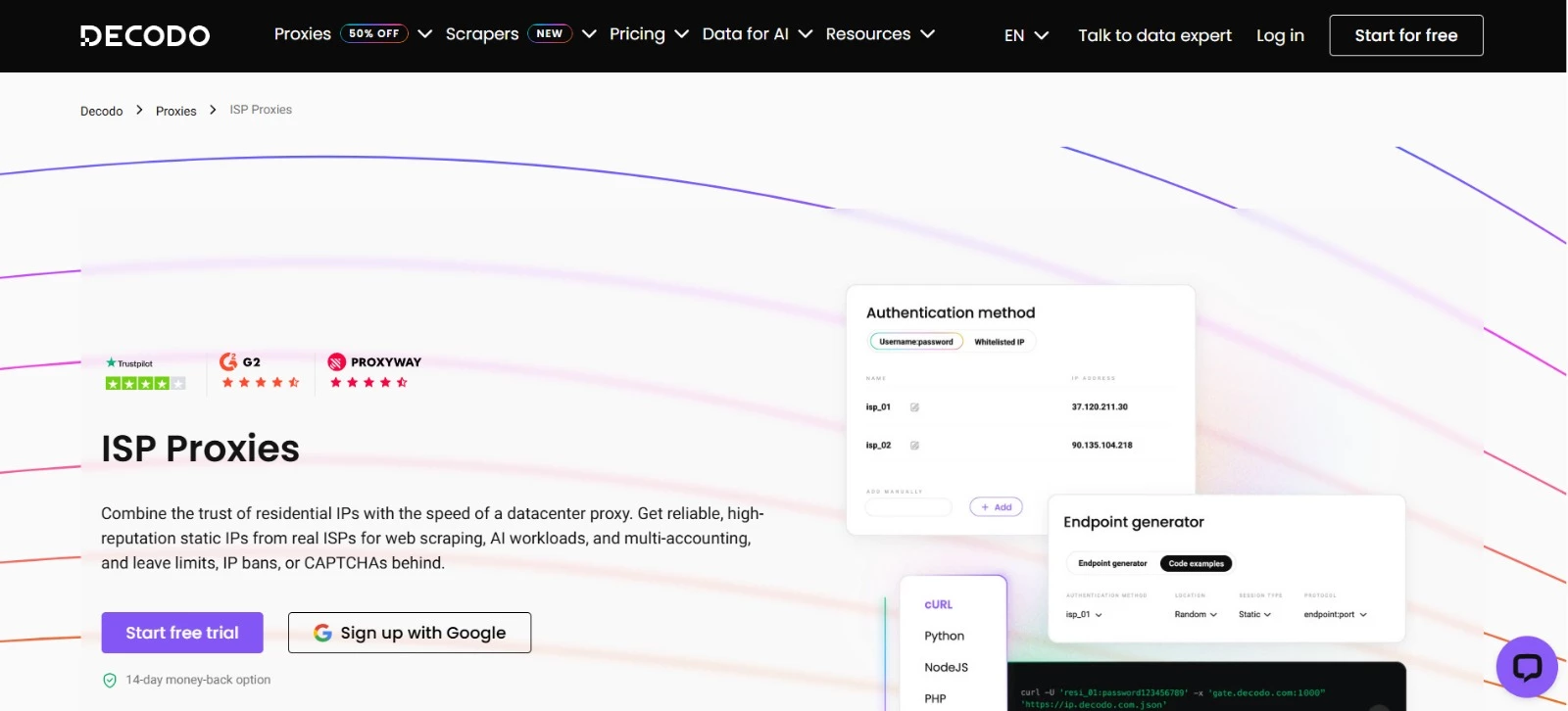
Decodo is known for offering accessible, scalable proxy solutions that work well for both beginners and growing teams. It’s especially appealing if you want ISP/static residential IPs without jumping straight into enterprise pricing.
| Pros | Cons |
|
|
The service combines residential-level trust with datacenter-style speed, making it useful for scraping, automation, multi-accounting, and other tasks where stability and reputation matter.
Decodo’s ISP proxies are designed to hold up against tougher targets while still being simple to deploy. Dedicated ISP IPs are useful when you need a stable identity for logins or long sessions, while shared pools are better for scaling data collection.
The dashboard keeps things approachable, which is one reason Decodo is often recommended to users moving up from basic proxy setups but not yet ready for heavy enterprise tooling.
Pricing
Decodo offers several ways to pay for ISP proxies:
- Pay per IP (shared ISP proxies)
- Starts at $3.33/IP (3 IP plan)
- Drops to around $2.60/IP on larger plans
- Pay per GB (shared ISP traffic model)
- Starts at $3.00/GB
- Decreases to $1.30/GB at high volumes
- Dedicated ISP proxies (private IPs)
- Custom-style pricing based on number of IPs, aimed at users who need fully dedicated identities
Key Features
- Static ISP proxies with strong performance: Up to 99.99% uptime and <0.2s response time, with IPs from premium ISPs
- Flexible ISP models: Choose dedicated IPs, shared pay-per-IP, or traffic-based (per GB) plans depending on your workload
- Easy setup and integrations: Works with common tools like Playwright, Puppeteer, and other scraping or automation setups
What Users Say
Decodo has built a reputation for being easy to use and dependable. Users often mention that setup is straightforward, performance is consistent, and support is responsive when issues come up.
It’s frequently described as a high-value option for scraping, SEO monitoring, multi-account setups, and similar tasks where you need stable IPs without the overhead of a fully enterprise-focused platform.
3. Oxylabs – Enterprise-Scale Web Scraping and Data Collection
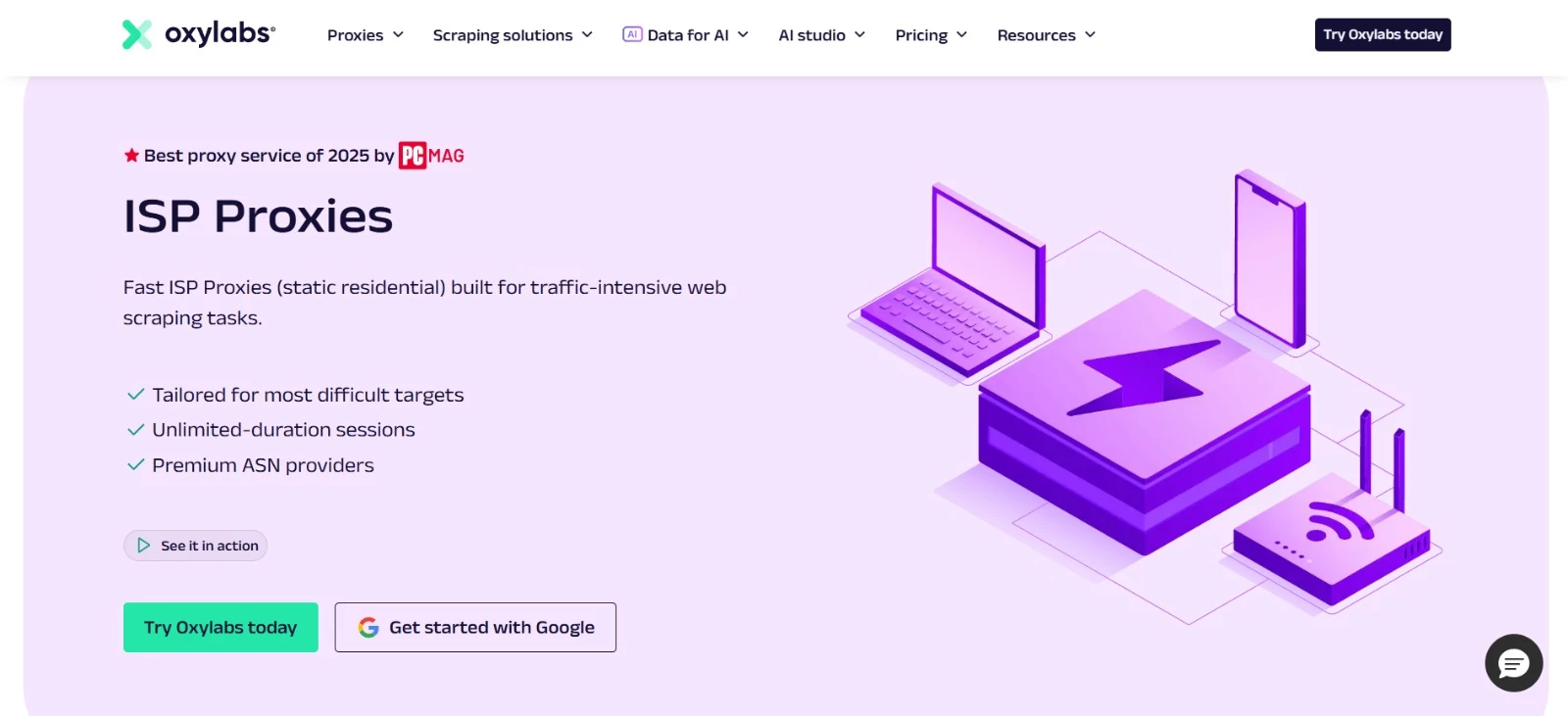
Oxylabs is built for large-scale scraping and data-heavy projects.
If you’re dealing with tough targets or running high-volume workflows, this is one of the providers that can handle the load.
Its ISP proxies combine residential credibility with datacenter-level speed, which helps reduce blocks while keeping performance high.
| Pros | Cons |
|
|
Oxylabs is commonly used for market research, eCommerce monitoring, ad verification, and other tasks where consistency and scale matter. It’s especially useful when you need long sessions or a stable identity without sacrificing speed.
Pricing
Oxylabs ISP proxies use per-IP pricing with unlimited bandwidth (fair usage applies):
- Starts at $1.60/IP (small plans)
- Drops to $1.30/IP and $1.20/IP on larger tiers
- Custom enterprise plans available for 2,000+ IPs
It’s premium pricing, but you’re paying for stability and enterprise support.
Key Features
- ISP IPs from premium ASN providers with a 99.9% success rate on difficult targets
- Unlimited-duration sessions and support for high traffic loads
- Enterprise-grade dashboard with usage analytics, team access, and proxy management tools
What Users Say
Users often highlight Oxylabs’ reliability at scale. Reviews frequently mention stable connections, strong performance on harder websites, and helpful documentation that makes integration smoother.
Support quality also gets positive feedback, especially from teams running ongoing, high-volume data collection.
4. Bright Data – High-Performance and Large-Scale Proxy Operations
Bright Data is one of the biggest names in the proxy space. If you’re running serious data collection and need scale, control, and compliance, this is where many teams land.
Its ISP proxies are static residential IPs designed to stay stable over long sessions, which helps when you’re managing accounts, verifying ads, or scraping sites that don’t tolerate datacenter traffic.
| Pros | Cons |
|
|
Bright Data supports everything from price monitoring and market research to academic data projects. Power users also get access to extra tools and integrations that help automate larger workflows.
It’s powerful, but not exactly plug-and-play. There’s a learning curve, and the platform expects you to know what you’re doing. That said, onboarding resources and account support make it manageable once you’re in.
Pricing
Bright Data offers multiple ISP pricing models:
- Shared ISP (pay per IP)
- Starts at $1.80/IP (small plans)
- Drops to $1.30/IP on larger tiers
- Dedicated ISP (private IPs)
- Starts at $3.50/IP, decreasing with volume
- Pay-as-you-go (bandwidth-based)
- From $8/GB with no long-term commitment
This puts Bright Data firmly in the premium category. It makes sense when performance, geo-coverage, and compliance matter more than keeping costs low.
Key Features
- Over 1.3M+ static residential (ISP) IPs with global geo-targeting
- 99.99% network uptime and consistently high success rates on tough targets
- Advanced control tools including a full proxy manager, API access, and real-time network monitoring
What Users Say
Bright Data receives positive feedback for its high-quality proxy network, broad range of proxy locations, and reliable customer support. Users appreciate its effectiveness for large-scale data collection and its intuitive interface, despite the platform’s complexity.
However, the primary downside is its high cost, making it best suited for users willing to invest in premium tools.
5. SOAX – Versatile Use and AI-Powered Routing
SOAX offers ISP proxies for teams that need consistent IP identities with good geo control.
It sits in the mid-range, giving you stable sessions without jumping into enterprise-only pricing.
| Pros | Cons |
|
|
SOAX’s ISP proxies are typically used when you need a steady identity for longer interactions, like checking search results from a specific city or managing accounts without triggering frequent re-verification.
Pricing
SOAX ISP proxies are priced based on bandwidth usage (per GB) rather than a flat per-IP subscription.
- Entry plans start around $3.60/GB
- Mid-tier plans fall closer to $2.00–$2.50/GB depending on volume
- Enterprise agreements can lower the effective rate further
This model works best when traffic usage varies from month to month instead of needing a fixed number of static IPs.
Key Features
- Static ISP IPs with city-level geo-targeting for localized tasks
- High success rates and stable sessions for scraping, SEO tracking, and ad verification
- Real-time dashboard with usage stats and session controls
What Users Say
Users generally have high praise for SOAX’s quality and support, particularly for its expansive IP pool and effective geo-targeting, which many users find ideal for tasks like SEO.
Many reviews highlight SOAX's ability to deliver reliable, clean proxies that work well for web scraping, ad verification, and accessing location-restricted content.
The general sentiment is positive, with users particularly appreciating the customer support team’s quick response times and hands-on assistance.
6. NodeMaven – High-Quality, Clean IPs and Long Sessions
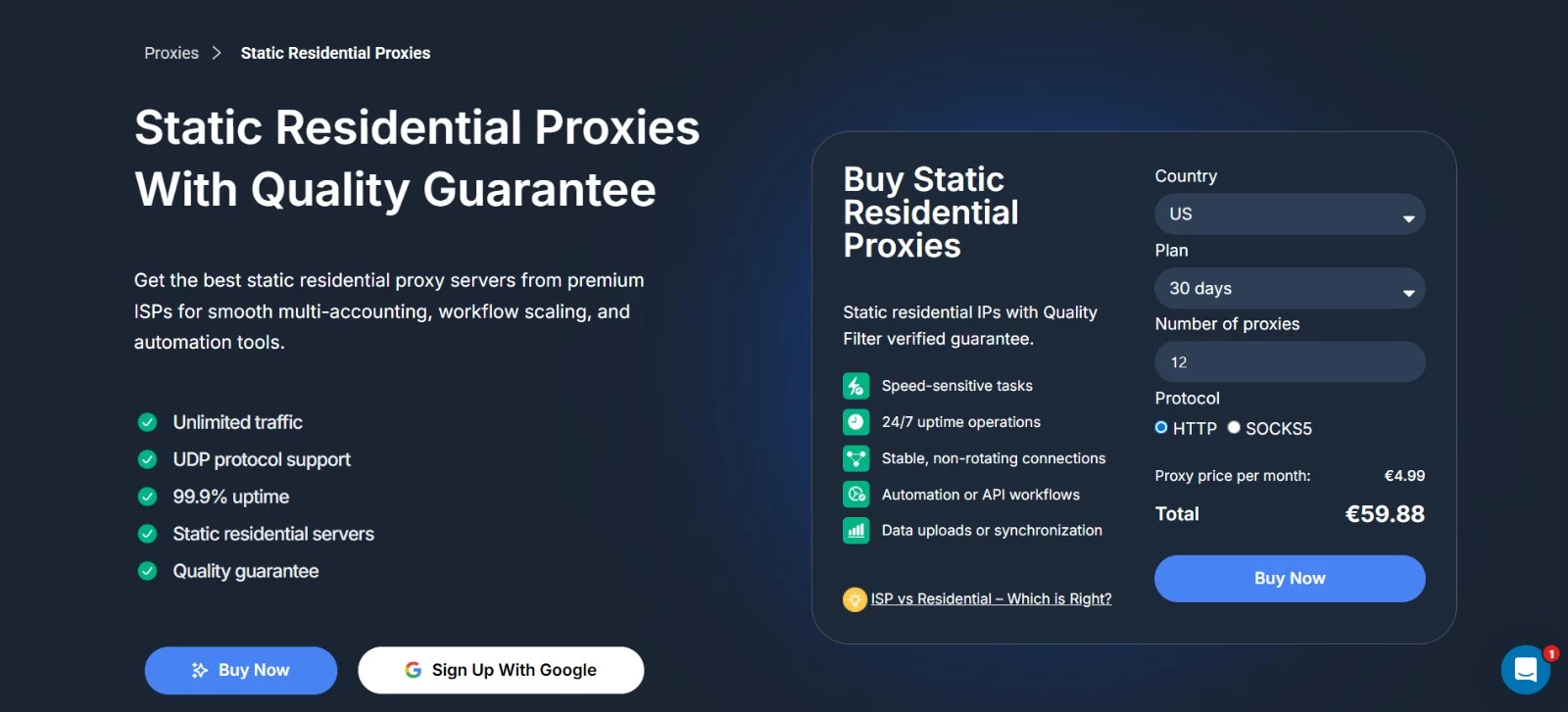
NodeMaven focuses on quality over sheer IP volume. Its ISP proxies are built for users who care more about clean reputation and session stability than massive rotating pools.
| Pros | Cons |
|
|
NodeMaven is commonly used for automation, account management, eCommerce monitoring, and other tasks where keeping the same IP for extended periods matters more than rotating constantly.
Pricing
NodeMaven sells static residential (ISP) proxies per IP, not by bandwidth.
- Example plan: 12 static IPs for €4.99 per IP/month
- Discounts apply for longer terms or larger volumes
- Unlimited traffic is included with static IP plans
This makes pricing predictable, especially for workflows that rely on long sessions.
Key Features
- Static residential IPs with a Quality Filter to reduce flagged or high-risk addresses
- Unlimited traffic and 99.9% uptime, built for long, stable sessions
- No domain restrictions, which helps when working with sensitive or strict platforms
What Users Say
Users praise its clean IPs, high success rates, and reliable performance on challenging sites, and highlight the helpful 24/7 live chat support and knowledgeable assistance.
While there’s little negative feedback so far, the service is priced for quality rather than volume, making it better suited for users who prioritize performance over bulk IPs.
7. NetNut – Speed, Stability, and Direct ISP Connections
NetNut takes a different approach from many proxy networks by connecting directly through ISPs instead of relying on peer-to-peer devices. That one-hop architecture helps deliver lower latency and more stable performance for large-scale data tasks.
| Pros | Cons |
|
|
It’s built for teams running continuous scraping, monitoring, and automation workflows where speed and uptime matter more than bargain pricing.
NetNut’s infrastructure is built for real-time use cases like price monitoring, market intelligence, and large-scale aggregation.
The direct ISP routing helps maintain stable sessions while keeping performance closer to datacenter speeds.
The dashboard also supports usage tracking, API access, and account-level controls, which makes it easier for technical teams to manage large proxy operations without constant manual adjustments.
Pricing
NetNut’s ISP proxies are priced by bandwidth (GB), with plans designed for high-volume usage.
Key tiers include:
- Starter: $17.5/GB (20GB plan)
- Advanced: $15/GB (50GB plan)
- Production: $10/GB (100GB plan)
- Semi-Pro: $8/GB (250GB plan)
- Professional: $6.5/GB (500GB plan)
- Master: $5 per TB equivalent pricing on very large-volume plans
Lower effective rates apply as volume increases, which makes NetNut more economical for businesses running steady, data-heavy operations.
Key Features
- Over 1 million ISP IPs globally with 24/7 availability
- One-hop ISP connectivity that reduces latency and improves response times
- 99.99% network uptime designed for uninterrupted, high-speed data extraction
What Users Say
NetNut is widely praised by users for its reliability, speed, and responsive support, especially among businesses handling mission-critical scraping tasks.
While some smaller users find the pricing geared more toward enterprise clients and note the dashboard could be more beginner-friendly, most view these as minor trade-offs.
Its direct ISP infrastructure earns approval from technically experienced users, and long-term customers report minimal issues like IP bans.
8. Rayobyte – Ethical Sourcing and Unlimited Bandwidth
Rayobyte is a long-established proxy provider known for its focus on ethical IP sourcing and stable, no-nonsense infrastructure.
Its ISP proxies are built for users who need persistent identities and high bandwidth without worrying about per-GB limits.
| Pros | Cons |
|
|
It’s a practical choice for scraping, SEO monitoring, and account-based workflows where session stability matters more than rotating huge pools.
Rayobyte’s ISP proxies are designed for long-running sessions and steady workflows.
Because you’re not billed by traffic, they’re especially useful for automation, monitoring, and scraping setups that generate consistent, high data volumes.
The dashboard keeps things straightforward, with API access, IP whitelisting, and the ability to scale IP counts up as projects grow.
Pricing
Rayobyte prices ISP (static residential) proxies per IP and includes unlimited bandwidth:
- Starter: $5.00/IP (5-99 IPs)
- Consumer: $4.80/IP (100-999 IPs)
- Corporate: $4.60/IP (1,000-4,999 IPs)
- Enterprise: Custom pricing for 5,000+ IPs
All plans include unlimited bandwidth, so costs stay predictable even with heavy usage.
Key Features
- Static ISP IPs with datacenter-level speed: Up to 1 Gbps connections and 99.99% uptime
- Unlimited bandwidth and sessions: No per-GB billing or throttling
- Diverse ASN coverage: 9+ real ISP ASNs to reduce bans and improve authenticity
What Users Say
User sentiment toward Rayobyte is generally positive, especially among long-term users who praise its reliability, ethical sourcing, and responsive support.
Many appreciate its transparency and proactive handling of issues, such as replacing problematic IP ranges.
Users also value its commitment to compliance, making it a trusted choice for those concerned about legality. Overall, Rayobyte earns strong loyalty from experienced users and remains a respected provider for long-term, stable proxy use.
Best ISP Proxy Providers: Final Words
Choosing an ISP proxy provider means opting for a smarter, faster, and more reliable path to securing high-performance data access.
For any project that demands rapid, dependable connections, ISP proxies provide a powerful, scalable solution that strikes the right balance between performance, cost, and credibility.

Our team ranks agencies worldwide to help you find a qualified partner. Visit our Agency Directory for the top IT services companies, as well as:
- Top Managed IT Service Providers
- Top IT Services for Startups
- Top IT Services for Financial Industry
- Top Healthcare IT Services
- Top IT Services for Transportation and Logistics
Best ISP Proxy Providers FAQs
1. What is an ISP proxy?
An ISP proxy (also called a static residential proxy) is a data-center-hosted IP that’s registered to an Internet Service Provider (ISP).
This gives it the speed and reliability of a datacenter proxy while appearing to websites as a genuine residential user, offering low latency, consistent uptime, and residential-level legitimacy.
2. How does an ISP proxy differ from datacenter and residential proxies?
An ISP proxy sits between datacenter and residential proxies in terms of how it behaves. Like datacenter proxies, it runs on stable server infrastructure, so you get strong speed and reliability.
But because the IP address is registered to a real internet service provider, websites see it as a residential user, which makes it harder to detect and block than a typical datacenter IP.
3. When should I choose an ISP proxy?
ISP proxies are ideal when you need a persistent session that looks residential (perfect for eCommerce account management, social media, or automation tasks), and also demand high speed and stability.
They strike a compelling balance when you need low detection risk without sacrificing performance.
4. Are ISP proxies secure and ethical?
Yes. Since ISP proxies use IPs leased directly from ISPs and are operated on stable server infrastructure, they avoid reliance on unknown peer devices.
This ensures both a secure environment and a transparent, ethically sourced setup that minimizes risks tied to compromised endpoints while delivering consistent performance and reduced downtime.
5. Can ISP proxies help reduce blocks and CAPTCHAs?
Yes, because ISP proxies use IPs registered to real internet service providers, many websites treat them more like genuine home connections.
This often reduces the frequency of blocks and CAPTCHAs compared with traditional datacenter proxies. That said, no proxy type can guarantee zero challenges on every site.
6. Do ISP proxies work for geo-specific tasks?
They can, since many providers offer ISP IPs tied to specific countries or regions, which helps when you need to simulate local traffic for things like localized content checks or pricing research.
However, their geographic pool is usually smaller than rotating residential networks, so they are less suited for very granular targeting such as city-block or ZIP-level testing.