
A single review, article, or AI-generated result can shape trust and purchasing decisions long before it shows up in revenue.
That is what makes reputation management difficult to budget for: the cost of the work is visible and immediate, while the cost of doing nothing stays hidden until a deal falls through or a search result starts driving customers away.
Reputation Management Cost: Key Findings
- The average cost of reputation management is $5,000–$100,000, with crisis and high-visibility cases often exceeding this range.
- On a monthly basis, that works out to roughly $800–$3,500 for small businesses and $2,000–$9,000 for mid-market programs.
- Small businesses and individuals typically spend under $20,000, most often on online review management and local search reputation repair.
Is Reputation Management Worth It?
Whether reputation management justifies its price is best measured by what its absence costs.
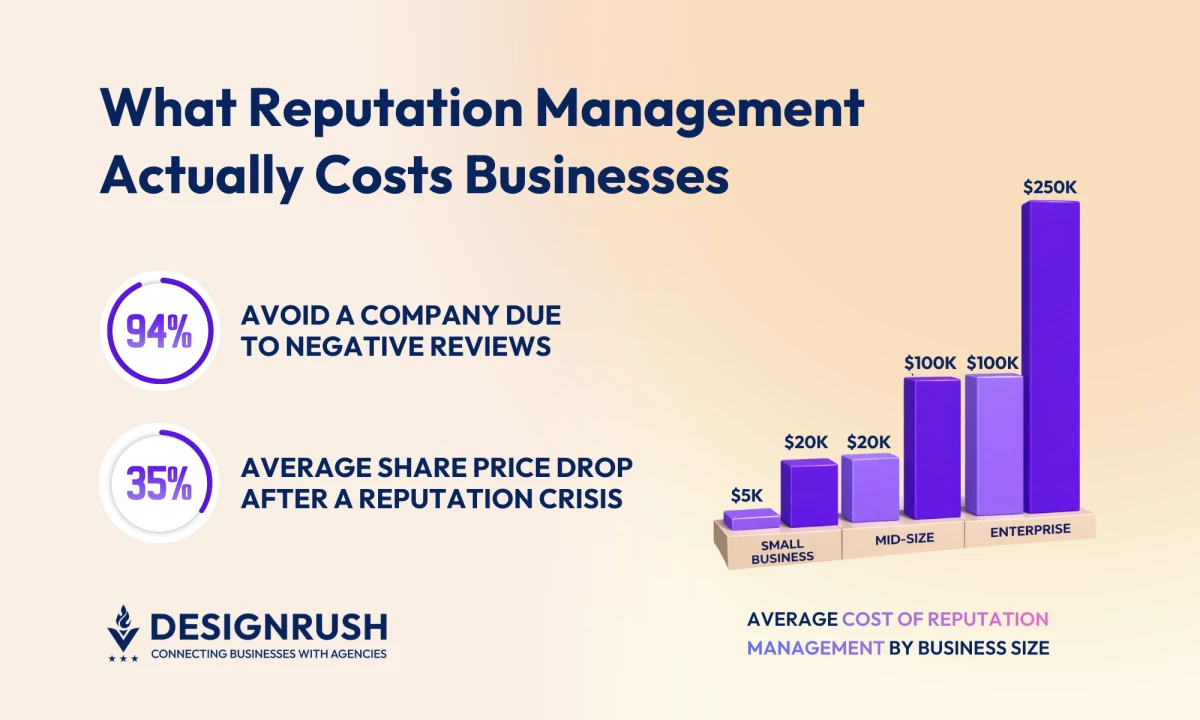
Data from the SenateSHJ Crisis Index 300 shows that corporate share prices fall by an average of 35.2% after a reputational crisis, and it can take well over a year to recover to pre-crisis levels.
At the everyday end, ReviewTrackers found that 94% of consumers say a negative review has convinced them to avoid a business.
One figure measures catastrophic risk and the other measures steady erosion, but both point the same direction: reputation problems compound while they go unaddressed.
The longer negative content sits, the more authority and backlinks it accumulates, which makes it harder and more expensive to move later.
That is why proactive reputation management usually pays for itself. Preventing a crisis, or catching one early, costs far less than repairing the stock drops, lost contracts, and customer churn that follow a reputation that has already slipped.


How Much Does It Cost To Hire a Reputation Management Agency?
Reputation management services pricing depends on three things: how visible a brand is, how severe the reputational issue has become, and whether the work is proactive or reactive.
Those variables move pricing so much that two engagements that look similar on paper can carry very different price tags.
Based on DesignRush portfolio data, the average cost of reputation management typically falls between $5,000 and $100,000, with higher-risk or high-profile cases exceeding that range.
Anyone who has searched this topic has probably seen much lower numbers, often quoted as a few hundred to a few thousand dollars per month. Those figures are real, but they usually describe DIY software or entry-level review management, not a full agency engagement built to solve an active problem.
DesignRush data reflects what businesses actually pay when they hire an agency to fix something, which is why the ranges below are expressed as total engagement costs rather than monthly fees.
For readers budgeting month to month, each range includes an approximate monthly equivalent based on typical engagement length.
The rest of this section breaks down reputation management costs the same way agencies price them: by hourly rate, by business size, and by service type.
- Reputation management agency hourly rates
- Average cost of reputation management by business size
- Reputation management services pricing by service type
Reputation Management Agency Hourly Rates
Hourly pricing is most common when a business needs flexibility or a short-term intervention rather than an ongoing program.
From the data, reputation management agency rates typically fall into three tiers:
- $100-$135 per hour
This range is common among agencies supporting small businesses, professionals, and local brands. These firms often provide online review monitoring, basic online reputation management (ORM), and targeted search result cleanup. - $150-$200 per hour
Mid-tier agencies in this range usually handle broader online reputation management services for small businesses, executive visibility, brand positioning, and public relations support across search and media platforms. - $400-$500 per hour
These rates are associated with elite firms handling hedge funds, public figures, investment managers, and crisis-level reputation repair. At this level, reputation management becomes a strategic advisory service rather than a tactical fix.
Average Cost of Reputation Management by Business Size
Reputation management costs scale with business size because visibility, risk exposure, and complexity all rise as a company grows.
What works for an individual or local business rarely applies to mid-sized or enterprise brands, which is why pricing varies so sharply across tiers.
- Small businesses and individuals
- Mid-sized businesses and established brands
- Enterprises, public figures and high-exposure organizations
Small Businesses and Individuals
For individuals and small organizations, reputation management is usually targeted and time-bound.
- Typical investment: Under $5K to $20K
- Duration: 1-6 months
- Common needs:
- Online review cleanup
- Local search reputation repair
- Negative content suppression
- Entry-level ORM campaigns
This is where many online review management companies operate, offering focused services rather than long-term brand strategy.
This pricing tier often overlaps with the best online reputation management services for individuals, especially for professionals in healthcare, education, and personal branding.
Mid-Sized Businesses and Established Brands
Mid-market companies typically require ongoing reputation oversight rather than one-off fixes.
- Typical investment: $20K-$100K
- Duration: 6-12 months
- Common needs:
- Executive and CEO reputation management
- Brand positioning and credibility rebuilding
- AI and search reputation management
- Industry-specific ORM (healthcare, eCommerce, finance)
This tier represents the most common average cost of reputation management, balancing proactive brand protection with reactive monitoring.
Enterprises, Public Figures and High-Exposure Organizations
For enterprises and high-visibility clients, reputation management is continuous and multi-channel.
- Typical investment: $100K-$250K+
- Duration: 9-24 months or longer
- Common needs:
- Crisis management and recovery
- Thought leadership and PR strategy
- Investor-grade reputation positioning
- Global or AI-driven reputation oversight
At this scale, agencies operate as long-term strategic partners rather than service vendors.
The cost reflects the senior talent, constant monitoring, and cross-channel coordination that high-exposure reputations demand.
Reputation Management Services Pricing by Service Type
Reputation management pricing varies by service because each discipline addresses a different level of risk and visibility.
Review management, full ORM, crisis response, and AI search reputation call for different expertise, timelines, and resources, which is why the cost of one can sit ten times above another.
The dividing line is whether the content can be removed at all. As Cenk Uzunkaya, CEO of online reputation management company Erase.com explains:
"It comes down to removability. One forum thread that breaks a policy can be a quick job. Fifteen results spread across news sites, review platforms, and Reddit, where most of it is true or hard to challenge, is a suppression campaign.
Suppression can take months if nothing is removed. You're pushing down results that have held their spot for years."
Each service below carries its own price for the same reason: how much of the work is removal, and how much is the slower job of outranking what cannot be removed.
- Online reputation management
- Online review management
- Crisis and misinformation response
- Public relations and thought leadership
- AI and search reputation management
1. Online Reputation Management
- Cost range: Under $5K to $20K for basic ORM
- Up to $100K+ for executive or enterprise ORM
This includes monitoring, content creation, suppression strategies, and visibility management across search engines and platforms.
2. Online Review Management
- Cost range: Under $5K to $20K
- Most commonly delivered by specialized online review management companies
- Focused on reviews, ratings, and local business reputation rather than full-scale PR
Online review management is often the entry point for online reputation management services for small businesses, especially when reputation issues are concentrated on Google reviews or local platforms.
As Paul Gordon, software founder behind Shortcuts Software and myPresences, advises:
“First, always reply. A bad review with no reply is not a good look. Be professional in your reply and show that you have listened to the feedback.
If the review is inaccurate, respectfully add your context. If your business is in the wrong, acknowledge it and indicate how you will address the issue.”
3. Crisis and Misinformation Response
- Cost range: Under $5K for limited incidents
- $20K-$100K+ for sustained or high-risk crises
Crisis work is short-term but intensive, often requiring media coordination, legal alignment, and rapid response frameworks.
4. Public Relations and Thought Leadership
- Cost range: $5K-$250K+
Used by executives, innovators, and regulated industries to proactively shape public perception rather than repair damage.
5. AI and Search Reputation Management
- Cost range: $20K-$100K
- Focused on managing brand visibility across Google Search, generative AI platforms, and algorithm-driven results.
This service category has grown rapidly as brands adapt to AI-powered discovery, where visibility is no longer driven by Google rankings alone.
What Affects Reputation Management Pricing?
Two engagements can look identical on the surface and still be priced very differently.
Reputation management cost is driven by the level of risk involved, the breadth of visibility at stake, and the complexity of the work required to protect or repair a brand's public perception.
Based on how agencies structure real-world engagements, the factors below move pricing the most.
- Level of reputational risk and urgency
- Brand visibility and search footprint
- Scope of services required
- Number and type of platforms involved
- Duration of the engagement
- Seniority and expertise of the reputation management agency
1. Level of Reputational Risk and Urgency
The single biggest pricing driver is whether the work is reactive or proactive.
- Low-risk, proactive reputation management
Monitoring, review management, and brand building cost significantly less because they are predictable and planned. - High-risk or crisis-driven reputation management
Active crises, legal exposure, viral incidents, or investor-sensitive situations require rapid response, senior-level involvement, and often 24/7 availability, which increases pricing.
2. Brand Visibility and Search Footprint
Reputation management pricing scales with how visible you are online.
- Local businesses with limited search presence typically require fewer resources.
- National brands, public figures, executives, and companies ranking across multiple keywords require far more content, monitoring, and suppression work.
3. Scope of Services Required
The more services involved, the higher the cost.
Pricing increases when reputation management extends beyond basic ORM into:
- Online review management across multiple platforms
- Search result suppression and content replacement
- Public relations and media outreach
- Executive or personal brand reputation management
- AI and generative search reputation oversight
4. Number and Type of Platforms Involved
Cost rises with every platform an agency has to cover:
- Google Search and Google Business Profiles
- Review platforms and forums
- News sites and high-authority publications
- Social media channels
- AI-driven platforms and generative search results
As Gordon explains, “Reviews outside Google are going to become more important with the move to AI-first search. AI tends to favor industry services over generic services. So, reviews on these sites will increase in importance.”
That shift widens the footprint an agency has to manage, since a brand's standing now depends on platforms that traditional ORM often ignored.
5. Duration of the Engagement
Short-term engagements are typically tactical and lower cost.
Long-term reputation management programs cost more because they include:
- Ongoing monitoring and reporting
- Content production over time
- Algorithm and platform adaptation
- Continuous review and sentiment management
6. Seniority and Expertise of the Reputation Management Agency
Not all agencies price the same because not all agencies operate at the same level.
- Entry-level firms focus on reviews and basic ORM at lower rates.
- Senior agencies provide crisis strategy, executive advisory, and high-stakes reputation repair at premium pricing.
Reputation Management Budget: In-House vs. Agency
On paper, in-house can look cheaper. In practice, once you account for headcount, benefits, tooling, and execution limits, the cost picture changes quickly.
Here’s how the two models compare in real terms.
In-House Reputation Management Budget
Running reputation management internally means paying for people first, then tools. Unlike an agency fee, these costs are fixed whether reputation risk is high or low.
In-House Staffing Costs
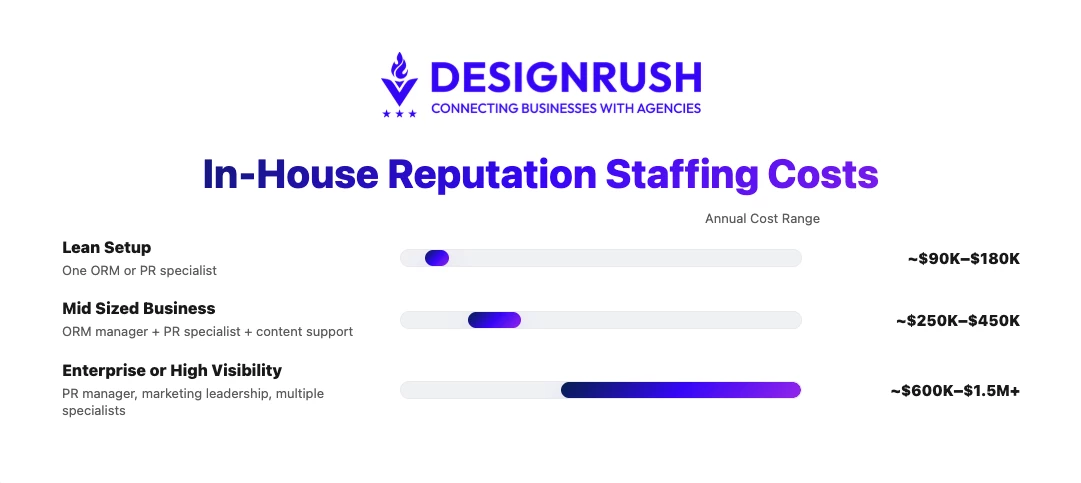
Most companies need at least one dedicated role to manage reviews, brand mentions, and escalations. As scope grows, additional PR and content capacity becomes necessary.
- Lean setup (small business or individual brand):
- One ORM or PR specialist: $90K-$180K per year, fully loaded
- Mid-sized business:
- ORM manager + PR specialist + content support: $250K-$450K per year, fully loaded
- Enterprise or high-visibility brand:
- PR manager, marketing leadership, multiple specialists: $600K-$1.5M+ per year, fully loaded
These estimates draw on US salary medians from the US Bureau of Labor Statistics and Glassdoor, adjusted using BLS data showing that benefits account for roughly 30% of total employer compensation costs in private industry.
In-House Software and Tools
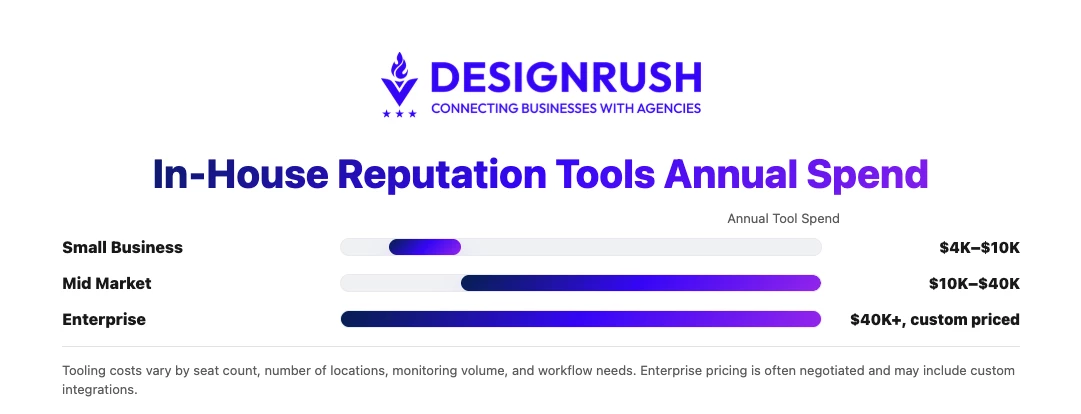
Even with staff in place, in-house teams still need monitoring and response platforms.
Typical annual tooling costs include:
- Social media and engagement management (e.g., Sprout Social)
- Brand monitoring and sentiment tracking (e.g., Brand24)
- Review management platforms (e.g., GatherUp, Grade.us)
Typical annual tool spend:
- Small business: $4K-$10K
- Mid-market: $10K-$40K
- Enterprise: $40K+, often custom-priced
Reputation Management Agency Budget
By contrast, a reputation management agency consolidates strategy, execution, tools, and senior oversight into one variable cost.
From a budgeting standpoint, here’s the key difference:
- In-house reputation management
High fixed costs, slower to scale, and limited exposure to crisis scenarios unless you hire very senior talent. - Agency-led reputation management
Lower entry cost, faster execution, and access to senior specialists only when needed.
That’s why many companies choose agencies even when they have internal marketing teams.
The average cost of reputation management through an agency is often lower than maintaining a fully staffed in-house function, especially for small and mid-sized businesses.
Reputation Management Pricing Models: Retainer, Project, and Hourly
The ranges above answer how much reputation management costs. They do not answer how a business is billed for it, and that distinction matters more than it first appears.
Two agencies can quote what looks like the same number and mean entirely different things, because one is a recurring monthly fee and the other is a one-time project total.
Before comparing any two quotes, a buyer needs to know which pricing model each one uses. Across the sources benchmarked for this guide, agencies structure that billing three ways.
1. Monthly Retainer
A retainer is a fixed recurring fee for an agreed scope of ongoing work.
- Typical term: 6 to 12 months, with a minimum commitment of around three months
- Best for: Ongoing maintenance, long-term suppression, continuous monitoring
- Tradeoff: Predictable, stable costs in exchange for commitment, not built for a quick exit
This is the most common model for reputation management because the work compounds over time.
Shorter contracts rarely give an agency enough runway to show results, since suppression, content production, and sentiment change all take months to register.
2. Fixed-Scope Project
Project pricing is a one-time fee for a defined deliverable with a clear start and finish.
- Typical range: $1,000 to $50,000, according to SurveySparrow, depending on scope
- Best for: Contained problems with a precise goal, such as removing a specific negative article, running a reputation audit, or pushing a set number of results off page one
- Tradeoff: No ongoing commitment, but no ongoing protection once the work ends
When the finish line is that clear, both sides agree on the deliverable and the deadline up front, and the engagement ends when the work is done.
3. Hybrid Model
The hybrid model combines the two: an intensive project phase to address an urgent problem, followed by a lighter ongoing retainer to hold the gains.
- Best for: A fire to put out, such as a leaked memo, a product recall, or a surge of fake reviews, that then settles into a state needing monitoring rather than active repair
- How it works: The project phase does the heavy lifting, and the retainer that follows catches new issues before they grow, scaling back up if the situation demands it
Knowing which model is on the table changes how a quote should be read. A $30,000 retainer and a $30,000 project are not the same offer, and a business that treats them as interchangeable can badly misjudge what it is actually buying.
How To Reduce Online Reputation Management Cost
The biggest cost drivers in most engagements are reactive work, unclear scope, and delayed response.
The good news is that most businesses can reduce online reputation management costs by addressing problems early and scoping efforts strategically rather than reacting after damage spreads.
Here are the levers that consistently lower cost in real-world engagements.
- Limit scope to what actually impacts visibility
- Separate review management from full ORM
- Use in-house resources for low-risk tasks
- Choose retainers over one-off emergency work
- Be transparent about budget and risk tolerance
- Reduce dependency on suppression with strong owned assets
1. Limit Scope to What Actually Impacts Visibility
One of the most common pricing mistakes is over-scoping. Not every negative mention needs suppression, and not every platform needs active management.
Costs drop sharply when the work concentrates on branded search results that actually rank, review platforms that influence buying decisions, and channels tied directly to revenue or credibility. Clear prioritization is what keeps pricing under control.
How Erase.com Cleared a Damaging Forum Thread in Two Days Without a Suppression Campaign
Tight scope is easiest to see in a case where the cheapest fix was also the fastest.
In one Erase.com engagement, a SaaS company had a forum thread full of complaints and disputed claims surfacing in procurement searches for its brand name, the kind of result that gives an enterprise buyer an easy reason to pause a deal.
Rather than launch a months-long suppression campaign to bury it, Erase.com identified the correct removal pathway and filed an expedited request documenting the thread's policy violations. The results:
- The thread was de-indexed from Google within two days of engagement.
- The content no longer surfaced on pages one, two, or three for the company's name.
- A follow-up audit confirmed no re-indexing of the content.
The speed came from a clean case rather than extra effort, something Uzunkaya traces to the following factors:
"Three things lined up. The thread broke clear rules, and we could prove each one. There was one decision-maker: Google's removal channels. We didn't have to wait on a site owner who might never write back.
And the harm was easy to show. The client had flagged the thread themselves and gotten nowhere. The difference wasn't effort. It was knowing which door to knock on and what proof to bring the first time."
One targeted action resolved what an unfocused program would have spent months and a far larger budget trying to push down.
2. Separate Review Management From Full ORM
Many businesses pay for full online reputation management when they only need review support.
If the core issue is ratings and customer feedback, carving review management out as a standalone service is far more cost-efficient than a full ORM program.
This is especially true for small businesses whose reputation lives on local platforms, where the entire problem often sits on Google reviews and a handful of directories.
3. Use In-House Resources for Low-Risk Tasks
A hybrid split usually gives the best return.
Routine tasks such as:
- Responding to reviews
- Flagging obvious policy violations
- Monitoring brand mentions
can be handled internally, while agencies focus on higher-impact work like search visibility, content suppression, PR, and crisis response.
Paying agency rates for tasks a staff member could do is one of the easiest ways to overspend.
4. Choose Retainers Over One-Off Emergency Work
Emergency reputation management is always more expensive.
Agencies price higher when they need to:
- Pause other client work
- Deploy senior staff immediately
- Operate under compressed timelines
A modest monthly retainer for monitoring and light optimization is often far cheaper over time than paying premium rates during a crisis.
5. Be Transparent About Budget and Risk Tolerance
Agencies price conservatively when expectations are unclear.
When clients clearly communicate:
- Acceptable risk levels
- Budget ceilings
- What “success” actually means
agencies can design leaner programs that avoid unnecessary deliverables. Transparency almost always results in better pricing alignment.
6. Reduce Dependency on Suppression With Strong Owned Assets
Long-term cost reduction comes from strengthening what you control.
Investing in:
- High-quality owned content
- Optimized brand pages
- Consistent thought leadership
reduces reliance on ongoing suppression tactics, which are resource-intensive and costly over time.
This is one of the most overlooked ways to lower the average cost of reputation management.
When Is Professional Reputation Management Worth the Cost?
The ranges in this guide only matter once a business decides it needs help at all.
Plenty of companies pay for reputation management they do not yet need, and plenty more wait until a problem has compounded past the point where it is cheap to fix. The line between the two is usually clear, and it comes down to a few specific signals.
Professional help tends to be worth the cost when at least one of these is true:
- Negative content ranks on the first page of branded search, where most prospects, partners, and recruiters will see it before they reach anything the business controls.
- The average review rating has slipped below roughly 3.5 stars, the point at which ratings start actively costing clicks and conversions rather than just denting perception.
- Lost deals, canceled contracts, or withdrawn offers can be traced to something a customer or decision-maker found online.
- A person's livelihood depends on how they appear in search, which is the norm for executives, doctors, lawyers, and other professionals whose names are searched before they are hired or trusted.
- An active crisis is underway, such as a viral complaint, a damaging news cycle, or a legal matter surfacing in results, where speed and senior judgment are worth paying for.
Handling reputation in-house is usually enough when the opposite conditions hold:
- Branded search results are clean, and the goal is simply to keep them that way.
- A few negative reviews sit against an otherwise solid overall rating.
- Someone on the team has the time and the skill to respond to reviews and publish content consistently.
- There is no active crisis and no revenue currently tied to a specific piece of negative content.
The tipping point is almost always money.
Once reputation issues start costing real revenue, whether through lost deals, falling conversions, or a crisis in motion, the math favors professional help, because the cost of the fix rises the longer the problem is left to gain authority and spread.
Reputation Management Cost: Final Thoughts
Reputation management has no single price because it is not a single service. The cost tracks the risk, visibility, and urgency behind each engagement, from a quick review cleanup to a multi-year corporate program.
What matters more than any headline figure is knowing which tier a situation calls for, whether a quote is a retainer or a fixed project, and whether the problem is worth solving now.
Businesses that act early and know what they are paying for spend less. The most expensive reputation problem is the one left alone.
If you're to compare providers, start with our directory of the top reputation management companies, vetted and ranked to help match a partner to the scope and budget an engagement requires.

Reputation Management Cost FAQs
1. How much does reputation management cost?
Reputation management typically costs $5,000 to $100,000, depending on brand visibility, urgency, and scope, according to DesignRush portfolio data. Small businesses and individuals often spend under $20,000, while larger brands and crisis situations require higher, ongoing investment.
2. How much does reputation management cost per month?
Most published monthly figures reflect DIY software or entry-level review management, not full agency work. Translated to a monthly view, DesignRush engagement data works out to roughly $800 to $3,500 for small businesses and $2,000 to $9,000 for mid-market programs.
3. Is a reputation management agency cheaper than in-house?
For most businesses, yes. In-house reputation management often exceeds $90,000 per year once salaries and tools are included, while an agency offers variable pricing that scales with actual risk and workload rather than fixed headcount.
4. How do I know if a reputation management quote is fair?
Ask what is included each month, whether pricing is a retainer or fixed-scope project, how results are reported, the minimum contract term, and whether removals are billed separately. Clear answers signal a fair quote. Guaranteed removals or rankings are a red flag.
5. What is the most affordable reputation management option?
The lowest-cost option is online review management or limited ORM focused on high-impact platforms. This approach works especially well for small businesses with localized reputations and avoids the higher cost of full-scale reputation repair.
6. What pricing models do reputation management agencies use?
Agencies bill three ways: a monthly retainer for ongoing work, usually on a 6 to 12 month term; a fixed-scope project fee for a defined deliverable, ranging $1,000 to $50,000 per SurveySparrow; or a hybrid of an intensive project followed by a lighter retainer.