
Keyword research is no longer just about finding high-volume terms and building content around them.
Search behavior has become more fragmented, with audiences moving between Google, AI search tools, forums, social platforms, and industry communities before making decisions.
That shift makes the research process more important than ever. The goal is to understand how people search, what they need at different stages of the journey, and where your content can realistically compete.
SEO Keyword Research: Key Findings
- Treat search intent as a traffic filter, not just a content-format guide. Informational queries are the ones AI summaries absorb, and organic clicks fall 38% when an AI Overview appears.
- Prioritize keywords by business potential before volume, because a term that names what you sell outperforms a higher-traffic one that draws visitors who never buy.
- Start every project from seed keywords drawn from what you sell and the words customers actually use, since a research tool can only build on the seeds you give it.
Why Keyword Research Still Matters in 2026
The clearest change is how much research now happens inside an AI answer.
McKinsey & Company found that 44% of AI-powered search users now call it their primary and preferred source of insight, ahead of traditional search at 31%. An Adobe survey found that among consumers who have used AI for shopping, 73% cite it as their primary source of product research.
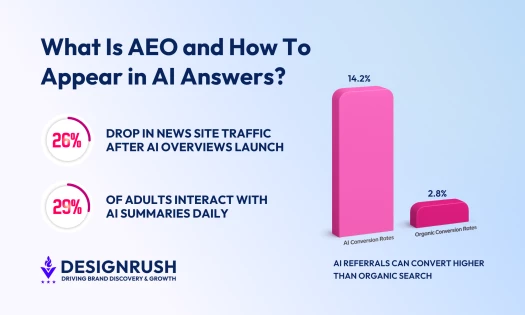
The shift shows up in clicks. A randomized field experiment by the Indian School of Business and Carnegie Mellon University found that search queries with AI Overviews saw organic clicks fall by 38%, while zero-click searches rose from 54% to 72%, as reported by Search Engine Journal.
Search satisfaction barely changed when those summaries were removed, which suggests the behavior is settled rather than temporary.
None of this makes keyword research obsolete. It just raises the stakes on which terms a business targets.
McKinsey also found that more than 70% of AI-powered search users ask top-of-funnel questions to learn about a category, brand, product, or service, so much of the early research now happens before anyone reaches a website.
Keyword research shows which topics can still earn a click and which search intent to prioritize. It also shows where commercial and transactional terms can reach buyers that a quick summary rarely satisfies.
Done well, keyword research still does what it always has. It connects what a business offers with the language real people use to find it.
The steps below move from a broad starting point to a prioritized list a team can act on.
Step 1: Brainstorm Your Seed Keywords
Seed keywords are the broad starting terms a business expands into a full keyword list. It's what research tools use to generate hundreds of related ideas, so the goal is range rather than precision.
A strong seed list comes from what the business already knows about itself and its customers. Three sources tend to produce the best seeds:
- The products or services the business sells provide the most obvious seeds.
- The problems those products solve provide more, since many searches start from a problem rather than a product name.
- The words customers use in emails, sales calls, reviews, and support tickets often reveal seeds that internal or technical language would miss.
Skipping straight to a tool without a considered seed list is the most common early mistake, because the tool can only build on what it is given.
Example: Seed Keywords for Project Management Software
Take a company that sells project management software. Starting from what it offers and the problems its customers describe, an initial seed list might look like this:
| Seed keyword | What it represents |
| Project management software | The core category term |
| Task management tool | How customers describe part of the job |
| Team collaboration software | A related need the product also serves |
| Gantt chart software | A specific feature people search for by name |
Each seed points at a different slice of the same audience, which gives the expansion step several directions to pull from.
These are starting terms only. Each still needs its intent and metrics checked in Steps 2 and 4 before it earns a place in the content plan.
Step 2: Map Each Keyword to Search Intent
Search intent is the reason behind a query, or what the searcher actually wants when they type it. Matching content to that intent is what decides whether a page earns the click and the conversion: Google and AI systems both reward pages that answer the real need rather than the exact phrase.
The table below maps the four types to real queries, using project management software as an example.
| Intent | Example query | Best content format | Funnel stage |
| Informational | "what is project management software" | Guide or explainer article | Awareness |
| Navigational | "asana login" | Brand or product page | Brand-aware |
| Commercial investigation | "best project management software" | Comparison page or listicle | Consideration |
| Transactional | "project management software free trial" | Product, demo, or signup page | Decision |
Intent classification also doubles as a traffic filter in 2026.
Informational queries are the ones AI summaries absorb most often, which is why a high-volume informational term can be worth less than a lower-volume commercial or transactional term where a summary rarely settles the question.
Mapping keywords to these stages helps a content plan cover the full journey and move readers from early research toward a conversion page.
How SparkToro Helped Beach Commute Choose the Right Keyword
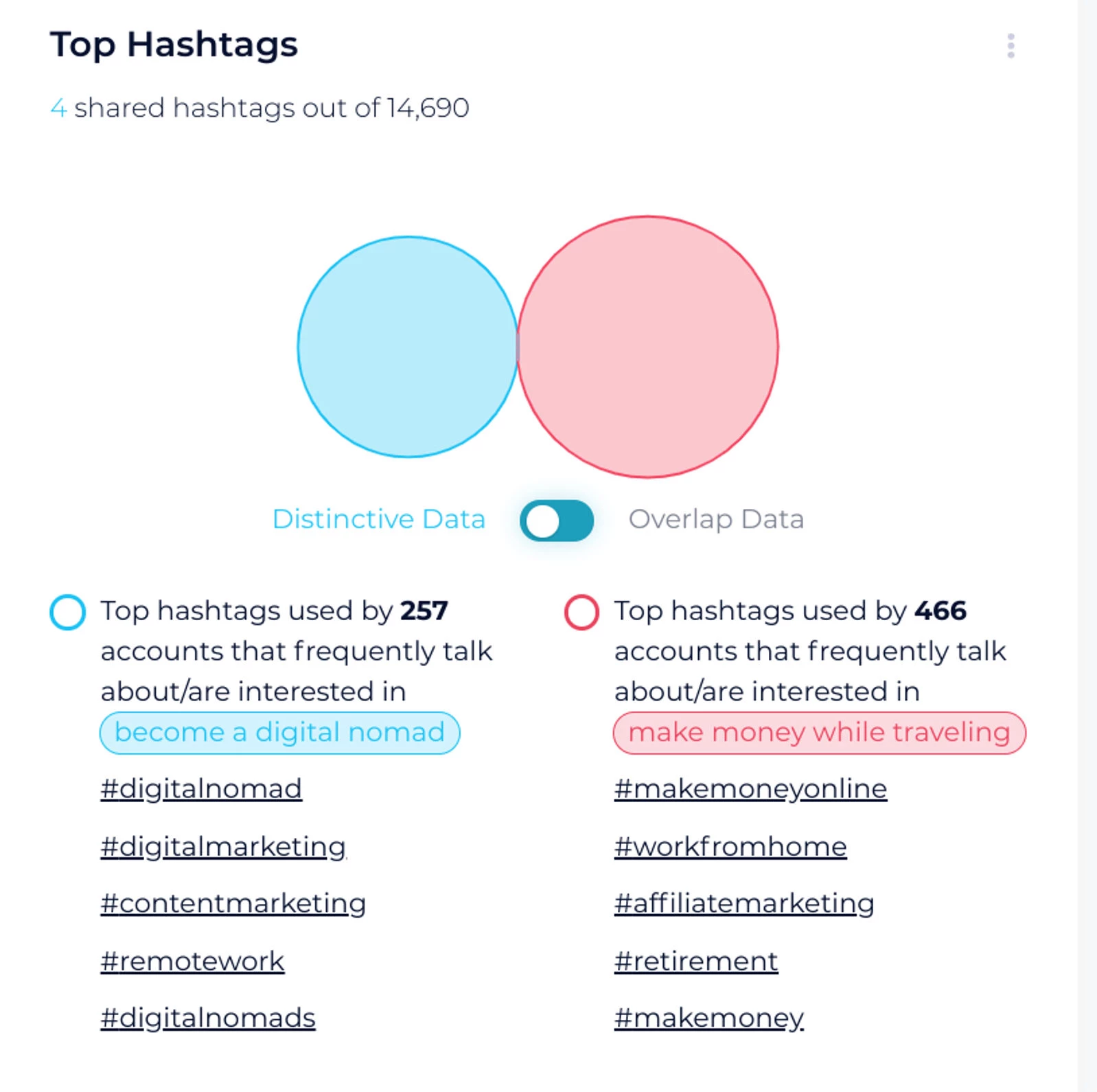
Beach Commute, a startup helping people build a location-independent career, weighed two homepage targets that looked equally promising: "become a digital nomad" and "make money while traveling."
Using SparkToro's audience data, the team found the two phrases attracted different audiences. The digital nomad crowd wanted aspirational travel, advice, and tips, while the "make money while traveling" crowd chased entrepreneurial income hacks.
Only one matched what Beach Commute offered, so the team built its homepage around "become a digital nomad."
Intent also ruled a term out. "Work and travel" looked like an obvious target until the team realized those searchers wanted programs that trade work for accommodation, such as hostel stays, not a career-focused lifestyle.
The phrase had strong surface relevance and the wrong intent behind it. Checking the intent behind a keyword, not just its wording, keeps this kind of term off the list.
Step 3: Expand Your Seeds Into a Full Keyword List
Expanding your seeds turns a handful of starting terms into a working list of dozens or hundreds of related keywords. The fastest way to do this is to enter each seed into a keyword research tool, which returns a large set of ideas along with the variations people actually search for.
Free options like Google Keyword Planner are enough for a starting list, while paid tools such as Ahrefs or Semrush return more ideas and more data per keyword.
Many of the most valuable results are long-tail keywords, the longer and more specific phrases that tend to be easier to rank for and often signal clearer intent.
The ideas a tool returns fall into two groups, and both belong on the list:
- Matching terms contain the words in your seed, such as "free project management software" or "project management software for small teams." They are close variations of the seed itself.
- Related terms are topically connected but do not contain the seed words, such as "kanban board" or "sprint planning." They capture the wider subject the audience cares about.
Matching terms are easier to spot. Related terms are where a lot of untapped opportunity sits, since fewer competitors think to target them.
Example: Expanding Project Management Seeds
Running the four seeds from Step 1 through this process produces a much longer list. A few examples of what each type looks like:
- Matching terms include "free project management software," "project management software for small business," and "best gantt chart software."
- Related terms include "kanban board," "sprint planning," "resource allocation," and "agile workflow."
- Question terms include "what is the best project management software for remote teams" and "how do gantt charts work."
Step 4: Find Keywords Your Competitors Rank For
Competitors have already done keyword research worth borrowing.
Search Google for a seed keyword and note the sites ranking on page one, then enter one of those domains into a keyword research tool to see its top pages and the keywords driving its traffic. The terms that fit the business become new candidates for the list.
A content gap analysis takes this further by showing the keywords competitors rank for that a site does not. Most tools have a version of this feature, such as Keyword Gap in Semrush or Content Gap in Ahrefs.
Enter your domain alongside two or three competitors, and the tool returns the terms they rank for and you miss. Filtered by intent, this surfaces the commercial and informational gaps most worth closing.
How Choreograph Used a Keyword Gap Analysis to Grow Volkswagen Türkiye's Organic Leads
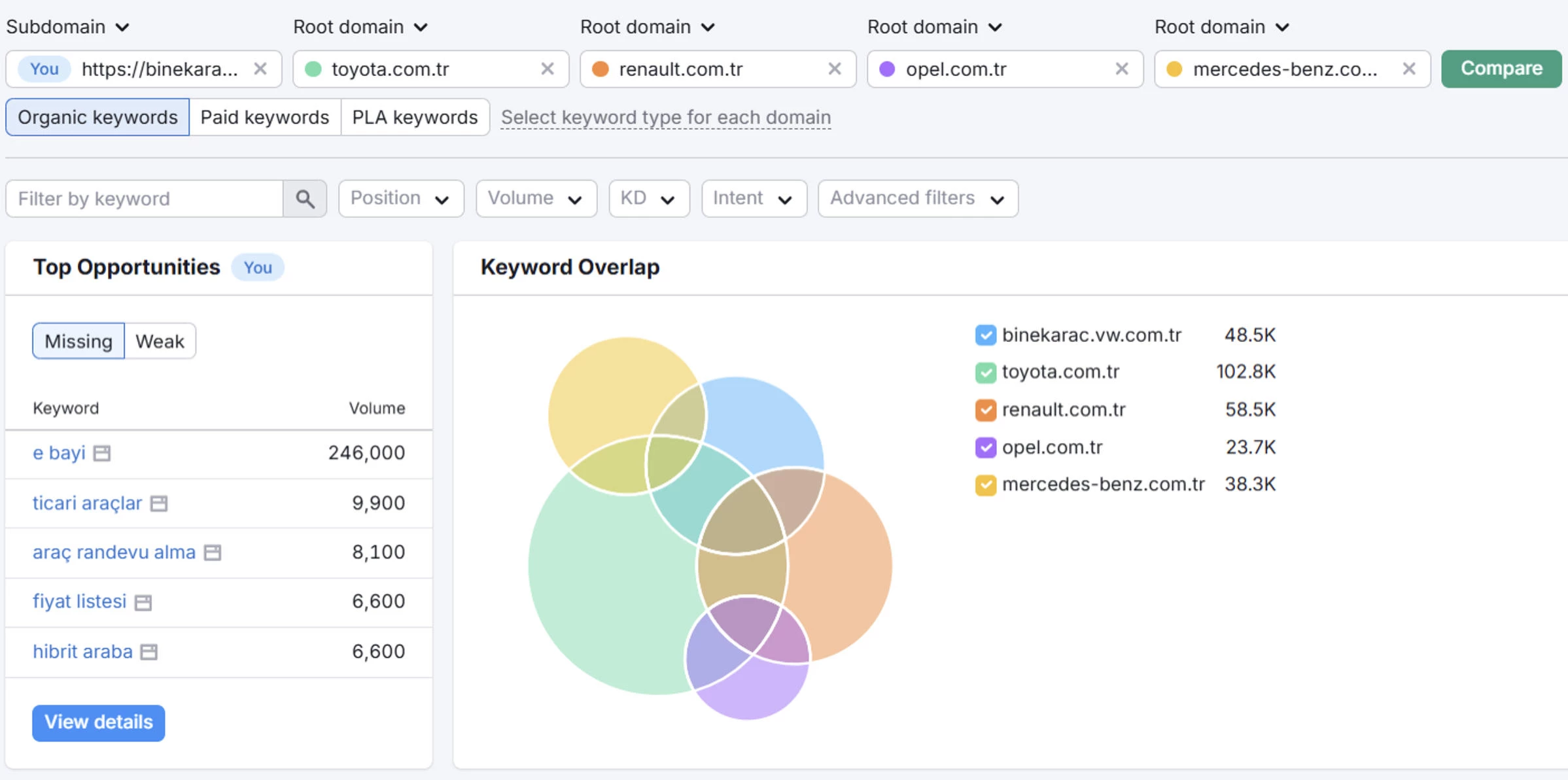
Volkswagen led Türkiye's car market but was losing the search results for its most valuable keywords to large multi-brand platforms. Working with Choreograph, WPP Media's data and technology company, the brand ran a keyword gap analysis in Semrush to find the terms driving traffic to competitors that Volkswagen was missing.
The analysis shaped the content that followed. The team prioritized commercial terms competitors were winning, such as "SUV prices" and "SUVs on sale," instead of the generic high-volume term "SUV," and built a "Driving Guide" blog series around low-difficulty, long-tail questions buyers were asking.
Over the following year, the brand reported:
- Organic clicks to the "Driving Guide" blog grew from 15,500 to 169,000.
- Total ranked keywords grew 108.8%, reaching 3,429.
- The organic channel added 1,130 digital leads and 10,364 "Build Your Own Car" completions.
Finding the keywords competitors ranked for, and Volkswagen did not, is what turned market presence into search demand.
However the keywords are found, the list at the end of this step is long and unfiltered. Step 5 narrows it by checking the metrics behind each term.
Step 5: Analyze the Metrics That Matter
The right metrics tell you which keywords are worth pursuing and which will drain effort for little return. A broad keyword list always contains terms that are too competitive, too vague, or too disconnected from what the business sells.
These metrics separate the keywords worth building content around from the ones to set aside.
Search volume
Search volume is how often a term is searched over a given period, usually shown as a monthly average. Higher volume means more potential traffic, but it also tends to bring more competition, so volume is a starting signal rather than a decision on its own.
Keyword difficulty
Keyword difficulty estimates how hard it is to rank on the first page for a term, usually on a scale from 0 to 100. The realistic target depends on a site's authority. As a rough guide on that scale:
- New or low-authority sites should focus on the lowest range, roughly under 20, along with long-tail terms.
- Established sites with some authority can pursue the middle range.
- Only high-authority sites should chase the most competitive head terms near the top of the scale.
- Difficulty scores are calculated differently by each tool, so compare terms within one tool rather than across several.
Traffic potential
Traffic potential is the total traffic a page can earn from every keyword it ranks for, not just its main term. A single page usually ranks for many related queries at once, so the top page for a topic can attract far more traffic than the search volume of any one keyword suggests.
This is why it is better to judge the potential of a topic than the volume of a single phrase.
Business potential
Business potential is how directly a keyword connects to what the business actually sells. A simple way to score it is a 0 to 3 scale:
- A score of 3 means the product or service is the direct solution to the query.
- A score of 2 means the product is clearly relevant but not the only answer.
- A score of 1 means the topic is related but the product is a minor part of the answer.
- A score of 0 means the term draws an audience that is unlikely to ever buy.
High-volume informational terms often score low here, which is why volume alone is a poor way to prioritize.
Growth and seasonality
Search volume is an annual average, so it can hide terms that are climbing or that spike at certain times of year.
A term tied to a filing deadline or a shopping season looks modest as an average but dominates for a few weeks. Google Trends shows this movement and helps spot rising terms before competitors commit to them.
Check SERP features before you commit
Before targeting a term, look at what already occupies its results page. This step decides whether a ranking will actually earn clicks in 2026:
- An AI Overview on an informational query absorbs many of the clicks that would otherwise reach a ranked page, which can make a high-volume informational term worth less than its numbers imply.
- Featured snippets, image packs, and video carousels each reward a specific content format, so the feature present tells you what kind of page has a chance of winning the space.
The metrics at a glance
| Metric | What it tells you | Where to find it |
| Search volume | How much demand a term has | Any keyword research tool |
| Keyword difficulty | How hard it is to rank for | Any keyword research tool |
| Traffic potential | Total traffic the topic can earn | Tool estimate plus top-page analysis |
| Business potential | How well the term fits what you sell | Manual 0 to 3 score |
| Growth and seasonality | Whether demand is rising or seasonal | Google Trends |
| SERP features | Whether a ranking will earn clicks | The live search results page |
Step 6: Cluster and Map Keywords to Content
Finding good keywords is only half the job. The next step is deciding which keywords belong together on the same page.
This process is called keyword clustering: grouping keywords that share the same search intent and largely return the same top-ranking pages in search results. Instead of creating separate pages for every variation, one page targets a primary keyword while naturally covering related terms.
For example, a page targeting "project management software" will often rank for related terms such as "task management software," "team collaboration software," and "project planning tools." Creating separate pages for each variation would usually create unnecessary overlap.
A simple way to check whether keywords belong in the same cluster is to search them and compare the results. If most of the top-ranking pages are the same, they likely belong on one page.
Many businesses organize these clusters using a pillar-and-cluster model:
- A pillar page covers the main topic in depth.
- Cluster pages cover related subtopics.
- Internal links connect the pages and help search engines understand the relationship between them.
The final step is keyword mapping: assigning each cluster to a specific URL. Every important keyword should have one clear destination page.
This prevents two pages from competing for the same search term and gives search engines a stronger signal about which page deserves to rank.
How Minuttia Built a Single Topic Cluster That Ranked for Over 1,000 Keywords
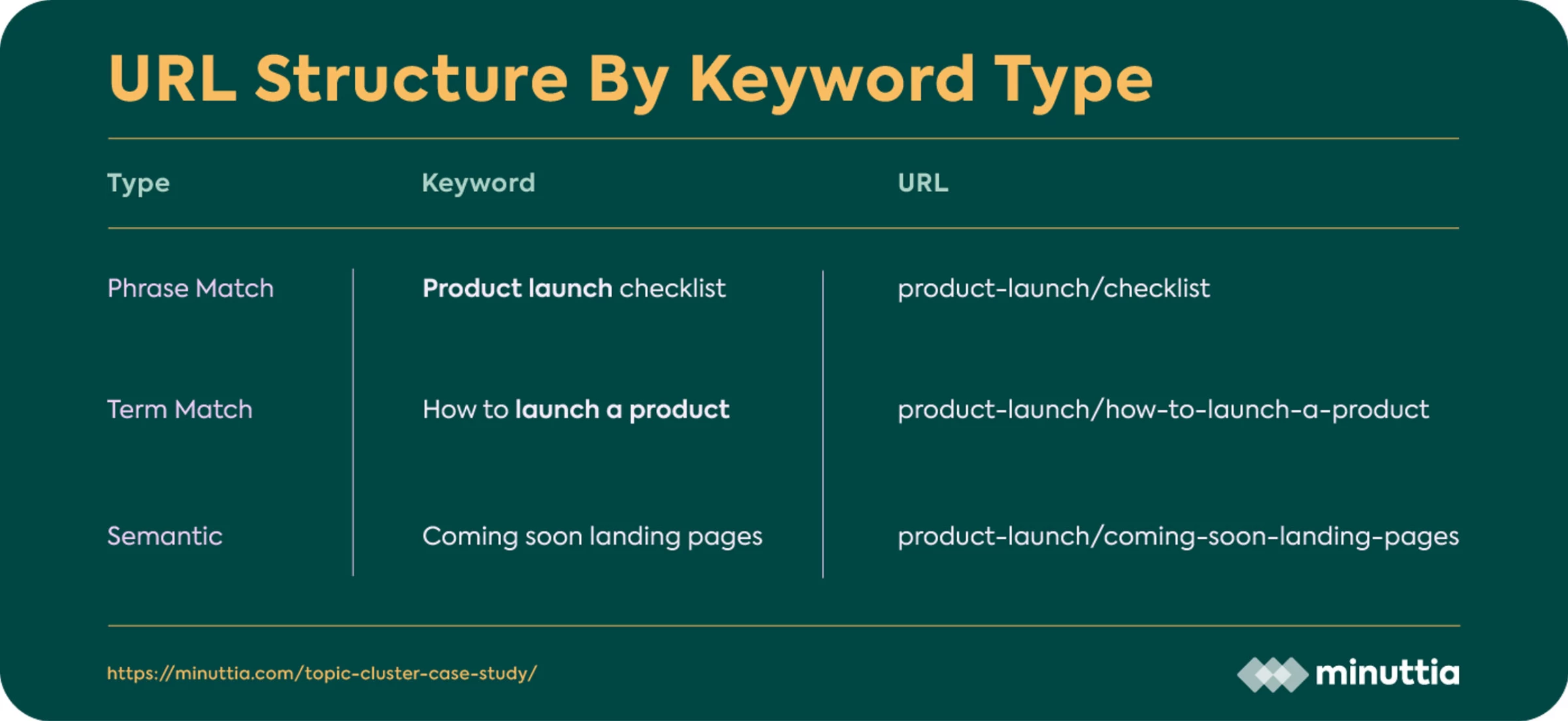
Referral marketing software Viral Loops wanted organic visibility for the topic of "product launch." Rather than write one long article, the agency Minuttia built a topic cluster: a central hub page on product launches, supported by cluster pages each targeting one subtopic, such as product launch strategy, email, metrics, checklist, and press release.
The structure did the work. Each cluster page lived in a clean URL under the hub, for example viral-loops.com/product-launch/strategy, so search engines read every page in the context of the parent topic.
Minuttia reported the following, with no link building involved:
- The cluster ranked for more than 1,100 organic keywords.
- Individual cluster pages reached top positions for their target terms, including a #1 ranking for "product launch metrics."
- The cluster collectively brought in around 100 organic clicks on weekdays.
As the agency noted, subtopics worth covering should not be judged on search volume alone. If a subtopic is closely related to the core topic, it earns a cluster page.
Step 7: Prioritize and Choose What to Target First
A finished keyword list is usually much larger than a business can realistically tackle at once. Prioritization turns that list into an action plan.
The most effective order is:
- Business potential
- Traffic potential
- Keyword difficulty
A keyword that directly connects to a product or service is usually more valuable than a higher-volume term that attracts visitors unlikely to become customers. Traffic matters, but relevance comes first.
For newer websites, difficulty deserves extra attention. Ranking for a highly competitive head term can take years, while a lower-difficulty long-tail keyword may generate meaningful traffic within months. Early wins help build authority, backlinks, and topical coverage that make larger opportunities more realistic later.
A balanced strategy usually includes three timelines:
| Timeline | Goal | Example |
| Short term | Quick wins from lower-difficulty keywords | "project management software for nonprofits" |
| Medium term | Build authority around core topics | "best project management software" |
| Long term | Compete for high-volume category terms | "project management software" |
This approach creates momentum while still investing in future growth.
One final shortcut: check for pages already ranking on page two of Google. Improving an existing page from positions 11-20 to the first page often produces traffic faster than creating an entirely new piece of content.
How Ignite Digital Helped a Manhattan Concierge Practice Prioritize High-Value Keywords
A Manhattan concierge medical practice was ranking for high-volume, low-value terms like "flu shot NYC" while missing the searches that actually drove revenue.
Working with the agency Ignite Digital, the practice shifted its keyword strategy toward high-value terms such as "best concierge doctor NYC" and "executive physical exam NYC," even though those searches had far lower volume.
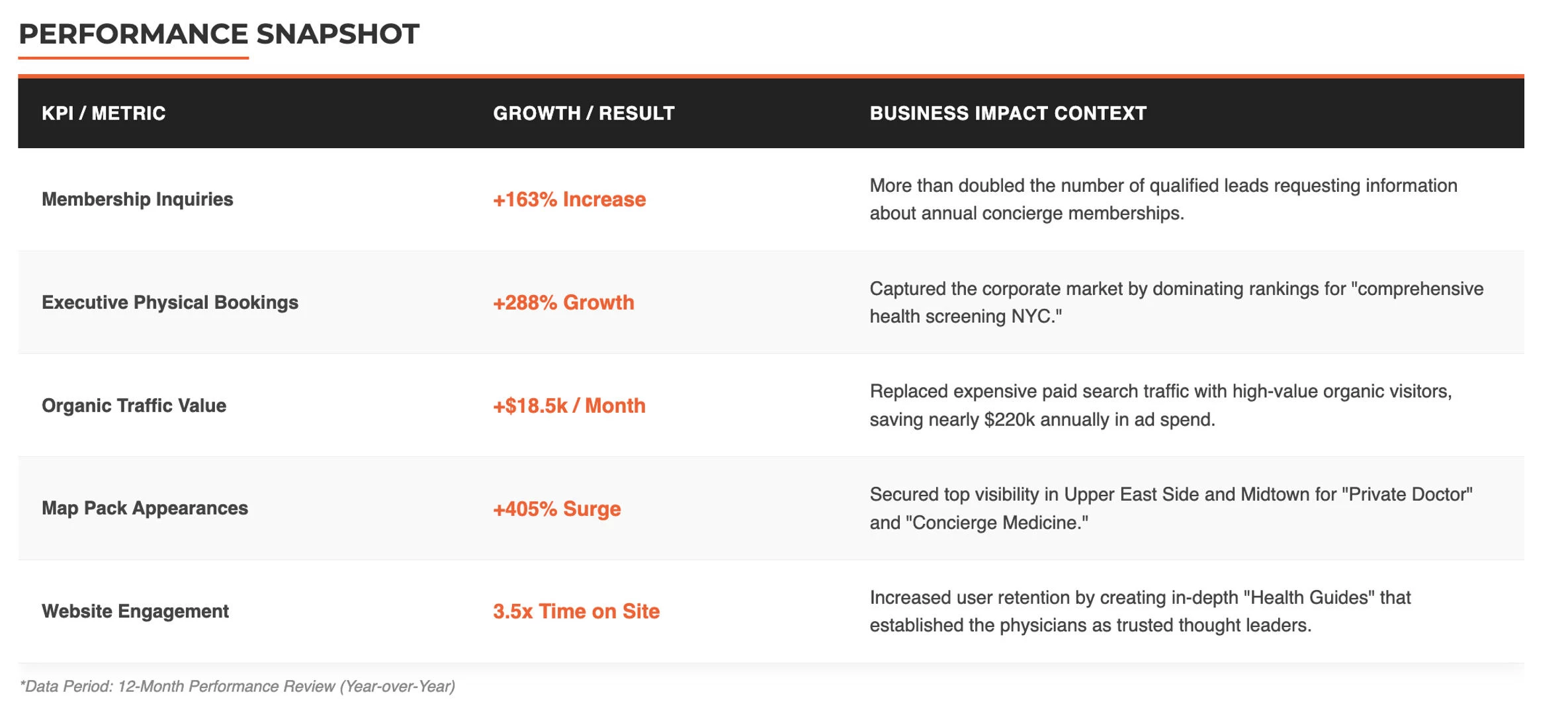
The economics explain the choice. A concierge membership patient is worth $5,000 to $15,000 or more a year, against a few hundred for a general-care patient, and the practice reported cutting its cost to acquire a patient from around $2,000 to under $350.
Over a 12-month period, and as part of the wider repositioning, the practice reported:
- Membership inquiries increased 163%
- Executive physical bookings grew 288%
- Time on site rose to 3.5 times its previous level
Search volume alone would have pointed to the wrong keywords. Business potential pointed to the ones that paid.
Keyword Research Tools: A Quick Starting Point
The right choice depends on budget and how much data each task calls for, so the options below are grouped by job rather than ranked.
- Google Keyword Planner and Google Search Console are the free starting point. Keyword Planner gives volume ranges and ideas straight from Google, and Search Console shows the queries a site already ranks for. Together they cover the basics at no cost, though Keyword Planner reports volume in broad ranges and has no difficulty score.
- All-in-one platforms like Ahrefs and Semrush are the paid workhorses. They return exact volumes, a keyword difficulty score, traffic potential, and competitor and gap data in one place, which is why most of the worked examples in this guide use one. They are the tools to graduate to once free options start to feel limiting.
- AnswerThePublic is worth adding for question-based keywords. It maps the questions people ask around a topic, which surface strong long-tail and informational terms that broad keyword tools can miss.
For a fuller comparison, including which free tools cover which jobs, see our guides to free Google SEO tools and AI SEO tools. The best tool is the one a person will actually use consistently, so starting free and upgrading when the limits get in the way is a reasonable path.
Keyword Mistakes That Can Hurt SEO Performance
Even a strong keyword list can be undermined by a few common mistakes. Avoiding these matters as much as choosing the right terms:
- Chasing keyword density: Google has repeatedly said it uses no target density, and John Mueller confirms it, so aiming for a figure like 1.5% only invites keyword stuffing. Use the primary term naturally and cover the topic thoroughly.
- Keyword stuffing: Repeating a term unnaturally reads as spam to both search engines and readers, and can cost rankings rather than earn them. Write for the person first, letting the keyword appear only as often as the writing genuinely calls for.
- Optimizing for exact-match variations: Google understands topics, not just phrasings. Cover the related terms and questions a topic involves so one page can rank for many variations.
- Ignoring search intent: A term is only worth targeting if the page matches what searchers expect. Ranking a product page where people want a guide causes quick exits. Check what already ranks, then match that format before committing.
- Keyword cannibalization: Two pages targeting the same keyword compete with each other, splitting ranking signals and often leaving both worse off. Cluster and map keywords to one page each, as covered earlier in this guide, to prevent it.
- Writing for search engines instead of people: Content built for algorithms rather than readers rarely satisfies either. Search engines and AI systems both pull from pages that genuinely help. Let keywords guide what a page covers, not how it reads.
SEO Keyword Research: Final Thoughts
Keyword research in 2026 is less about chasing the highest-volume terms and more about judgment: knowing which keywords still earn a click, which match what a business sells, and which belong together on one page.
As AI answers absorb more of the early research, the businesses that win visibility will be the ones targeting the right terms with the right intent, not simply the most searched.
Start with a focused seed list, let the metrics decide what to pursue, and map each keyword to the page best placed to rank for it.

Our team ranks agencies worldwide to help you find a qualified partner. Visit our Agency Directory for the top SEO agencies, as well as: