
We’re breaking down the most important SEO statistics of the year, each one paired with expert-backed context and practical takeaways to help your team adapt faster, perform better, and stay visible across evolving search ecosystems.
SEO Statistics: Key Findings
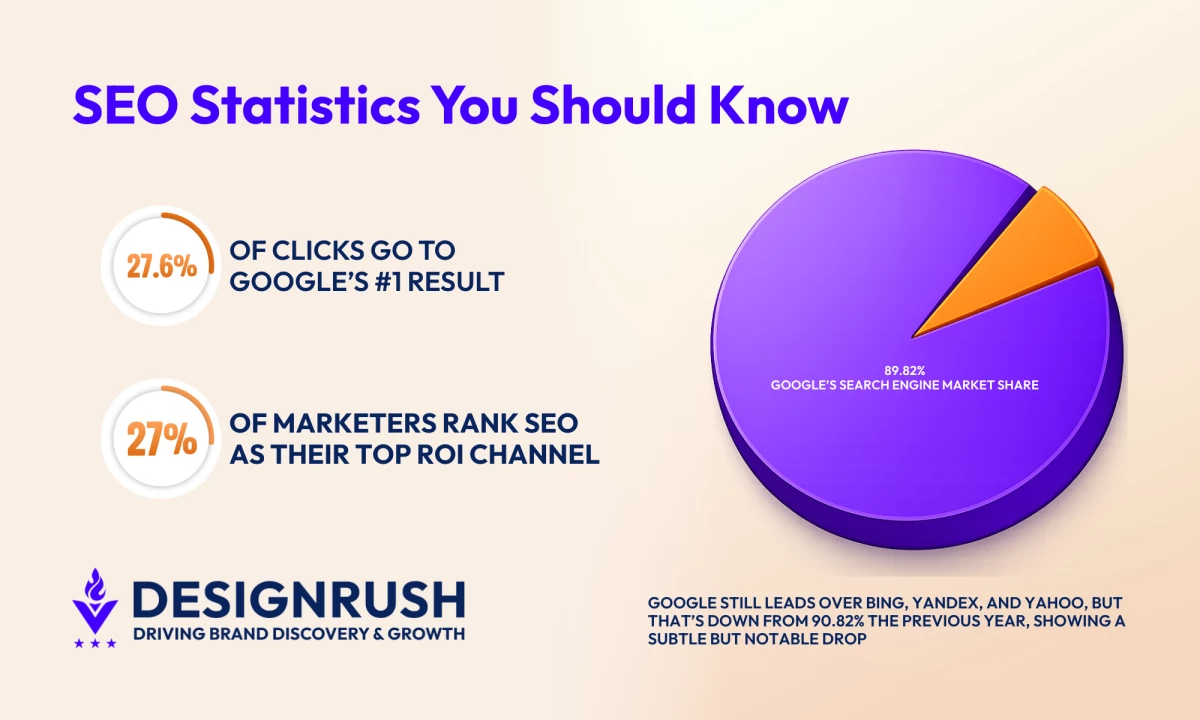
- Despite holding 89.82% of global search market share, Google’s dominance is shifting as tools like ChatGPT and Perplexity gain traction.
- Google rewards intent-driven content more than anything else, with satisfying content now accounting for 23% of its ranking algorithm.
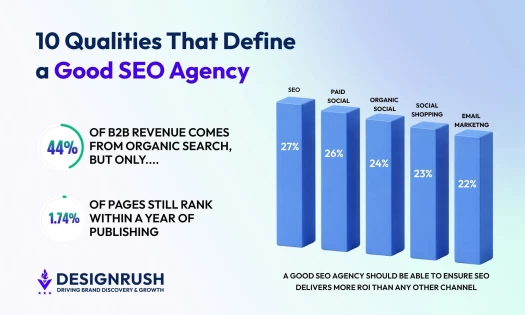
- SEO, websites, and blogs rank highest for ROI at 27%, ahead of paid social at 26% and organic social at 24%.
Is Google Still the Starting Point for Search in 2026?
Google has long been the default gateway to online discovery, but in 2026, that dominance is being quietly reshaped.
With AI tools entering the search journey and users blending platforms, it’s time to rethink what search actually means, and where your content needs to show up.
Google Owns Almost 90% of Search, But AI Is Entering the Search Journey
Google remains the dominant force in search with 89.82% of the global market share. But that doesn’t mean users are only turning to traditional search engines.
In December 2025, Google dominated the global search engine market with a 90.82 percent share. However, this stronghold may be eroding, as its share across all devices dipped to its lowest point in over two decades.
This dip suggests a gradual shift in global search behavior.
Generative AI Is Reshaping the Search Experience
Generative AI tools like ChatGPT, Gemini, Perplexity, and Claude are quietly becoming part of how people find answers, reshaping how search fits into the information-gathering process.
In 2024, about 15 million adults in the United States reported using generative artificial intelligence as their primary tool for online search. By 2028, this number is projected to reach over 36 million users.
AI Overviews now appear in 30% of all Google results and 74% of problem-solving queries. This signals that AI is no longer a separate tool — it’s embedded in the search experience.
While 82% of consumers have noticed AI Overviews in search results, most do not rely on them exclusively, and some voice frustration.
These findings underscore the need for marketers to maintain strong content strategies across traditional and AI-driven channels, ensuring consistency and relevance as consumer behavior evolves.
AI Mode is also advancing with Gemini 3. It’s more intelligent and changes how Search delivers value by offering tailored results.
- With Gemini 3 understanding deeper intent, your content must be even clearer and more authoritative to be surfaced.
- AI Mode can create interactive tools in responses, so think about how your content can be referenced or linked in those experiences.
- Complex questions will rely on this model, so crafting content that addresses nuanced queries will be key to visibility.
Adoption is also rising on standalone AI platforms. ChatGPT has over 900 million weekly active users worldwide, reflecting how deeply these AI tools are being woven into daily workflows.
Adapting Your SEO Strategy for the AI Era
So, what steps should you take as AI changes search? How should you prepare for this shift?
Michael Hodgdon, Managing Director of Elite SEO Consulting, shares:
“Google and AI-driven search tools aren’t just asking what people are searching for — they’re trying to understand why they’re searching and how they want the answer delivered,”
“We’re seeing more zero-click results, AI-generated summaries, and voice assistants changing how users interact with search entirely.”
To stay competitive, brands must structure content that performs well across both search engines and AI-driven interfaces:
- Use structured data and concise formatting: Add schema markup and format key answers with headers, bullet points, and FAQs. This improves eligibility for AI Overviews and makes your content easier for AI tools to parse.
- Monitor how AI platforms present your content: Tools like ChatGPT and Perplexity often cite web pages. Run queries related to your niche and audit how your content appears, then optimize for clarity, authority, and citation value.
- Track how users find your content across platforms: Use analytics tools to monitor traffic sources beyond Google, especially in regions where alternative engines are gaining traction.
- Diversify your optimization strategy: Consider how your content appears not only in Google SERPs but in AI-generated summaries, Bing’s search results, and other fast-rising platforms.
AI’s growing role in search is already influencing how SEO professionals work. These recent findings show how deeply generative AI is being adopted across the industry:
- According to HubSpot’s State of Marketing Report, teams now rely on AI to automate keyword research, metadata creation, and large-scale audits, reclaiming hours for higher-level strategy.
- Instead of reviewing dozens of pages manually, AI scans thousands of ranking signals at once to surface trends, gaps, and competitive weaknesses.
- Many SEO workflows now include AI-assisted content optimization that benchmarks pages against top results and strengthens structure and relevance.
- Predictive models bring forecasting into SEO, helping teams prioritize content based on ranking potential and projected traffic impact.
- Across the industry, AI functions as a decision-support layer, while human expertise still guides strategy, brand voice, and final judgment.
- Also, in The State of AI in 2025 Survey, 62% of respondents say their organizations are already experimenting with AI agents.
- Respondents also cite use-case-level cost and revenue gains, with 64% saying AI drives innovation. Yet only 39% report enterprise-level EBIT impact.
- AI has evolved from a niche tool into a core marketing tool. Global AI marketing revenue is expected to surpass $107 billion by 2028.
While Google still commands a massive lead, this milestone is a reminder that disruption is happening, especially as AI tools change how people interact with content online.
What Google Actually Rewards in 2026
With algorithm updates rolling out constantly, it’s easy to chase the latest trend. But in 2026, Google’s core ranking signal hasn’t changed: content that satisfies search intent.
Signals From the February 2026 Discover Update
Here’s the latest:
- February 2026 Discover Core Update focuses on improving the Discover feed.
- More locally relevant content from country-based websites.
- Reduces clickbait and sensational content in Discover.
- Highlights in-depth, original content from sites with demonstrated expertise.
- Expertise is recognized by topic, allowing niche and multi-topic sites equal opportunities.
- Discover traffic may fluctuate, with some sites seeing changes and others none.
Consistent publication of high-quality, satisfying content remains paramount, accounting for 23% of the ranking weight. This underscores the importance of regularly producing content that effectively addresses user intent.
Because of this, many B2B marketers are doubling down on content. In fact, nearly half planned to increase their content marketing budgets, with 33% projecting moderate increases and 13% expecting double-digit growth. This renewed investment reflects a broader recognition: valuable content is a ranking signal.
If you want to align with what Google actively rewards, here’s where to focus:
- Prioritize publishing frequency and consistency: Aim to release high-quality content at least twice per week to maintain topical authority and freshness in Google's eyes.
- Build around search intent: Understand the purpose behind your audience’s queries. Create content that answers their questions thoroughly and encourages deeper engagement.
- Invest in content operations: Like nearly half of B2B marketers who plan to increase their budgets, prioritize the resources — AI tools, strategy, writers, editors — that let you scale quality without compromising it.
- Elevate content depth and originality: With AI-generated content flooding the web, Google increasingly rewards content that offers unique insights, expert perspective, and practical value.
Why High-Quality Content Remains the Core Ranking Factor
High-quality content is both a ranking signal and a measurable driver of performance. These recent findings show how marketers are evolving their strategies around it:
- Content that includes a video not only earns more backlinks but can increase your reach and build trust.
- Interactive content drives 52.6% higher engagement than static formats, with users spending an average of 13 minutes on interactive experiences compared to 8.5 minutes on static ones.
- 65% of businesses have seen better SEO performance with AI, and 67% say content quality has improved — a clear sign of AI’s expanding role in search optimization.
- Content with at least one exact match anchor drives five times more traffic than pages that don’t use them.
- Marketers who use AI for content creation report stronger results — only 21.5% say their strategy is underperforming, compared to 36.2% of those who don’t use AI.
Tony Paris, Owner of AppWT LLC, agrees AI is reshaping SEO, but says its greatest strength lies in its ability to support—not replace—marketers:
“Today’s AI tools can analyze your content, surface related topics, and spot emerging trends before they take off,” he explains. “It can handle technical tasks and data analysis, giving your team more time to focus on creative strategy and building real connections.”
He adds that voice search and personalized content will be heavily shaped by AI’s ability to understand natural language and user behavior.
How Much Does Ranking First Really Matter?
Click-through behavior hasn’t changed much. Users still tend to click what they see first. But with SERPs now packed with AI answers, ads, and visual features, securing the top organic spot is more competitive than ever.
The #1 Result in Google Gets Over a Quarter of All Clicks
Ranking at the top of Google isn’t just a win; it’s a traffic magnet. The first organic result captures 27.6% of all clicks, while the second result only gets around 15.8%.
That means position one earns nearly twice the engagement of position two, making a strong case for aiming as high as possible in the SERPs.
But the real story goes beyond position. CTRs depend on how results are presented — and in 2026, that includes featured snippets, visual enhancements, and even AI-generated summaries. In some cases, the top link isn’t even the one getting the most attention.
So, what does this mean for your search strategy? Focus on ranking where it counts, but don’t stop at position. Optimize how your result appears:
- Craft compelling title tags and meta descriptions: These influence clicks just as much as your ranking. Treat them like ad copy.
- Target featured snippets: Hodgdon emphasizes that today’s SERPs demand more than rankings. Visibility is shaped by how your result is presented. To do this effectively, format your answers using lists, tables, or definitions. These structures are more likely to get pulled into AI summaries and featured snippet boxes.
- Test click-worthy formats: Add schema markup, use power words in headlines, and A/B test different title strategies to improve visibility and engagement.
- Watch your CTR benchmarks: In most cases, a 3% CTR is considered solid, so track performance and test where you fall short.
Key Insights on Ranking and Visibility Impact
Here are additional insights that reinforce the power of ranking and visibility:
- According to Backlinko, the top three Google search results collectively receive 54.4% of all clicks, emphasizing that visibility drops fast after position three.
- Pages that earn the featured snippet, often called position zero, can capture up to 42% of all clicks, even when they’re technically not ranked first.
- Backlinko’s research also found that URLs that closely match the search keyword see up to 45% higher CTR, proving that even small on-page elements influence performance.
- Over 76% of the sources featured in Google AI Overviews also appear within the top 10 organic search results.
Why SEO Remains One of the Best Long-Term Investments
With short-term tactics becoming more expensive and less predictable, businesses are turning to SEO for compounding returns. In 2026, it’s more than just about ranking but also sustaining visibility, reducing acquisition costs, and turning organic traffic into lasting growth.
How Strong Is SEO’s Business Impact in 2026?
In 2026, 73% of marketers report increased budget scrutiny, but 93% still expect budgets to hold or grow.
Although marketers are investing in AI chatbots, video, and paid social, SEO delivers the top ROI. In fact, by ROI, SEO, websites, and blogs lead at 27%, followed by paid social at 26% and organic social at 24%.
As companies move away from traditional media and explore niche communities, the key takeaway is that SEO remains a proven long-term growth investment.
Apply These Tactics for Long-Term SEO Success
So, how can your business maximize SEO returns? Consider these:
- Prioritize long-term strategy over quick wins: The highest ROI comes from consistent execution, combining technical SEO, high-value content, UX improvements, and link building over time.
- Let SEO complement your full funnel: Content aligned with buyer stages supports both traffic growth and revenue generation.
- Track the right metrics: Look beyond rankings. Focus on conversion rate, lead quality, customer acquisition cost, and the lifetime value of SEO-generated leads.
SEO Statistics 2026: Final Thoughts
Treat SEO like a core business function, not a side task. That means consistent output, tracking what matters, and staying adaptable as search evolves.
If you don’t have the bandwidth to execute that well in-house, it may be time to bring in an SEO agency that can.
If your team needs help putting all these pieces together, working with an SEO agency can give you the clarity, consistency, and results that are tough to build in-house.

Our team ranks agencies worldwide to help you find a qualified partner to implement the latest AI solutions. Visit our Agency Directory for the Top SEO Agencies, as well as:
- Top SEO Consultants
- Top B2B SEO Agencies
- Top Enterprise SEO Companies
- Top SEO Outsourcing Companies
- Top Small Business SEO Companies
SEO Statistics 2026: FAQs
1. How does social media influence SEO strategies?
While social media signals aren't direct ranking factors for search engines, a strong social media presence can enhance SEO efforts.
Sharing content on social platforms increases visibility, drives traffic to your website, and can lead to natural backlinks, all of which are beneficial for SEO. Integrating social media into your digital marketing strategy can amplify your content's reach and support overall search performance.
2. What role does user experience (UX) play in SEO rankings?
User experience significantly influences SEO rankings.
Websites that offer intuitive navigation, fast load times, and mobile responsiveness tend to have lower bounce rates and higher engagement, signaling to search engines that the site is valuable to users.
Prioritizing UX can lead to improved search visibility and higher rankings.
3. How is AI changing SEO in 2026?
AI is restructuring how search engines interpret content and how marketers optimize it. With AI Overviews, conversational search, and generative tools influencing results, SEO now requires a deeper intent alignment and stronger topical authority.
If you haven’t already, you must start optimizing for visibility within AI-generated summaries and multi-platform search experiences.