
Local SEO is all about being found by the right people, right when they need you. It's especially important for service-based businesses, which are looking for nearby clientele that is ready to buy.
We chatted with DesignRush’s SEO Manager, Lauren Polkey, to break down how to get seen, get leads, and ultimately, conversions.
Local SEO: Key Points
- A complete Google Business Profile makes customers 70% more likely to visit and 50% more likely to consider purchasing.
- 76% of people who search for something nearby on their phone visit a business within a day.
- Consistent NAP info across directories (like DesignRush, Yelp, Yellow Pages) boosts trust and rankings — inconsistent listings confuse both users and search engines.
What Is Local SEO? An Overview
1. Top AI SEO Tools To Try
2. Maximize SEO ROI
3. Take Advantage of Zero Click Searches
According to Google, 76% of people who search on mobile for a nearby service visit a business within a day.
We share how to help you capture customers at the moment of intent with data-backed insights on what local SEO really is about from our very own SEO manager.
Who is Lauren Polkey?
An SEO leader and digital marketing expert with over 7 years of experience specializing in off-page SEO, digital PR, and content authority. At DesignRush, she drives impactful, data-driven SEO strategies that improve brand authority and organic reach.
1. Optimize Your Google Business Profile
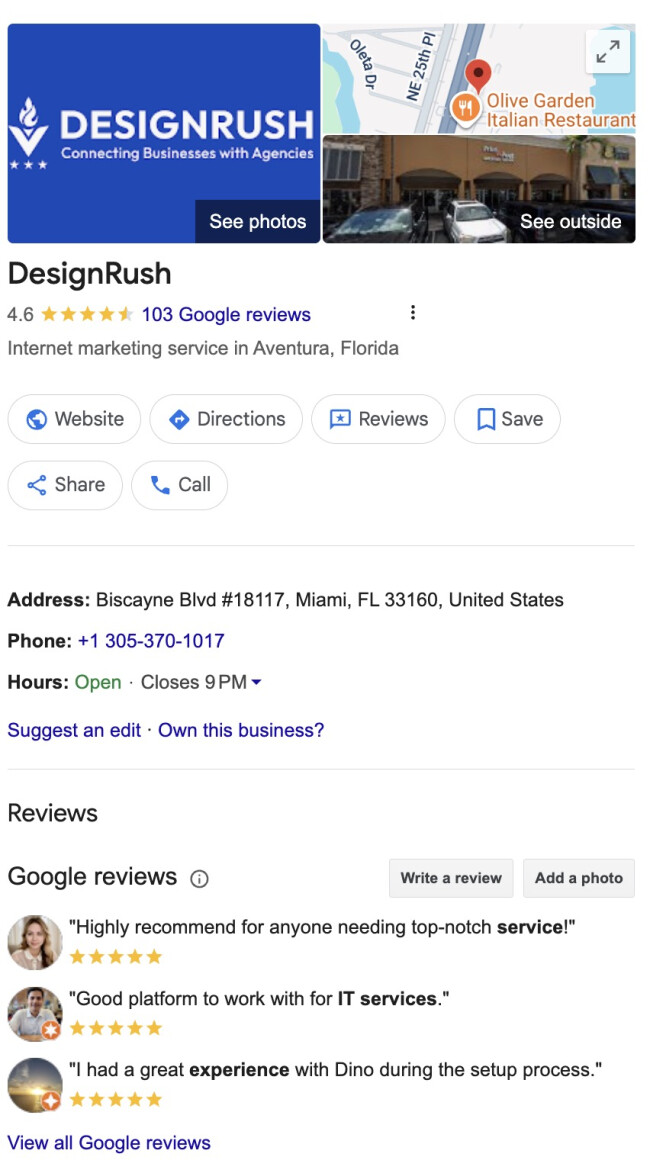 Your GBP often serves as the first impression your business makes online.
“First things first: it’s super important to make sure your Google Business Profile is set up and optimized,” Lauren emphasizes. “That’s what gets you on Google Maps - and that’s huge for being discovered locally.”
In practice, conduct a full GBP audit or setup; claim or verify the profile and fill every field to maximize visibility.
Google Business Profile Non-Negotiables
- Business name, address, and phone number (NAP)
- Business hours & industry
- A complete list of services/products
- High-quality and geo-tagged photos and cover images
Then, come the customer reviews and responses & regularly posting updates, but more on that in a bit.
A complete, optimized profile builds trust fast. It helps you show up, stand out, and turn searchers into customers.
In fact, customers are 70% more likely to drop by and 50% more likely to consider buying when a business has a complete Google Business Profile.
2. Establish Consistent Citations Across Directories
Make sure your business information is consistent across all directories, from industry-specific directories like DesignRush to local ones like Yellow Pages.
“You want to get yourself across multiple of these [directories] in a way that makes sense,” explains Lauren.
These listings, also known as citations, help search engines verify your business's legitimacy. Consistent citations signal trust and authority, which can improve your visibility in local search results.
“Every platform that makes sense for your location, category, or subcategory — you want to be on it, and you want to be consistent.”
Any inconsistencies between your website and your directory listings can confuse both users and search engines, which can hurt your rankings.
Lauren also notes that having a broad, yet relevant, presence across directories can enhance your local authority over time:
“Collect as many reviews as you can from your customers on these directories. That overarching presence will eventually impact your local searches.”
How To Get Good Citations
- List your business on every relevant directory in your industry and location
- Keep your NAP information consistent everywhere
- Actively collect reviews to strengthen your presence
Getting these right lays a strong foundation for all your other local SEO efforts.
3. Localize Your Website Content and Build Local Pages
For multi-location businesses, you should create separate local pages that cater to the interests in different locations. That way, you can rank in those specific local search results.
"If you're investing in unique local content, do not canonicalize — let each page stand on its own. But if they’re near-duplicates, canonicalizing can help avoid duplication issues."
Location Pages Best Practices
- Highlight services specific to the region
- Mention location-specific details (e.g., neighborhood names, local landmarks)
- Include customer testimonials from that area
However, Lauren also cautions against creating duplicate or thin content in an attempt to rank in multiple locations. It could easily backfire.
“Oftentimes, you find these pillar pages pieces with little meaningful support or supporting content without a lot of thought put into it.
Google could actually reprimand you for this kind of this approach, if it's not done carefully.”
4. Create Content and Showcase Your Local Expertise
Having a Google listing isn’t enough. To compete in local SEO, your website should reflect your knowledge of the area you serve. Here’s how:
- Create pages and blogs that address location-specific challenges like seasonal trends.
- Use your unique experience and cultural insights to create content that speaks directly to your local client base.
- Explain why your services are tailored to your region.
Incorporating local knowledge proves that you understand your audience in a way out-of-town competitors can’t match.
It shows that you’re not just in the neighborhood — you're part of it.
5. Optimize Local Content for Today’s Search Trends
Optimizing Local SEO starts with one key principle: knowing your keywords. Whether local or not, businesses need to understand the terms people use to find their services.
Lauren Polkey recommends starting simple. Even without SEO tools, you can uncover insights by checking the “People also ask” box or the related searches at the bottom of Google results.
“You can get an understanding of the type of questions people are looking for without access to any tools and build your content around those.”
And as AI becomes more integrated into search, it’s no longer just about keywords. Search engines now prioritize intent more than ever.
How To Align Content With AI and Search Intent
- Use keyword variations and natural phrasing, especially question-based formats
- Incorporate long-tail keywords that reflect voice search and conversational queries
- Add location-specific terms naturally (e.g., city names, neighborhoods, “near me”)
In short, strong local content today means balancing traditional SEO with emerging AI trends.
The goal? Content that’s helpful, local, and aligned with how people actually search.
6. Conduct Competitive Analysis To Inform Your Strategy
To understand what’s working in your area, look at your competitors. Their strategies can reveal what’s driving results for businesses like yours.
“Are we seeing sponsored posts? Are we seeing them use Facebook? This is going to give you a good indication of what local approach is probably going to work best in your area, in your industry,” says Polkey.
Here’s how to put that into practice:
- Audit their online presence: Check their websites, Google Business Profiles, and social media pages.
- Look at their content: Are they writing blogs, sharing customer stories, or posting on forums? What topics do they cover?
- Watch where they advertise: Are they running paid ads on Facebook, Google, or local news sites?
- Evaluate how helpful they are: Are they answering real customer questions or sharing insights that serve their community?
Use your findings as a starting point, then build out pillar pages based on what your customers need and optimize around the gaps your competitors haven’t filled yet.
Your goal isn’t to imitate. It’s to outperform.
7. Engage Authentically With Your Local Community
Engaging with your local community online is a powerful way to build trust, visibility, and even generate leads, especially for small businesses with limited marketing budgets.
Here are a few practical ways to do it:
- Join conversations where your audience already hangs out, be it local subreddits, neighborhood Facebook groups, or niche industry forums.
- Today’s customers are quick to spot a sales pitch, but what they respond to is genuine advice, shared experiences, and honest support.
As Lauren puts it, this shift in mindset is key to earning real trust:
“There’s been more of a shift in recent years toward being helpful rather than promotional. That builds genuine trust in your company.”
So instead of pushing your services, focus on providing value first. Answer common questions, share your knowledge casually, and let your expertise shine through naturally.
“I think, in general, maintenance is always good, and reaching out to the customers is still very successful.
It doesn't need to be your whole business focus, but dedicating a couple of hours on LinkedIn, for example, can go a long way.”
A small, authentic effort goes further than a polished sales message. In the long run, it’s this kind of genuine engagement that keeps your business top of mind.
8. Use Reviews To Build Trust and Boost Visibility
Online reviews, especially Google Reviews, are a major factor in both local search rankings and customer decision-making.
“Reviews are essential for local businesses,” says Lauren. “You could just use Google Reviews as your main review hub. Or Trustpilot. Wherever you collect them, display them all clearly on your website. The more reviews, the more trust.”
Beyond standard reviews, showcase in-depth testimonials from past clients. These "local success stories" can position you as a reliable expert within your community or niche.
@darrenshawseo This is why diversifying your review platforms is worth it. #seo#localseo#googlebusinessprofile#googlemybusiness#smallbusinessseo#marketing♬ original sound - Darren Shaw - Local SEO
How To Make the Most of Your Reviews
- Ask at the right time. After a successful project or purchase, follow up while the experience is still fresh.
- Use short surveys or feedback forms to gather insights on what customers liked or what they want next.
- Monitor and respond to reviews and questions, especially in the Google Q&A section, to show you're engaged and responsive.
When managed well, reviews help shape your reputation. And in today’s local search, that can be a powerful advantage.
Local SEO Trends Shaping Strategy in 2026
Local SEO is evolving with the way people search, interact, and engage online.
Here are some key trends shaping the future of local search, and how you can use them to stay visible and relevant:
- Consumer search behavior shifts to forums like Reddit and Quora
- AI integration: Rigid vs. holistic online presences
Consumer Search Behavior Shifts to Forums like Reddit and Quora
Consumer search behavior is shifting. People now turn to forums like Reddit and Quora for trusted, peer-based answers.
Google has taken note of this, favoring more forum content and localized, conversational pages that speak directly to the way people naturally search, especially for niche or very specific queries.
Lauren notes that this shift is closely tied to the integration of AI in search:
“AI is trying to learn more natural language patterns, and that’s been a big part of how we got to where we are today.
That’s why we’re seeing more Reddit, Quora, and other forum content show up in search results — search engines are prioritizing this kind of content.”
AI Integration: Rigid vs. Holistic Online Presences
AI integration in search is also shifting how Google evaluates websites. According to Lauren, we’re moving from a more technical, checkbox-style approach to something much more holistic.
“Traditionally, SEO was very focused. We’d look at how many dofollow links we had, how many referring domains, and aim to hit specific metrics,” Lauren explains. “That still matters, but things are more nuanced now.”
With AI, Google’s ranking systems have expanded to include overall online presence and consistency. Beyond getting links, it’s now also about brand mentions, content quality, and visibility across platforms.
“It’s about getting your name out there. Even nofollow links or brand mentions — things we might have ignored in the past — can now help boost your rankings.”
These recent updates favor smaller businesses; with high-quality and user-focused content, you can rank better than ever — maybe even above the big guys.
In short, don’t just think backlinks; think presence.
AI is helping Google understand the bigger picture, and that could work in your favor if you're active, helpful, and consistent online.
Winning Local SEO: Trust, Relevance, and Consistency
Local SEO is a strategy rooted in showing up, standing out, and staying connected to the people around you. As Lauren Polkey emphasizes throughout, success depends on smart optimization, authentic engagement, and adapting to how your audience actually searches.
Because at the end of the day, local SEO is about more than rankings. It’s about becoming the obvious choice in your neighborhood.

Our team ranks agencies worldwide to help you find a qualified partner to implement the latest & most suitable SEO strategies. Visit our Agency Directory for the top SEO agencies, as well as:
- Top Local SEO Agencies
- Top SEO Consultants
- Top Small Business SEO Companies
- Top Startups SEO Companies
- Top Enterprise SEO Companies
Local SEO FAQs
1. Should I create a separate Google Business Profile for each location?
For multi-location businesses, it's not recommended to create separate profiles for each location from scratch. Instead, you could have one main Google Business Profile and then add multiple locations within that profile. This keeps things more consistent and organized.
2. How does Google rank businesses in local search?
Local SEO is not instant, but it usually shows payoff faster than broader SEO. Most businesses see early signs of improvement within 3–6 months and stronger results by 6–12 months.
Quicker gains happen in low-competition niches with active SEO efforts, while competitive markets may take longer.