
In 2026, social media costs are soaring as more marketers produce more content than ever.
Brands now juggle 5-8 channels, produce weekly videos, and spend $20K+ per month on multi-platform campaigns, yet hidden costs like analytics and influencer management can easily double that.
We break down what you'll actually pay by business size, industry, and staffing model.
Social Media Budgeting: Key Findings
- Agencies charge $100–$200/hr, with monthly retainers from $5K to $20K+, depending on scope and specialization.
- Small businesses can run social campaigns under $5K, focusing on a single platform with limited reporting.
- Multi-platform programs for medium-sized companies typically cost $5K–$20K per month, covering content, ads, and analytics.
Why Social Media Marketing Costs Are More Nuanced Than You Think
In 2026, social media budgets can't be boiled down to just ad spend.
Marketers today manage a web of content production, paid promotions, and measurement, all of which add up.
According to HubSpot's 2026 State of Marketing Report:
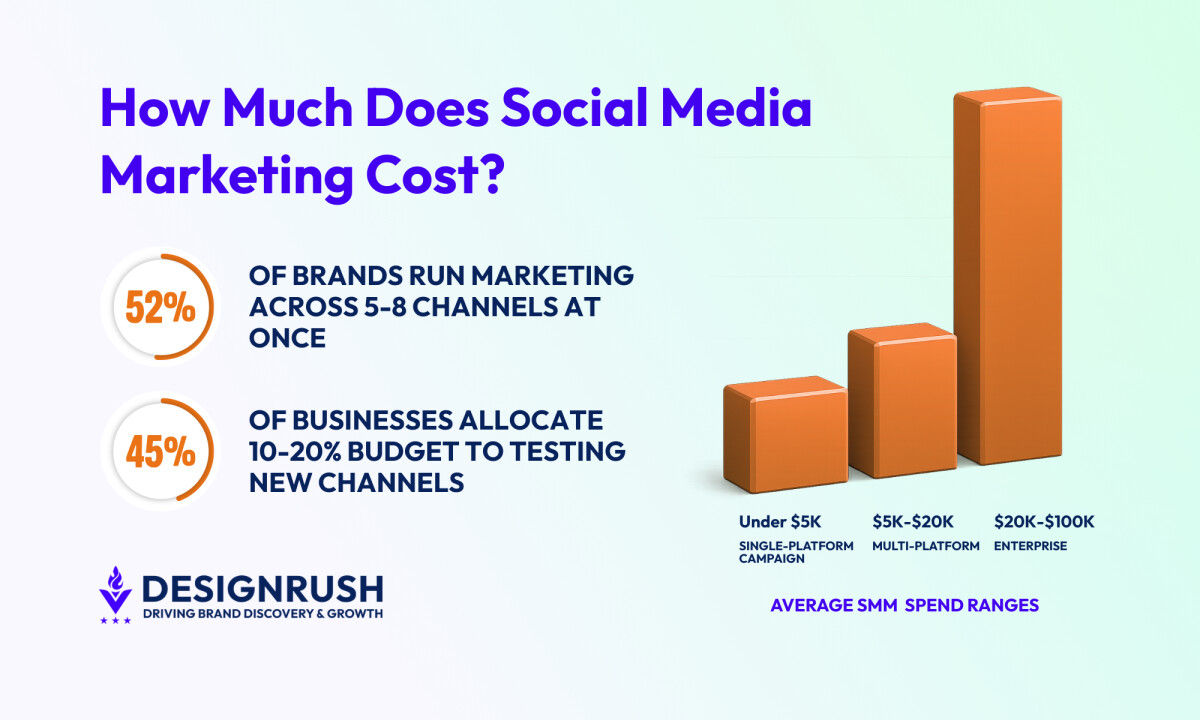
- 52% of brands now run marketing across 5-8 channels at once.
- 83% of marketing leaders report escalating content demand, wherein teams are being asked to publish more than ever.
- 45% allocate 10-20% of the budget to testing new channels.
More channels, more content, and more experimentation mean more production hours, more creator fees, more coordination time, and more performance tracking.
All these factors make social costs far more nuanced than a single monthly number. Let's dive deeper into these factors below.
How Much Does Social Media Marketing Cost in 2026?
Here's what social media marketing costs look like based on our data at DesignRush.
Average Spend Ranges
From the agency portfolios I analyzed, pricing changes based on project scope, timeline, and the type of agency service provided.
Budget Range | Typical Engagement Profile | Common Timeline |
Under $5K |
| 1-6 months |
$5K-$20K |
| 4-6 months |
$20K-$100K |
| 6+ months |
The lowest tier is the most common. These projects focus on narrow campaigns and involve a few pieces of creative and require minimal reporting. Because the scope is tight, project fees stay on the lower end.
As the scope expands to multiple platforms, budgets move into the $5K-$20K range. For instance, a national B2B company or e-commerce brand that needs content, paid ads, influencer marketing, and in-depth analytics.
By the time you add agency retainer or a full in-house team, these programs can easily exceed $100K in total spend.
SMM Costs by Business Size
As companies grow, their social media budgets usually grow with them. Have a look:
Business Size | Typical Budget Range | Hourly Rates | Engagement Pattern |
Small business | Under $5K | $25-$45/hr | Focused platform execution |
Medium-sized business | $5K-$20K | $100-$125/hr | Multi-platform programs |
Enterprise | $20K-$100K | Up to $200/hr | Integrated content + paid + reporting |
Small businesses often focus on one platform, usually Facebook, and clear metrics like leads or sales. Because the setup is simpler, many handle parts of the work internally or hire freelancers to keep overhead low.
Big organizations have the steepest costs. They may run dozens of campaigns across global markets, and need extensive creative libraries, cross-channel reporting, and formal legal or brand review processes.
What changes across tiers is the structure behind the work. As complexity rises, spending shifts from basic execution to building and maintaining a system.
SMM Costs by Industry
Industry norms influence spend, too. Here's how it breaks down:
Industry | Typical Budget Range |
Real estate | Under $5K |
Restaurant | Under $5K |
Accounting | Under $5K |
Automotive | Under $5K |
SaaS / tech | $5K-$20K |
E-commerce / retail | $5K-$20K |
Most service-based businesses operate in the lower budget tier and often focus on a single platform.
Once we move into tech, SaaS, and retail brands, the scope expands. They might need LinkedIn ads, Instagram shoppable posts, or a YouTube channel, which drives budgets into the mid-tier.
What this tells me is that industry alone does not determine spend. The real driver is the amount of coordination, experimentation, and oversight the campaign requires.
In-House vs. Freelancers vs. Agency: Cost Comparison
How you staff and manage social media also changes costs. It depends on the breadth of coverage you need.
A full-service agency might charge a higher hourly rate, but in return, it covers everything, while a lean startup might DIY more and spend primarily on tools and a few contractors.
Here's a side-by-side look at what you might spend on a lean in-house team, freelancers, or an agency:
In-House Teams
In-house teams carry fixed costs across salaries, benefits, and software subscriptions. The real cost of an employee is always higher than the salary on paper.
Typical salary ranges look like this:
Role | Hourly Rates | Annual Salary Range |
$20–$40/hr | $50K–$100K | |
$25–$30/hr | $67K–$122K |
And that's just base pay. Once you add benefits and payroll taxes, total compensation can increase by around 30%.
Then there are admin costs, equipment, subscriptions, and office stipends, which can add another 10–25%.
The upside is control. In-house teams are fully dedicated to your brand, communication is faster, and over time, they build strong internal knowledge.
However, expertise is limited to who you hire, so if you need advanced analytics or a paid media strategy, you may need to bring in additional roles.
Freelancers
Hiring freelancers for content creation or ad management can be cost-efficient for isolated tasks.
Here are some average rates for social media freelancers on Upwork.
Role | Hourly Rates |
Social media managers | |
Social media marketers | |
Social media content creators |
You avoid payroll and can scale up or down quickly. However, freelance models shift management burden back onto internal staff because someone still needs to coordinate content calendars, briefs, and track results.
Social Media Marketing Agencies
SMM agencies bundle cross-functional expertise on strategy, creative, media buying, and reporting, and tend to have established workflows.
This convenience comes at a premium hourly rate. But what you're paying for is consolidated expertise. That means a cross-functional team with established workflows, rather than hiring separate specialists.
Agency Type | Typical Hourly Rate | Typical Monthly Retainer |
Boutique / Small agency | $100–$125/hr | $5K–$10K |
Mid-sized agency | $125–$175/hr | $10K–$20K |
Enterprise / global agency | $175–$200+/hr | $20K+ |
Most full-service agencies charge blended hourly rates between $100 and $200, depending on seniority and specialization.
That typically translates to monthly retainers starting around $5,000 and scaling beyond $20,000+ for campaigns covering strategy, creative, paid media, and reporting. Multi-market or big campaigns can exceed six figures annually.
The trade-off is less direct control and a higher cost upfront. For brands that need coordinated, multi-channel execution, however, the efficiency often justifies the higher rate.
What Affects Social Media Marketing Cost?
The cost of social media marketing is determined by the scope. And that scope has expanded.
Higher competition, faster content cycles, and higher reporting expectations are changing what social really includes.
Here's what affects your budget this year:
- Rising content demands
- Platform competition
- Expanding to more platforms
- Influencer ROI
- Ongoing testing
- Data growth and analytics demand
- Compliance and approval cycles
1. The 83% Production Pressureand Rising Content Demand
Output expectations are rising. 83% of marketers say they are expected to produce more content than before.
Video is a big part of this. By some accounts, nearly half of all ROI-driving content is short-form video. Over 40% of companies publish at least one video per week, and mid-sized teams average three.
That means brands now shoot, edit, and caption at least one 30–60 second video every week on average. Add in regular static posts, stories, and live streams, and the creative labor hours skyrocket.
In short, building a consistent "content factory" demands people and production budget well beyond basic posts.
REPLUG's co-founder Lorenzo Rossi adds perspective on the stakes:
"Nowadays, it's become more and more difficult to understand how effective your app marketing campaigns are; hence, [businesses need to] allocate the budgets efficiently to the best channels."
2. Competing in a $317 Billion Attention Market
Social media ad spend is projected to reach $317 billion in 2026. And as every company chases user attention, platforms become more expensive.
For example, industry data show that holiday season CPMs can jump by over 60% due to Black Friday competition.
Higher CPMs and CPCs mean you need to create more precise targeting, test more variations of ads, and refresh creatives more often to maintain ROI.
In practice, that means more budget is burned simply to keep up with competitors, even if your actual audience size hasn't changed.
3. Expanding to More Platforms Means Higher Overhead
Marketers keep adding networks. More than half of companies juggle 5–8 channels simultaneously, while 94% of teams diversified their channels last year (HubSpot).
Each additional platform adds different ad interfaces, audience targeting, and content formats. For instance, Instagram prioritizes vertical Reels with captions, while LinkedIn performs best with article-style posts and PDFs.
This also means running parallel campaigns across multiple channels. That translates into more production time per format and separate community management and analytics to track.
That overhead accumulates simply to manage channel volume, before you even factor in ads and creative costs.
4. Influencer Marketing: The $5.20 Return That Changes Spend
Influencer partnerships are expanding due to their exceptional ROI. Brands report earning $5.20 to $6.50 for every $1 invested in influencer campaigns.
Such high yield fuels more spending on influencers. In fact, 59% of marketers are planning to increase spend (Hubspot).
@aynbernos Replying to @moi ♬ original sound - Ayn Bernos
But building influencer campaigns incurs hidden expenses: sourcing talent, negotiating fees, and handling usage rights, plus tracking performance separately.
The upside of influencer marketing is real, but budget accordingly for the extra work and expertise required.
5. 10–20% of Social Budgets Go to Testing
45% of teams allocate 10-20% of their budget to testing new channels or formats. That's increasingly necessary as new platforms and ad products emerge.
Proper testing means running A/B experiments on creative, bidding strategies, and audience segments.
Each test adds creative variations and data to analyze, so the faster your growth target, the faster you iterate. That means more campaigns running at once and more time spent interpreting data.
Over time, experimentation expands scope, and with it, overall costs.
6. 230% More Data Increases Analytics and Reporting Costs
Marketers now use 230% more data than they did in 2020, but handling that data isn't cheap.
However, 56% report not having time to examine that data thoroughly, while 65% of leaders must connect social performance to business outcomes to secure investment.
Meeting those demands requires real infrastructure. That means investing in CRM integrations, custom dashboards, BI tools, and specialists to monitor them.
As campaigns become more complex, the analytical load grows heavier, and so do the associated costs.
7. Compliance and Approvals Extend Production Timelines
Finally, many businesses deal with unavoidable procedural costs. In regulated industries like finance or healthcare, every campaign often needs legal review, archiving, and strict brand checks.
Even outside regulated industries, large organizations often impose multi-step approvals for any public content.
Every extra sign-off adds days or even weeks to production. Longer timelines mean more hours for project managers and coordinators, and sometimes content must be revised after feedback, further raising costs.
The Hidden Social Media Marketing Costs You Might Overlook
Many costs hide in plain sight, such as recurring fees, extra labor, and behind-the-scenes work that quickly add up. Don't forget:
- Software & tools: Recurring fees for scheduling platforms, analytics suites, design licenses, and even stock media subscriptions can add up, especially for enterprise-level tools.
- Asset libraries: Building a robust library of images, graphics, and video templates is an upfront cost. When new products or initiatives launch, you'll need fresh branded content beyond your existing assets.
- Community management: Responding to comments, messages, and moderation often involves a dedicated community manager or agency at hourly rates. This ongoing labor is essential but easy to under-budget.
- Campaign overhead: Setting up tracking like UTM parameters is usually billed by the hour, as is campaign planning and post-analysis. These tasks don't show up as line items in ads, but they consume time.
By counting all these pieces, the total cost of social media strategies can easily double or triple what you initially allocated.
Final Thoughts on the Cost of Social Media Marketing
In 2026, social media is not a cheap channel to manage, but it can be one of the most rewarding if handled strategically.
Startups often benefit from a few skilled hires or freelancers, while growing companies and enterprises need multi-channel coverage, creative testing, and analytics, often with agency support.
Above all, remember that social media costs are dynamic. What seemed expensive last year might be baseline today or vice versa, so regularly review industry reports to stay ahead.

Our team ranks agencies worldwide to help you find a qualified partner. Visit our Agency Directory for the Top Social Media Marketing Companies, as well as:
- Top LinkedIn Marketing Agencies
- Top Instagram Marketing Agencies
- Top Social Media Marketing Consulting Services
- Top Facebook Marketing Companies
- Top Direct Marketing Companies
Our design experts also recognize the most innovative design projects across the globe. Visit our Awards section for the best & latest.
Social Media Marketing Costs FAQs
1. How much do agencies charge for social media management?
Typical hourly rates range from $100–$200, with monthly retainers starting around $5K and scaling beyond $20K for multi-channel campaigns.
2. Are there hidden costs beyond ad spend?
Yes. Software subscriptions, creative asset libraries, community management, training, and campaign setup all add to the total cost.
3. Can I do social media marketing on a low budget?
Yes, many businesses start with a small budget:
- Focus on organic growth through consistent posting and engagement.
- Use free tools for content scheduling and design.
- Use micro-influencers or collaborations instead of large ad spends.
Even $300–$500/month can get meaningful results if spent strategically.
4. Should I focus more on organic content or paid ads?
A balance works best. Organic content builds trust and long-term engagement, while ads can give faster results and reach specific audiences.
Many small businesses start with organic first and scale into ads as they grow.
5. How often should I review my social media budget?
Monthly or quarterly reviews work best. By looking at what's performing and what's not, you can adjust your spend, shift resources to better-performing campaigns, and stay on track with your goals.