
What can you expect to pay for advertising on TikTok? The short answer: It varies. In this guide, I’ll break down different cost ranges and the key drivers behind your TikTok advertising cost.
TikTok Ads Cost: Key Findings
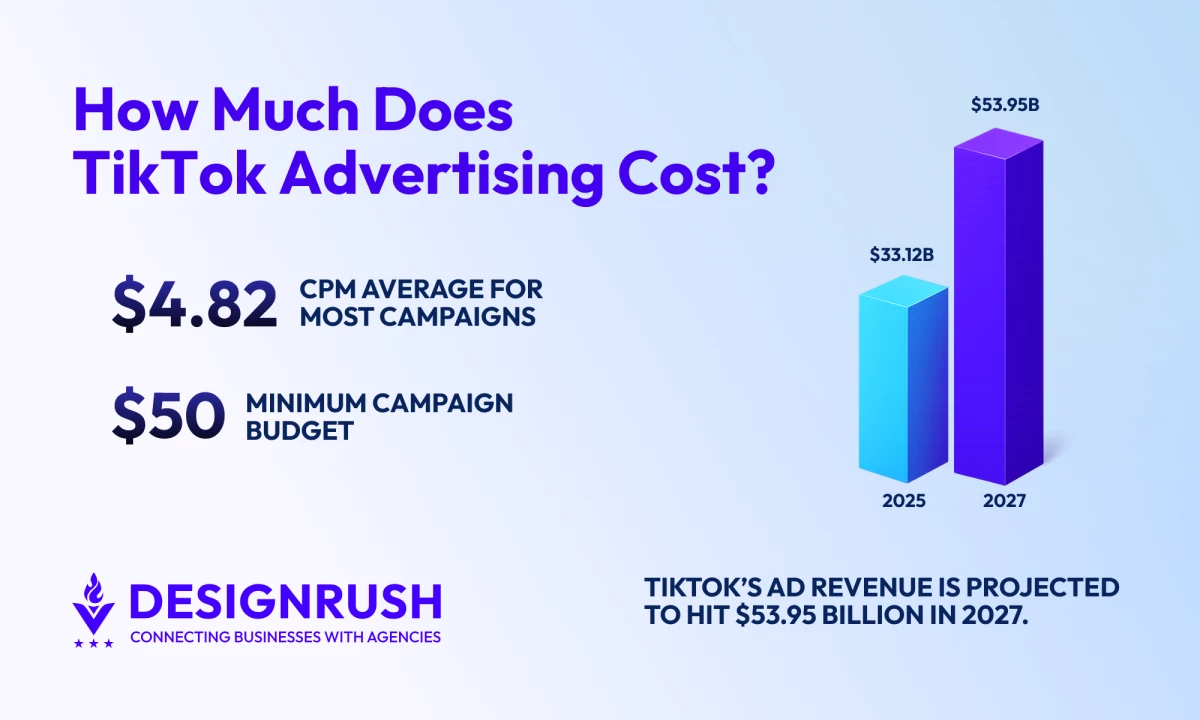
- TikTok ads are budget-friendly to start, with a $50 minimum campaign spend and an average CPM of around $4.82.
- Costs rise sharply in competitive verticals: Tech, Cosmetics, and Fashion lead TikTok spend globally.
- Premium formats can get expensive, with TopView/Brand Takeovers at $150K-$300K/day.
The Cost of Advertising on TikTok: An Overview
With ad revenue projected at $33.1 billion, it’s clear businesses are investing heavily. To set expectations, here are the core cost benchmarks most advertisers work with today:
- Minimum ad campaign budget: $50
- Minimum daily budget per ad group: $20
- Average CPM (cost per 1,000 impressions): $4.82
- Average CPLC (cost per link click): $0.49 per click
- Typical TikTok marketing spend per month: $1,000 to $50,000+
But take those figures with a grain of salt. TikTok can be surprisingly cheap or unexpectedly pricey, depending on a myriad of factors we’ll get into.
What Drives Your TikTok Ad Cost?
When I audit TikTok accounts, one thing becomes obvious fast.
Two brands can spend $5K and get completely different results. For example, a beauty brand spending thousands on UGC-driven Spark Ads may generate strong conversions, while a B2B SaaS company paying the same amount might only be buying awareness and warm leads.
Management model, industry, and business size each pull the cost in a different direction. Knowing which lever matters for you saves money.
- TikTok Advertising Cost: Agency vs. In-House
- How Industry Affects Your Budget
- Ad Spend by Business Size
TikTok Advertising Cost: Agency vs. In-House
Going in-house looks cheaper upfront, but you’ll need people who can handle creative production, testing, and optimization consistently. If your team lacks bandwidth or experience, campaigns slow down and costs rise fast.
Agencies solve that with structure and speed. You’re paying for strategy, creative execution, and ongoing optimization, not just ad placement.
Here’s the agency cost snapshot based on our data:
- Average hourly rate: $99
- Agencies accepting projects under $1,000: 22.2%
- Agencies requiring $50K+ minimum engagements: 1% (typically full-scale management)
For comparison, Glassdoor salary data shows TikTok Specialists earn roughly $62K-$104K per year, with a median of about $80K.
| Approach | Best For | Pros | Cons |
| In-House | Brands with time + talent for testing |
|
|
| Agency | Brands wanting speed + scalability |
|
|
If you want to scale faster without building a full in-house team, an agency can shortcut the learning curve and drive performance sooner.
How Industry Affects Your Budget
Your industry has a significant influence on TikTok ad costs, driven by competition levels, compliance rules, audience size, and purchase intent.
Below is a snapshot of estimated global annual TikTok ad spend by industry, useful for understanding where competition is highest:
- Electronics & Technology: $2B
- Cosmetics & Toiletries: $1.76B
- Clothing & Accessories: $1.70B
- Retail: $1.68B
- Telecommunications: $1.51B
- Public/Non-profit: $815M
- Financial Services: $790M
- Leisure & Entertainment: $785M
- Pharma & Healthcare: $755M
- Media & Publishing: $735M
Here’s what I usually see across major verticals.
E-Commerce & Retail
Great news here. E-commerce companies often sees lower CPMs and CPCs because TikTok is built for fast shopping behavior. Features like product catalogs and GMV Max make selling easier and trackable.
The only catch is peak seasons. During Black Friday or Cyber Monday, everyone bids at once, which means higher costs. I always advise clients to warm audiences ahead of peak sales instead of dumping budget at the last minute.
Beauty & Fashion
@levisteede This fashion brand paid me €15k and we made them back €1.4 million in revenue with TikTok Ads. #ecommerce#fashion♬ original sound - Levi - ADS EXPERT
This vertical is made for TikTok. Visual storytelling, fast trends and UGC make it easy to capture attention which usually keeps costs moderate and results scalable.
Competition is where things get pricey, especially in trend-driven or influencer-heavy niches. What you should focus on is keeping the creatives fresh and testing quickly to maintain efficient ad spend.
Finance & Insurance
Most likely, you’ll pay more if you’re in finance or insurance. CPMs and CPCs often land on the higher side because targeting requires precision, and regulations limit creative flexibility.
I’d recommend allocating the budget for testing and tightening your targeting early to avoid wasting money.
B2B & Technology
B2B is a different game compared to consumer categories. Audiences are smaller and harder to reach, so cost per result tends to be higher. For better efficiency, run awareness first and conversion later, so you’re not paying premium rates to a cold audience.
Health & Wellness
The challenge here is compliance. Health claims, supplements, and wellness services often need tighter review, which slows delivery and can increase costs. What I suggest is clear messaging and multiple creative variations as your cost-control tools.
Ad Spend by Business Size
When clients ask how much they should spend, I also look at where they are in their growth stage.
- Startups often begin with modest budgets to test creatives and refine targeting before increasing investment.
- SMBs in growth mode tend to boost spend once they find messaging and audiences that convert, expanding budgets step by step based on results.
- Enterprise brands usually allocate more substantial budgets to run awareness, retargeting, and conversion campaigns in parallel, which accelerates learning and performance.
The good news is efficiency doesn’t belong only to big budgets. With 78 percent of small businesses reporting positive ROI within six months, results are achievable even at smaller spend levels when testing and creative execution are done well.
Other Factors Affecting Your TikTok Ad Spend
Budget alone doesn’t determine cost efficiency. These are the variables that also influence what you pay:
Ad format
The format you choose has a direct impact on what you spend. Here's how they typically behave cost-wise:
- In-feed ads: generally the most cost-efficient option and where most brands start
- Spark ads: built around existing organic posts; often strong engagement at moderate cost
- E-commerce ads (Shopping/GMV Max): optimized for conversions and catalog performance
- TopView ads: premium placement when users open the app; higher cost, high visibility; a TopView campaign for Dungeons & Dragons reached 50M+ impressions at just £0.02 per view
- Branded Hashtag Challenge: large-scale engagement format; estimated cost around $150K per week, plus $100K-$200K recommended supporting ads
- Brand Takeover: exclusive high-impact format suited for launches; pricing ranges from $150K to $300K per day depending on setup
Targeting
The narrower the audience, the more you typically pay. Broader targeting gives the algorithm room to work and usually keeps CPMs lower. Here’s what you need to know:
| Targeting Type | Cost Expectation | Notes |
| Broad targeting | Lower cost | Good for awareness and scale |
| Demographic targeting | Moderate cost | Age, location, and gender filters |
| Interest targeting | Higher cost | More competitive and focused |
| Custom/lookalikes | Highest cost | Most relevant, strong for conversions |
Smart targeting matters, but even more so when it's tied to creative relevance. As Lorenzo Rozzi, co-founder of REPLUG, shared insights from one of their clients’ results:
"By pushing towards a UGC approach on TikTok, they managed to reduce our CPA with UGC in one month by almost 50%. They gave us very good recommendations and optimized our creative strategy accordingly, resulting in an impressive 213% increase in our registration rate.”
Bidding strategy
TikTok uses an auction model, so your bidding type affects what you pay and how your ads are delivered.
These are the main bidding models you’ll choose from:
- CPM (Cost per 1,000 impressions): You pay for reach. Useful for awareness. TikTok's average CPM is around $4.82
- oCPM (Optimized CPM): You still pay per 1,000 impressions, but TikTok shows your ads to users more likely to convert or install
- CPV (Cost per view): You pay when a user watches at least 6 seconds or interacts early. Best for driving retention and warming up audiences
- CPC/CPLC (Cost per click or cost per link click): You pay only when someone clicks. Ideal for traffic or conversion goals. Average cost per link click sits around $0.49
TikTok also decides how to spend your budget based on the bidding strategy you choose. Cost Cap tries to keep your CPA near a target you set, which is great when you want predictable costs and controlled scaling.
Maximum Delivery focuses on volume and spends your budget freely to get as many results as possible, even if the CPA moves around. In simple terms, Cost Cap protects efficiency, while Maximum Delivery pushes reach.
Seasonality and Demand
Seasonality affects ad cost more than you’d expect. When demand rises, CPM rises with it, and Q4 can get expensive quickly. In quieter months, though, you can stretch the same budget further and learn cheaper.
Typical cost pattern across the year:
- Q1: lowest CPMs
- Q2-Q3: mid-range
- Q4: peak pricing, especially around holidays
During one of the most expensive periods of the year (Black Friday/Cyber Monday), James Allen, an online diamond retailer, used Smart+ Catalog Ads to leverage demand instead of fighting it. And the payoff was huge.
Results during BFCM peak season:
- 127% increase in conversions
- 91% increase in ROAS
- 59% decrease in CPA
By consolidating campaigns and letting TikTok’s AI optimize audience targeting, creative rotation, and budget allocation in real time, they increased purchase intent. They lowered acquisition costs, even during peak CPM season.
This shows that high-demand periods are also high-reward when creative relevance and optimization are strong.
How To Maximize Your TikTok Ad Budget
These are the tactics I use to help clients stretch their TikTok budget further and get better results:
- Start broad, narrow later: Broad audiences lower CPM and help TikTok learn faster before you refine.
- Lead with creative first: Your hook matters more than your targeting if you want cheap traffic.
- Fund learning: Underfunded campaigns cost more; give the algorithm room to optimize.
- Spark what works: Boost organic winners instead of paying to push weak creatives.
- Pick the right bid strategy: Align your bid type with your KPI, or you’ll misread performance.
- Increase gradually: Raise budgets in controlled steps (about 50%) to avoid resetting learning.
- Scale only what's proven: Only scale campaigns with stable CPA and repeatable results.
@jonloomer Should you use a daily or lifetime budget? While there don't appear to be any inherent advantages to using one option over the other, you should consider how each works with your strategy. It's a personal preference. #facebookads#facebookadstips♬ original sound - Jon Loomer
If there’s one thing that drains your TikTok ad budget, it's unnoticed red flags. Here’s what to pay attention to:
- Learning phase resets
- Every time you change bids, budgets, creative, or targeting, TikTok re-enters learning. The more you tinker, the more money you burn
- Watch for: That yellow “Learning” badge sitting on your ad sets for days
- Fix: Batch changes. Scale budgets in controlled increments (e.g., <20–30%)
- Misaligned objectives
- Some advertisers choose “traffic” or “video views” to lower CPMs, then expect purchases. This delivers cheap, low-intent impressions and drains budgets
- Watch for: High click-through, low ROAS
- Fix: Use the conversion objective when evaluating CPA/ROAS
- Testing during peak CPM windows without adjusting budgets
- Q4, major holidays, and industry-specific sales periods dramatically increase auction pressure
- Watch for: CPMs doubling overnight
- Fix: Run creative and bidding tests in Q1-Q3; enter Q4 only with proven assets
Closing Statement on TikTok Advertising Costs
Before you launch your next TikTok campaign… Remember, you don’t win on TikTok by spending the most. You win by spending smart.
Creative testing, the right bidding setup, and pacing your scaling matter more than the raw budget.

Our team ranks agencies worldwide to help you find the right fit. Visit our Agency Directory for the top social media marketing agencies, as well as:
- Top Social Media Marketing Companies
- Top Advertising Agencies
- Top Content Marketing Agencies
- Top Video Marketing Agencies
- Top Instagram Marketing Agencies
Looking for creative ideas beyond ad budgeting? Check out our Design Awards, featuring winners known for bold storytelling and scroll-stopping design, such as the latest winners of best video design.
TikTok Ad Cost FAQs
1. How much do TikTok ads cost per day?
The daily cost of TikTok ads depends on different factors like the bid amount, your ad objective, and your budget. In general, expect to pay at least $20 for an ad group. If you choose the campaign level, TikTok advises you to start with $50 per day.
2. Are TikTok ads more expensive than Meta ads?
According to the data we gathered, TikTok ads seem to be more expensive than Meta ads. However, they also come with a higher engagement rate compared to all other main social media platforms. Hence, the TikTok advertising cost may be worth it in the long run.
3. What affects TikTok ad cost the most?
TikTok ad costs are driven mainly by creative quality, how broad your targeting is, and your bidding/objective setup. Strong creative in broad audiences gets the algorithm working for you, lowering CPMs and CPAs, while narrow targeting or mismatched bidding quickly pushes costs up.