
As more healthcare data moves to the cloud, storage has become one of the most frequent and expensive points of exposure.
This guide breaks down the 10 best HIPAA-compliant cloud storage providers for 2026, highlighting where each excels, the tradeoffs involved, and which options genuinely reduce compliance risk.
HIPAA-Compliant Cloud Storage Providers: Key Findings
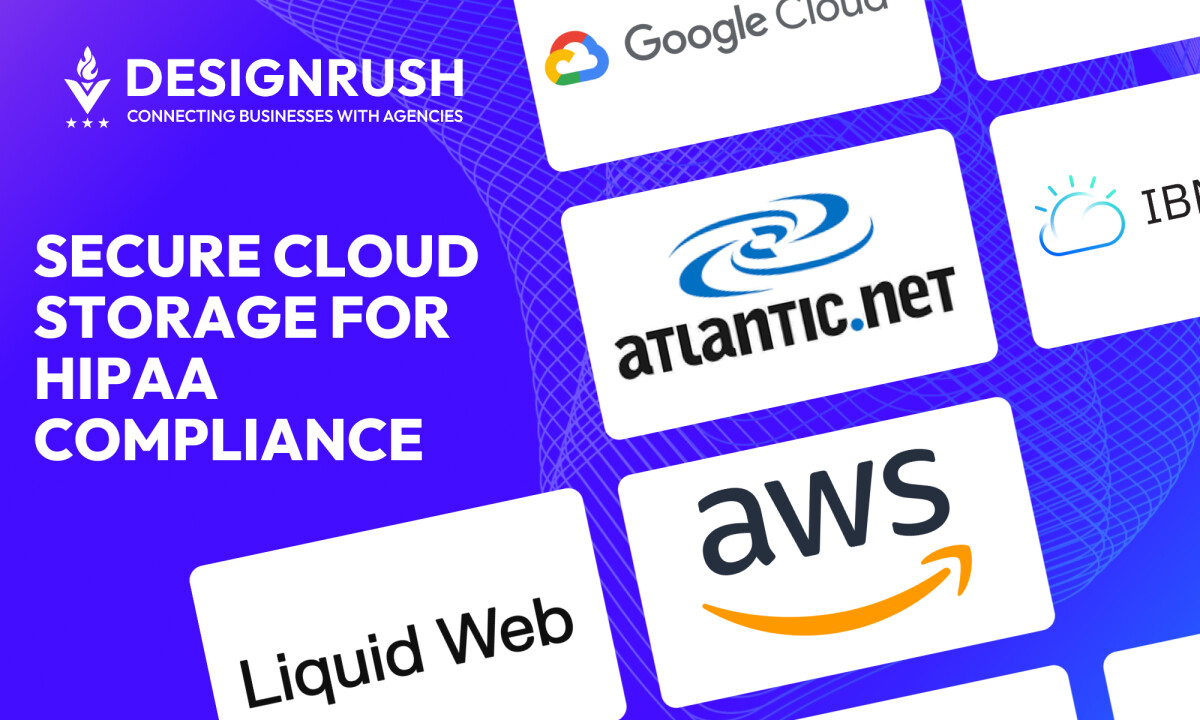
- Atlantic.Net and Liquid Web offer fully managed HIPAA environments suited for SMBs and healthcare practices.
- AWS, Azure, and GCP provide scale and integration but require strong in-house HIPAA configuration.
- ClearDATA and Aptible add governance, automation, or startup-focused compliance on top of major clouds.
What Is HIPAA-Compliant Cloud Storage?
These are file storage systems designed to meet the requirements of the U.S. Health Insurance Portability and Accountability Act (HIPAA) for handling electronic protected health information (ePHI).
To comply, covered entities and business associates must apply technical safeguards such as data encryption and strict access controls to limit who can view, share, or modify sensitive files.
This level of protection is critical: network servers are the leading source of breached PHI and over 80% of healthcare data breaches involve cloud-stored information. Misconfigured or unsecured storage remains a major risk vector.
When implemented correctly, HIPAA-compliant storage helps healthcare organizations safeguard patient records, reduce breach exposure, and maintain compliant file access, sharing, and retention practices across the organization.
Satish Hemachandran, the SVP of Hosting at Newfold Digital, has decades of cloud and hosting expertise. He emphasizes the importance of performance and scalability along with compliance:
“A service that grows with you is an important foundation for the long-term success of your business.”
These HIPAA-compliant cloud storage providers consistently meet healthcare security, access control, and compliance demands.
Provider | Best For | BAA | Managed Security | Scalability | Pricing |
Atlantic.Net | SMBs, clinics, and startups wanting all-in-one HIPAA hosting | ✅ | ✅ | ✅ | Starting at $350.68/month |
AWS | Enterprises, SaaS vendors needing global scale | ✅ | ❌ | ✅ | Custom |
Microsoft Azure | Mid-market/enterprise Microsoft shops | ✅ | ❌ | ✅ | Custom |
GCP | Data-driven orgs using AI/analytics | ✅ | ❌ | ✅ | Custom |
ClearDATA | Hospitals, payers, life sciences with multi-cloud | ✅ | ✅ | ✅ | Custom |
Liquid Web | SMBs/mid-market needing managed single-tenant | ✅ | ✅ | ❌ | Custom |
Rackspace | Enterprises needing HITRUST and managed services | ✅ | ✅ | ✅ | Custom |
IBM Cloud | Enterprises invested in IBM ecosystem | ✅ | ❌ | ✅ | Custom |
OCI | Enterprises on Oracle DB/ERP | ✅ | ❌ | ✅ | Custom |
Aptible | Startups/SaaS needing HIPAA PaaS fast | ✅ | ✅ | ✅ | Starting at $499/month |
1. Atlantic.Net: Best Fully Managed HIPAA Cloud
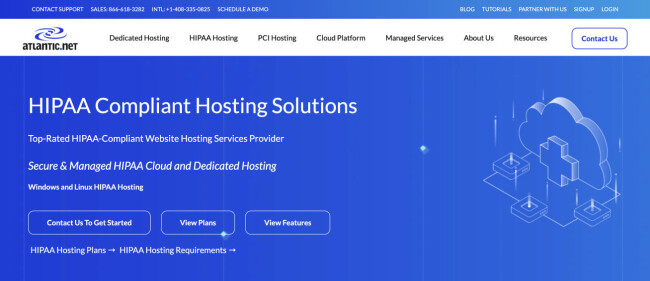
Atlantic.Net has been around since the mid-90s, and its HIPAA-compliant hosting is battle-tested.
Unlike hyperscalers that hand you the keys and leave compliance up to you, Atlantic.Net bundles firewalls, IDS/IPS, malware protection, encrypted VPNs, backups, and even disaster recovery into its HIPAA plans.
They even offer HIPAA-ready WordPress hosting and GPU servers for AI and imaging workloads.
Pricing:
- Linux
- HIPAA Developer: $350.68/month
- HIPAA Business: $572.22/month
- HIPAA Enterprise: $727.27/month
- Windows
- HIPAA Developer: $367.53/month
- HIPAA Business: $594.27/month
- HIPAA Enterprise: $795.52/month
- Custom
Satish noted that many providers trap businesses in rigid plans with hidden overage fees, but the better approach is transparency and a clear upgrade path.
Atlantic.Net follows this philosophy, offering straightforward tiers you can scale into as your resource needs grow.
Key Features
- Managed firewall, IDS/IPS, anti-malware
- Encrypted VPN and backups
- Disaster recovery & business continuity
- HIPAA WordPress hosting & GPU hosting options
- One-click HIPAA cloud deployment
- 100% uptime SLA
Who It’s For
Atlantic.Net is a fit for healthcare providers, SMBs, and digital health startups that need predictable pricing and an all-in-one HIPAA-ready environment.
It’s made for clinics or practices without large IT teams, agencies building HIPAA-compliant WordPress sites, and companies experimenting with AI/medical imaging who need GPU power under HIPAA safeguards.
2. Amazon Web Services (AWS): Best for Long-Term Data Retention
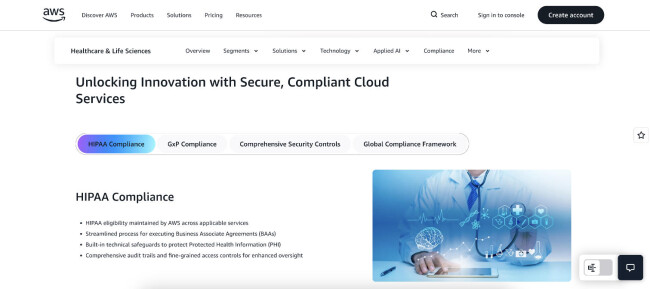
AWS is the cloud giant, and yes, they sign BAAs.
The catch? You need to use only HIPAA-eligible services (there’s a long, regularly updated list).
That still gives you everything from EC2 and RDS to S3 and Redshift, making AWS ideal if you need global reach and dozens of specialized services.
Pricing:
- Custom
Hemachandran warned that scale without stability can backfire if you aren’t prepared:
“Reliability has many components to it — from uptime guarantees to how your infrastructure handles sudden surges in traffic.”
AWS gives you the tools, but the responsibility for proper configuration rests on your IT team.
Key Features
- HIPAA BAA via AWS Artifact
- 100+ HIPAA-eligible services
- Encryption, IAM, advanced security tooling
- Global data centers and compliance reference guides
Who It’s For
AWS is best for enterprises and software vendors that need the widest service catalog and global scale.
It works well for large hospitals with complex workloads, SaaS companies building healthcare apps for national or international markets, or research institutions running large datasets.
Strong in-house IT/security resources are a must to configure HIPAA workloads correctly.
3. Microsoft Azure: Best for Role-Based Access
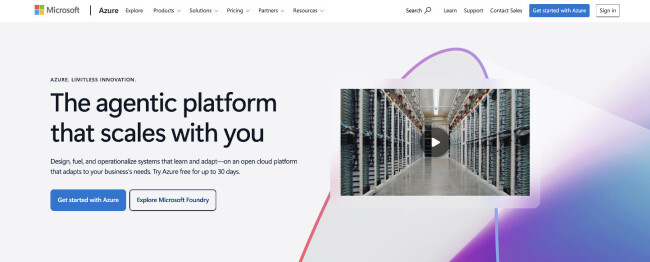
If your organization already lives in the Microsoft ecosystem (Active Directory, M365, Teams), Azure makes HIPAA hosting straightforward.
A BAA is baked right into Microsoft’s Product Terms, and they maintain a list of in-scope HIPAA-eligible services.
Pricing:
- Custom
As Hemachandran explained, choosing a provider often comes down to integration and performance tuning:
“It’s equally important that you have an infrastructure stack optimized for performance and availability, from the network layer all the way to the application stack.”
That’s where Azure really makes a difference with its seamless integration across Microsoft products and enterprise identity systems.
@the.rachel.woods Microsoft just announced HIPAA complaince will be added to #gpt and #openai’s APIs in Azure. This is great to see starting to happen. I expect more announcements like this. #rachelwoods#chatgpt#ai#generativeai#applyingai#aiforhealthcare♬ original sound - Rachel Woods
Key Features
- HIPAA BAA in Microsoft Product Terms
- Wide range of HIPAA-eligible services
- Seamless Microsoft 365 and AD integration
- Compliance and governance tools
Who It’s For
Azure is a natural choice for businesses already embedded in Microsoft’s ecosystem.
It’s especially useful for mid-market to enterprise organizations that want seamless integration across productivity, collaboration, and cloud.
4. Google Cloud Platform (GCP): Best for Analytics-Ready Storage
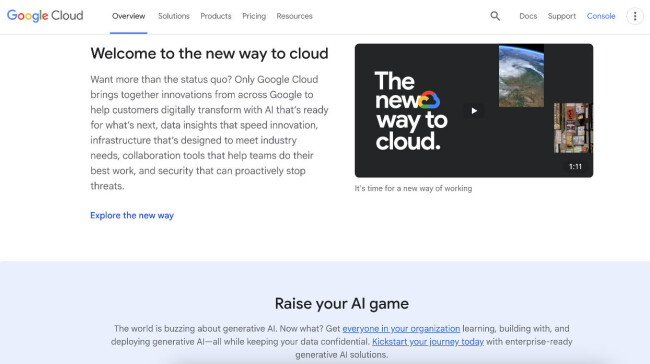
GCP might not be as big as AWS or Azure, but it shines in AI and analytics.
Under their HIPAA BAA, services like BigQuery and Vertex AI can safely handle PHI if configured correctly.
Google also offers clear documentation on covered services, so you know exactly what’s in scope.
Pricing:
- Custom
Hemachandran highlights the importance of on-demand scalability for traffic spikes and data growth, something GCP delivers with flexible machine types and storage.
View this post on Instagram
Key Features
- HIPAA BAA available for covered services
- Strong AI/analytics tools (Vertex AI, BigQuery)
- Global infrastructure with redundancy
- Encryption and compliance tooling built-in
Who It’s For
GCP suits startups and enterprises leveraging AI, ML, or data analytics under HIPAA compliance.
It’s a strong match for companies working in healthcare research, population health analytics, telemedicine platforms, and other PHI-heavy data workflows.
If your competitive edge is data-driven, GCP gives you the HIPAA framework to scale securely.
5. ClearDATA: Best for Healthcare-Specific Data Governance
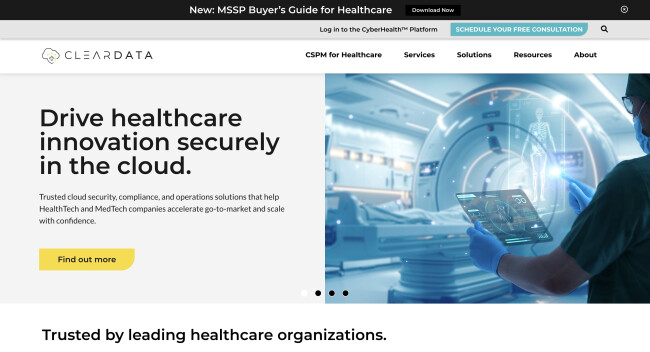
ClearDATA is a healthcare-only managed platform. They sit on top of AWS, Azure, or GCP and enforce compliance automatically with policy-as-code and real-time monitoring.
They’ll sign the BAA, handle managed detection and response (MDR), and keep your environments locked down.
Pricing:
- Custom
Key Features
- Healthcare-exclusive managed platform
- Policy-as-code compliance automation
- Governance dashboards and audit support
- Works across AWS, Azure, GCP
Who It’s For
ClearDATA is for large healthcare systems, payers, and life sciences organizations operating in multi-cloud environments.
If you run workloads across AWS, Azure, and GCP, ClearDATA helps unify compliance monitoring and reporting, making it ideal for enterprises facing strict audits and governance demands.
As Hemachandran points out, businesses shouldn’t just look for infrastructure, but for solutions that actively help them stay compliant during growth and unexpected traffic spikes.
ClearDATA embodies this by layering governance and MDR on top of the big clouds.
6. Liquid Web: Best for Isolated Secure Storage
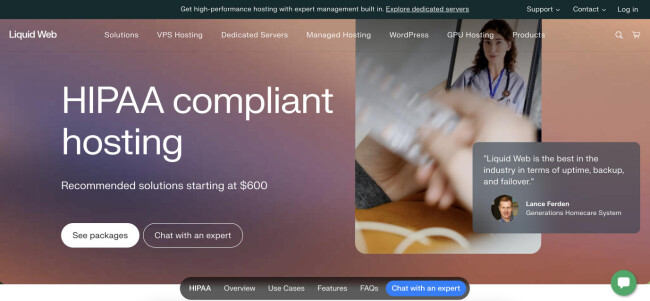
Liquid Web focuses on fully managed dedicated and cloud-dedicated environments.
Their HIPAA-audited hosting is designed for businesses that want more control than shared hosting but don’t want to wrestle with AWS complexity.
Hemachandran noted that “all websites are not created equal — the type of website often dictates the performance and compliance needs.”
Liquid Web’s managed dedicated servers reflect that principle, offering flexible solutions for practices or agencies that want HIPAA compliance without over-engineering.
Pricing:
- Custom
Key Features
- HIPAA-audited single-tenant hosting
- Dedicated or cloud-dedicated servers
- Security hardening and firewalls
- IDS, backups, and compliance support
- 24/7 managed support
Who It’s For
Liquid Web is designed for SMBs and mid-market healthcare businesses that prefer dedicated infrastructure without the complexity of hyperscale providers.
It’s well-suited for medical practices, regional hospitals, and agencies that need strong compliance, personal support, and reliable managed services at a predictable price point.
7. Rackspace: Best for Managed, HITRUST-Ready Environments
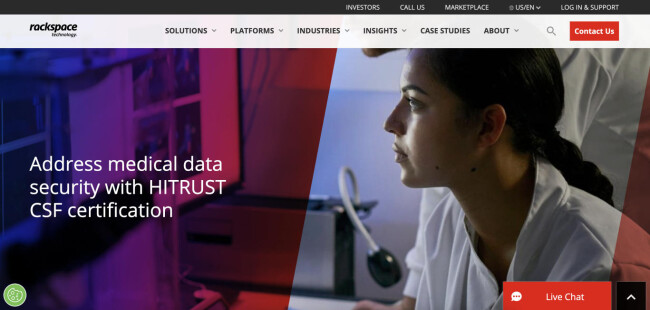
Rackspace is known as a managed cloud provider.
They’ll support your HIPAA workloads on AWS, Azure, or their own dedicated environments, and they’re HITRUST CSF-certified, which goes a step beyond basic HIPAA compliance.
Pricing:
- Custom
Key Features
- HIPAA and HITRUST-certified environments
- Managed services across AWS, Azure, dedicated infra
- 24/7 monitoring, compliance reporting
- Governance and audit support
Who It’s For
Rackspace is ideal for enterprises and regulated organizations that want HITRUST-level compliance assurance and a partner to manage cloud complexity.
It’s well-suited for hospitals, insurers, and pharmaceutical companies that require managed HIPAA workloads with governance, risk management, and audit preparation included.
8. IBM Cloud: Best for Enterprise-Grade Data Storage
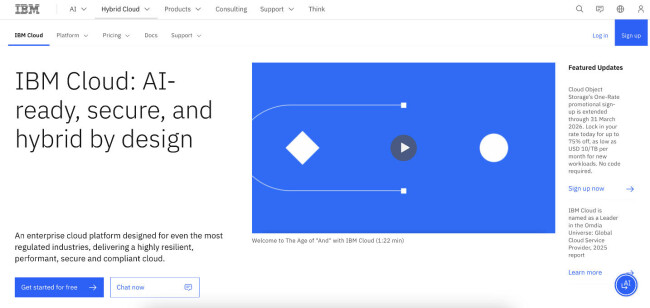
IBM Cloud requires you to enable HIPAA compliance on your account and accept a BAA. Once that’s done, you can filter IBM’s catalog to show HIPAA-ready services.
For enterprises already invested in IBM software and systems, this can be a smooth fit.
Pricing:
- Custom
Hemachandran emphasizes customization at the workload level: “Businesses should look for a provider that offers flexibility at the website level, so resources can be allocated where they matter most.”
IBM Cloud supports this model by letting enterprises filter for HIPAA-enabled services.
@healthcareittoday How do you remove friction from a patient’s hospital stay? 💡 Joseph Narvaez says it starts with empathy and empowerment. Smart TVs & digital whiteboards from eVideon are helping NorthwellHealth make patient care smarter and more human. 📽️ Full interview here! https://www.healthcareittoday.com/2025/03/20/smart-rooms-improving-the-delivery-of-care/ #HIMSS2025 #VibeHealth #PatientCenteredCare #HITsm
♬ original sound - Healthcare IT Today
Key Features
- IBM BAA required
- Catalog filter for HIPAA-ready services
- Enterprise-grade infrastructure
- Strong IBM ecosystem integration
Who It’s For
If you’re invested in IBM software, analytics, or legacy infrastructure, IBM Cloud extends that ecosystem into HIPAA-compliant workloads.
It’s particularly valuable for enterprises in finance, pharma, and healthcare research with strict data security demands.
9. Oracle Cloud Infrastructure (OCI): Best for Structured Data Storage

Oracle Cloud Infrastructure publishes HIPAA-assessed regions and services, making it clear where PHI workloads can live.
OCI is built for performance, especially with Oracle databases and ERP systems, making it attractive to enterprises that already rely on Oracle technology.
Pricing:
- Custom
Key Features
- HIPAA-assessed regions and services
- Bare-metal and VM options
- High-performance networking and storage
- Enterprise security and compliance
Who It’s For
OCI is especially strong for EHR workloads, financial systems, or research data warehouses that demand high throughput and performance.
OCI is also attractive for organizations looking for cost-competitive enterprise-grade cloud.
10. Aptible: Best for HIPAA-Focused PaaS and Startups
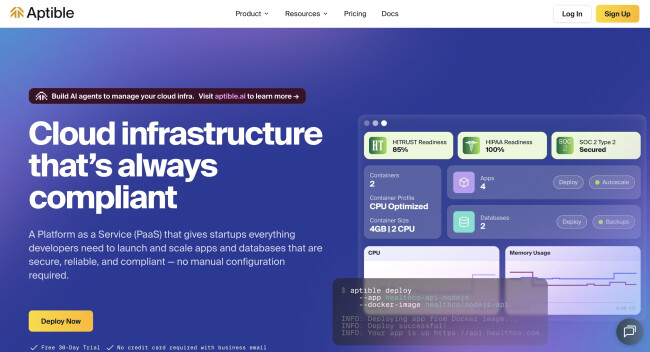
Aptible takes a different approach: it’s a platform-as-a-service (PaaS) built for compliance.
Sign up for a Production plan and you get a HIPAA BAA, isolated stacks, managed databases, VPN, and security defaults that keep you out of trouble.
Hemachandran explained that many businesses run into trouble during sudden growth surges. “Customers should be able to grow their business without any last-minute surprises.”
Aptible solves this by letting startups scale HIPAA apps without worrying about infra bottlenecks.
Pricing:
- Development: Free
- Production: $499/month
- Enterprise: Custom
Key Features
- Dedicated stack isolation
- Managed databases, VPN, logging
- Compliance defaults built-in
- Developer-friendly PaaS
Who It’s For
Aptible is perfect for startups and SaaS providers building HIPAA-compliant applications.
You can launch apps fast without needing to design HIPAA-compliant infrastructure from scratch.
It’s a strong fit for digital health innovators, telemedicine startups, or niche SaaS platforms that want compliance “out of the box” while staying lean and agile.
How To Choose the Best HIPAA-Compliant Cloud Storage Provider?
When evaluating HIPAA-compliant cloud storage, focus on how well a solution meets your real data storage and management needs, not just its brand or market reputation.
Here’s a concise decision checklist to guide your choice:
- File volume and growth: Ensure the platform can scale securely as your ePHI storage needs increase, without sacrificing performance or compliance.
- Collaboration needs: Look for secure document sharing with role-based permissions, audit trails, and controlled external access.
- EHR integration: Confirm the storage system integrates securely with your EHR and clinical applications to support compliant data workflows.
- Internal access policies: Prioritize strong access controls, including unique user IDs, multi-factor authentication, and detailed audit logging.
- Backup and recovery: Verify that backups are automatic, encrypted, and easily recoverable to protect against data loss or corruption.
Hemachandran offers this advice:
“Reliability has many components, from redundancy to load balancing to compliance enforcement. The right provider ensures your business can grow without putting sensitive data at risk.”

Our team ranks agencies worldwide to help you find a qualified partner. Visit our Agency Directory for the top web development companies, as well as:
- Top Cloud Consulting Companies
- Top Managed IT Service Providers
- Top WordPress Development Companies
- Top Front End Web Development Companies
Our design experts also recognize the most innovative design projects across the globe. Given the recent uptick in web development, you'll want to visit our Awards section for the best & latest in website designs.
HIPAA Compliant Cloud Hosting Provider FAQs
1. Is cloud storage HIPAA compliant?
Cloud storage can be HIPAA compliant, but only if the provider signs a Business Associate Agreement (BAA) and you use HIPAA-eligible services with proper safeguards in place (encryption, access controls, logging). It’s not the storage itself, but the configuration + agreement that make it compliant.
2. What is a Business Associate Agreement (BAA) and why is it important?
A BAA is a legally binding agreement required under HIPAA between covered entities and their cloud service providers. It ensures both parties share responsibility for safeguarding PHI.
3. Do I still need my own security if the host is HIPAA-compliant?
Yes. HIPAA is a shared responsibility. The provider secures the infrastructure, but you must configure access controls, encryption, logging, and application-level safeguards.


-preview.jpg)